Win Rate: The Number That Is Lying to You

🤓 Nerd Mode
If I told you that your favorite trader on Instagram, the one flaunting a 90% win rate, could be losing money every single month, would you believe me? You should. Because the win rate, the percentage of trades closed in profit, is the most overrated and most misunderstood number in all of trading.
It is the number that makes you feel good while your account bleeds out. In this article I will explain why it is lying to you, and which number actually counts.
The win rate, on its own, tells you nothing
Picture two traders. The first wins 9 trades out of 10, but when he loses, he loses big. The second wins only 4 times out of 10, but when he wins he takes home twice what he risked. Who makes money?
It might surprise you, but it can easily be the second one. Because the win rate tells you how often you are right, not how much you make when you are right and how much you lose when you are wrong. And it is those two things together that decide whether you are in profit or in the red.
A 90% win rate with losses that wipe out ten winners is a machine for losing money in style. A 40% win rate with a good risk/reward ratio is a profitable system.
🧩 Explained Simply: expectancy
The number that really counts is called expectancy: how much you expect to make, on average, on each trade. The formula is simple:
Expectancy = (Win rate × Average win) − (Loss rate × Average loss)
If the result is positive, you make money over the long run. If it is negative, you lose, no matter how high your win rate is. Expectancy combines the two things the win rate ignores: how much you win and how much you lose.
Two systems, same profit, opposite win rates
Let’s take 10 trades, always risking 100 dollars per trade. Look at what happens with two different approaches:
| System | Win rate | R:R | Result over 10 trades |
|---|---|---|---|
| A | 60% | 1:1 | 6×100 − 4×100 = +200 |
| B | 40% | 1:2 | 4×200 − 6×100 = +200 |
The exact same profit. But system B gets there while being right less than half the time. This changes everything on the mental side: if you do not need to guess much, you are far less exposed to frustration, revenge trading and the urge to force trades. A good risk/reward ratio buys you patience.
The minimum win rate you actually need
The good news is that, once you know your risk/reward ratio, you can instantly work out the minimum win rate you need just to break even. The formula is:
Minimum win rate = 1 / (1 + R:R)
Here is what it means in practice:
| If your R:R is | You only need a win rate of |
|---|---|
| 1:1 | 50% |
| 1:2 | 33% |
| 1:3 | 25% |
With a 1:3 ratio you only need to be right a little more than once in four to be in profit (exactly one in four already puts you at break-even, before spread and commissions). This is why experienced traders are obsessed with risk/reward and not with the win rate: they hunt for the few trades that offer a favorable ratio, and skip the rest.
What to do about it, in practice
Three concrete moves, right now:
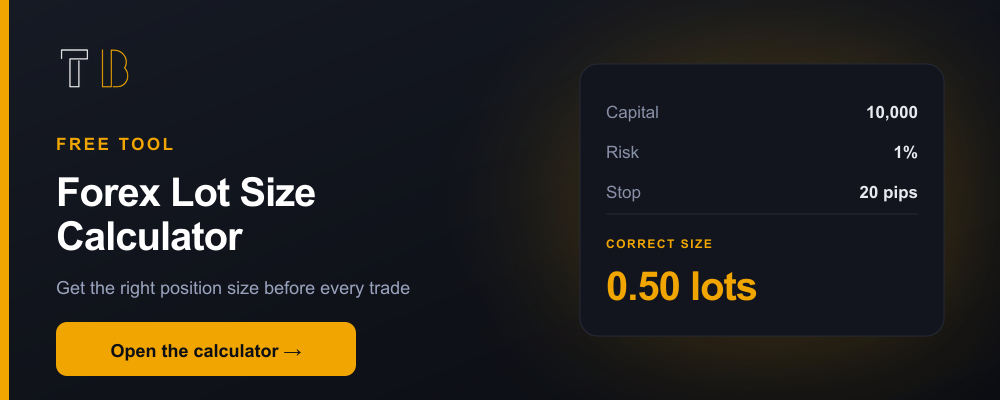
1. Calculate your size before every trade. Expectancy only works if the risk per trade is constant. Before you enter, calculate the correct lot size based on capital, risk percentage and stop distance.
2. Track everything. You cannot improve what you do not measure. Log every trade, your real win rate, your average R:R and your expectancy. The TradingBlog Diary works them out automatically, complete with equity curve and Monte Carlo simulation.
3. Go deeper on money management. The win rate is just one piece of the puzzle. If you want the full picture, read Money Management Like a True Professional.
It is not whether you are right or wrong that is important, but how much money you make when you are right and how much you lose when you are wrong.
Want to put your market reading to the test?
Compete and challenge other traders inside an Arena in a demo environment, with no real capital at risk. Discover the Performance Arena Events by The Thunder Trader.