Bitcoin in 2026: ETF Flows Now Set the Price

🤓 Nerd Mode
June 2026 will be remembered as the month Bitcoin stopped listening to Twitter and started listening to Wall Street.
BTC closed June 30 around $58,500, down roughly 20% on the month. Not just any pullback: we’re talking about the worst month relative to historical seasonality, according to Fortune. And the interesting part isn’t the number. It’s the culprit.
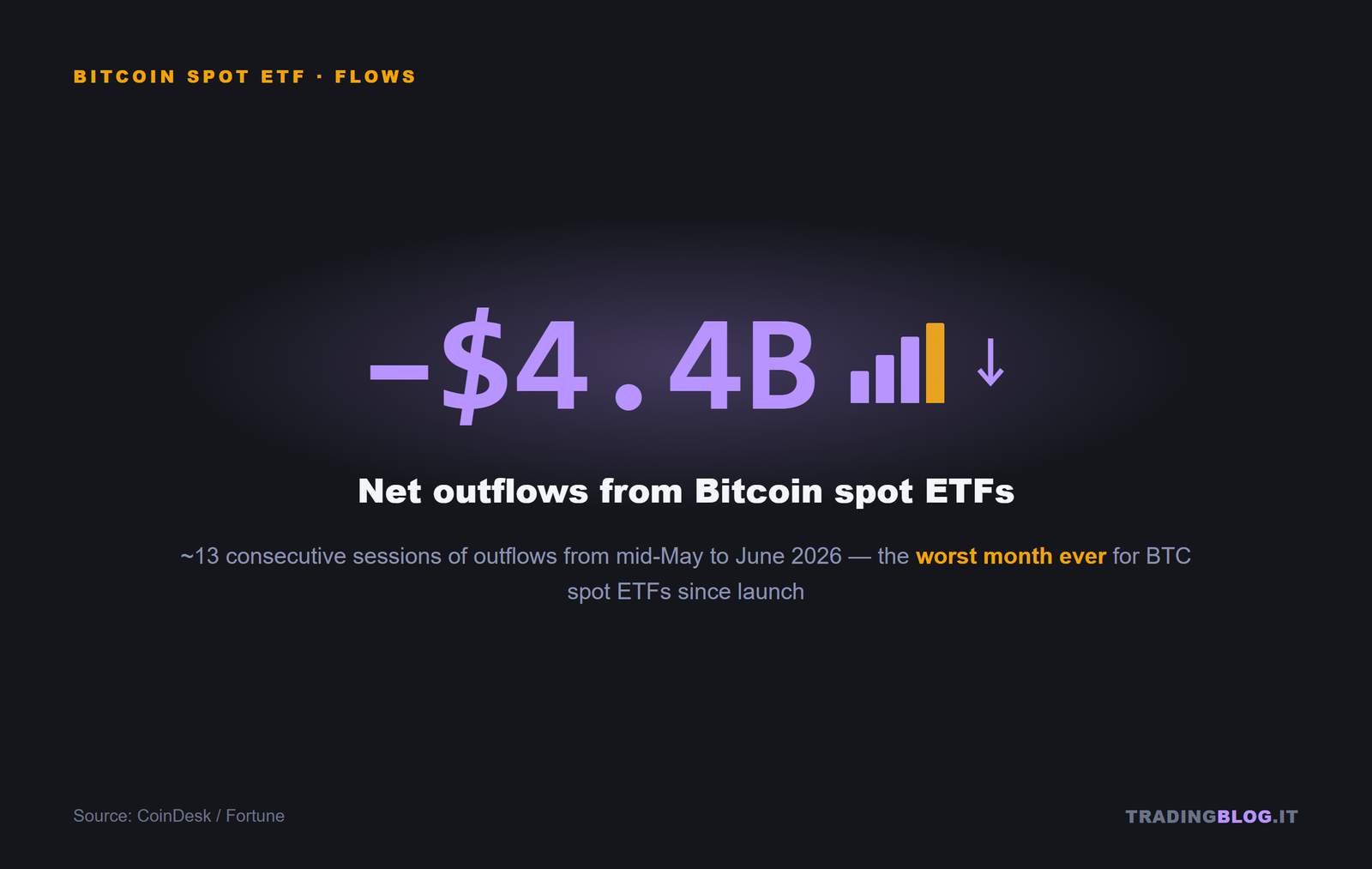
It wasn’t retail panic-selling. It was a slow, orderly, almost bureaucratic flow: continuous redemptions from the U.S. spot ETFs. About $4.4 billion in outflows across roughly thirteen sessions since mid-May. Every day a little piece of supply coming back to the market, no shouting, no memes, no capitulation.
Welcome to Bitcoin in 2026: where the marginal price is set by whoever runs an ETF, not by whoever posts rocket emojis.
Who holds the pen now
For years the narrative was simple: retail moves the price, whales front-run it, institutions show up late. In 2026 that story aged badly.
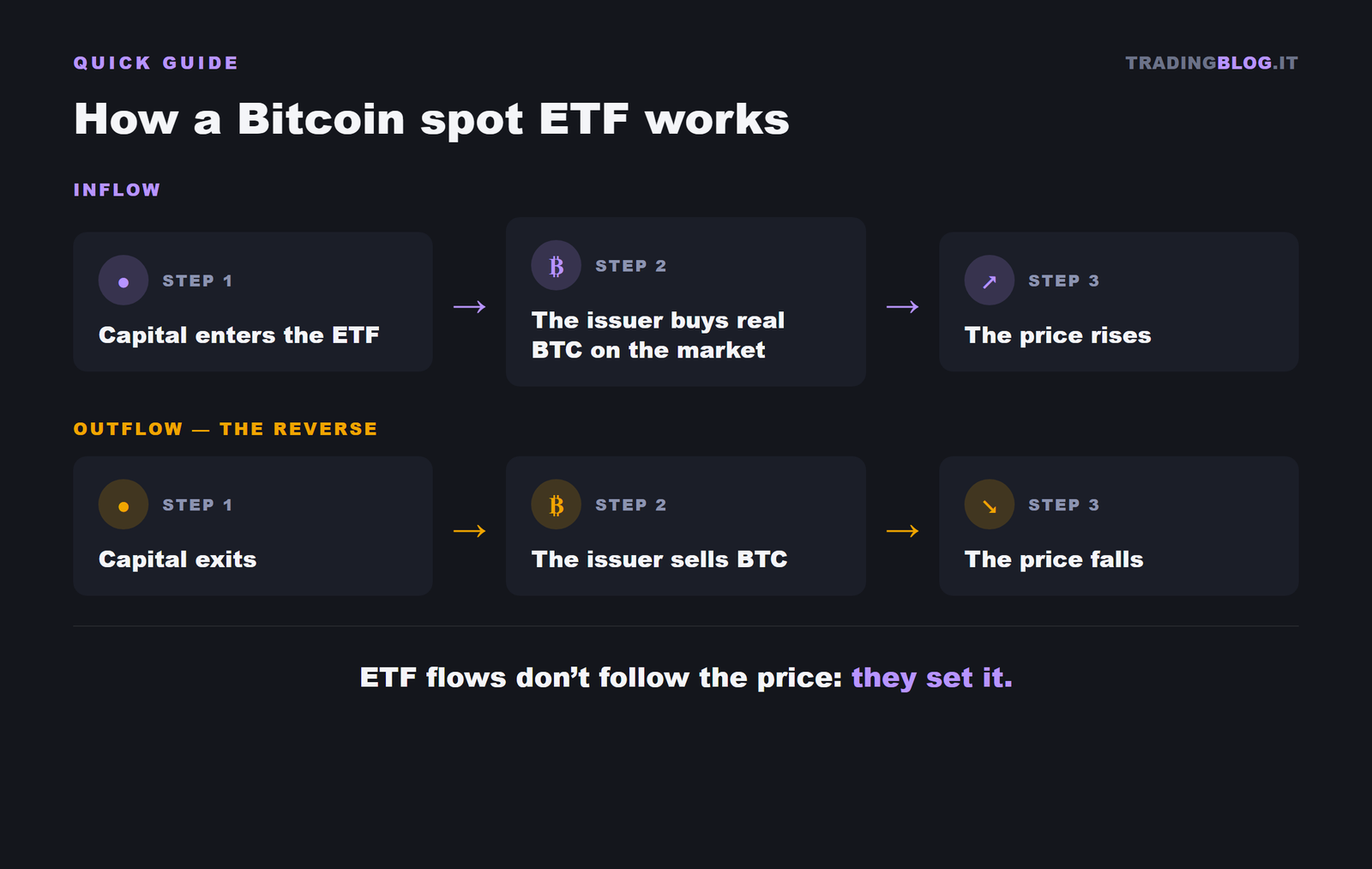
Since Bitcoin spot ETFs became the dominant access channel for professional capital, their net flows are the variable that matters. When money comes in, the issuer buys BTC on the market to back the shares. When it leaves, it sells. ETF flow is supply and demand, translated in real time.
And that’s why June’s drivers tell a coherent story: a more hawkish Fed than expected, keeping real yields high and making a non-yielding asset less appealing; and a rotation of capital toward AI-linked equity, where in 2026 the real party seems to be. In that context, managers simply rotated out. The outflow is the snapshot of that decision.
🧩 Explained Well: what a spot ETF is
A Bitcoin spot ETF is an exchange-listed fund that holds “real” BTC and tracks its price, bought and sold like an ordinary share. Every time capital comes in or goes out, the issuer buys or sells Bitcoin on the real market. That’s why its flows don’t follow the price: they make it.
Ethereum, the sibling left behind
If you needed proof that institutional demand is now in charge, not generic “crypto” enthusiasm, look at Ethereum.
In June, ETH spot ETFs recorded outflows for several consecutive sessions, right as the Bitcoin ETFs, for a few sessions, briefly swung back to net inflows. Two products on the same shelf, same regulatory wrapper, opposite behaviors. Professional capital is choosing, and it’s choosing BTC.
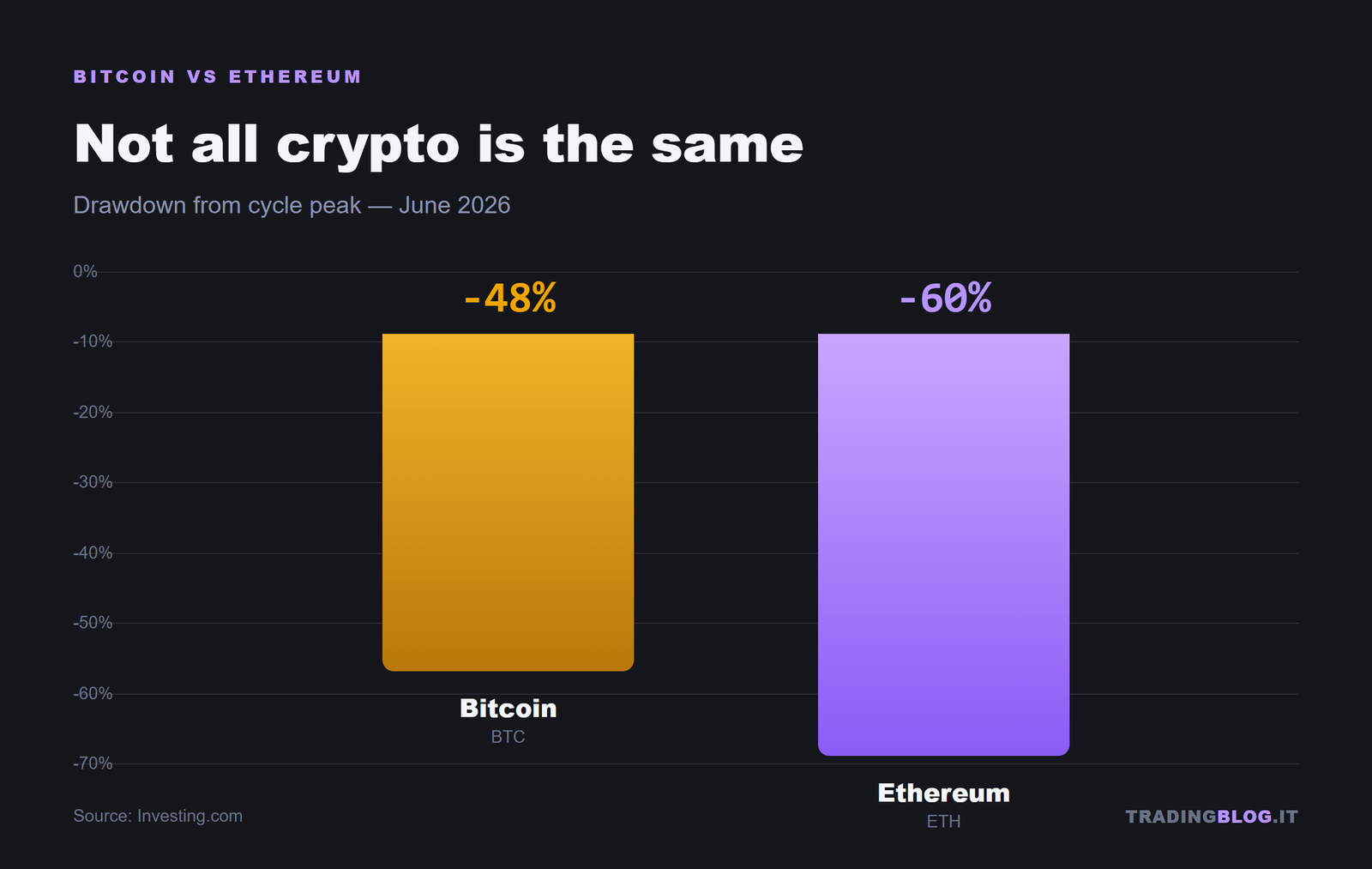
The price result is brutal: ETH’s drawdown from its cycle high widened toward -60%, according to Investing.com. The demand gap between the two assets isn’t closing, it’s widening.
The nerd read is this: in the ETF world there is no “crypto” as a single block. There are individual assets with individual mandates, and whoever allocates decides line by line. Bitcoin has earned “institutional portfolio asset” status. Ethereum, for now, remains the more technical exposure that struggles to find the same patient buyers.
The SEC is redrawing which ETFs get born
Here comes the piece few are connecting, but which could matter more than any single session of outflows.
Around June 30 the SEC opened a comment window of roughly 60 days, through early September, on a new single, “asset-neutral” framework for complex, next-generation ETFs. Source: The Block.

What’s inside that perimeter? Basically the entire next wave: spot crypto ETFs, staking-yield products, altcoin baskets, and even ETFs tied to prediction markets. Not by chance, around two dozen event-contract filings have been frozen since May, waiting for the rules of the game to be written.
Translated: the SEC is stepping away from judging every crypto ETF case by case and is trying to define a single model. A framework that decides in advance which structures are admissible and which aren’t. What kind of products will be able to raise institutional capital in the coming years. And if ETF flows are now Bitcoin’s marginal price, then whoever writes the ETF rules is writing the price rules.
It’s no longer a question of adoption. It’s a question of architecture.
What to watch
Two events, both on the near-term calendar.
- FOMC minutes, July 8. If they confirm the hawkish tone that drove June’s outflows, the pressure on ETF inflows stays. If they open even a slightly softer crack, the flow can turn fast, and we now know that flow is the price.
- SEC window, through early September. Every comment, every draft, every signal about what will enter the “asset-neutral” framework is material for understanding the next generation of institutional crypto products. And which assets will be left out.
Crypto in 2026 is no longer read on social media. It’s read in the flows and the filings.
Disclaimer: content for purely informational and educational purposes. It does not constitute financial advice or an investment solicitation. Always do your own research.