Revenge Trading: Why the Brain Falls for It

June 2026 was a mean month. Bitcoin left about 20% on the table, markets got jittery over a weak NFP, and plenty of accounts found themselves in the red without having done anything spectacularly wrong.
And it’s right there, with the screen full of negative numbers, that the most dangerous thought of all kicks in: “now I’ll jump back in and get my money back.” Welcome to revenge trading.
What revenge trading is
Revenge trading is the attempt to recover a loss by quickly opening new positions, driven by anger rather than a market idea.
It’s not a strategy. It’s an emotional reaction dressed up as trading. The logic isn’t “there’s a valid setup here,” but “the market took my money and I’m taking it back, now.”
The problem is that the market doesn’t even know you exist. It isn’t punishing you and it owes you nothing. But your brain, in that moment, is convinced otherwise.
Why the brain falls for it
This has nothing to do with low intelligence. It has to do with how we’re wired.
Loss aversion. Numerous behavioral studies show that the pain of losing weighs about twice as much as the pleasure of gaining the same amount. Losing €200 burns like gaining €400. This imbalance pushes you to do irrational things just to erase that pain.
Tilt. It’s the term borrowed from poker: a state in which emotion has hijacked your decisions. On tilt you see opportunities everywhere, ignore your plan, and mistake agitation for clarity.
Payback FOMO. After a loss, the fear of “falling behind” amplifies. Every candle that moves without you looks like the train you’re missing, and you throw yourself in just to not stand still.
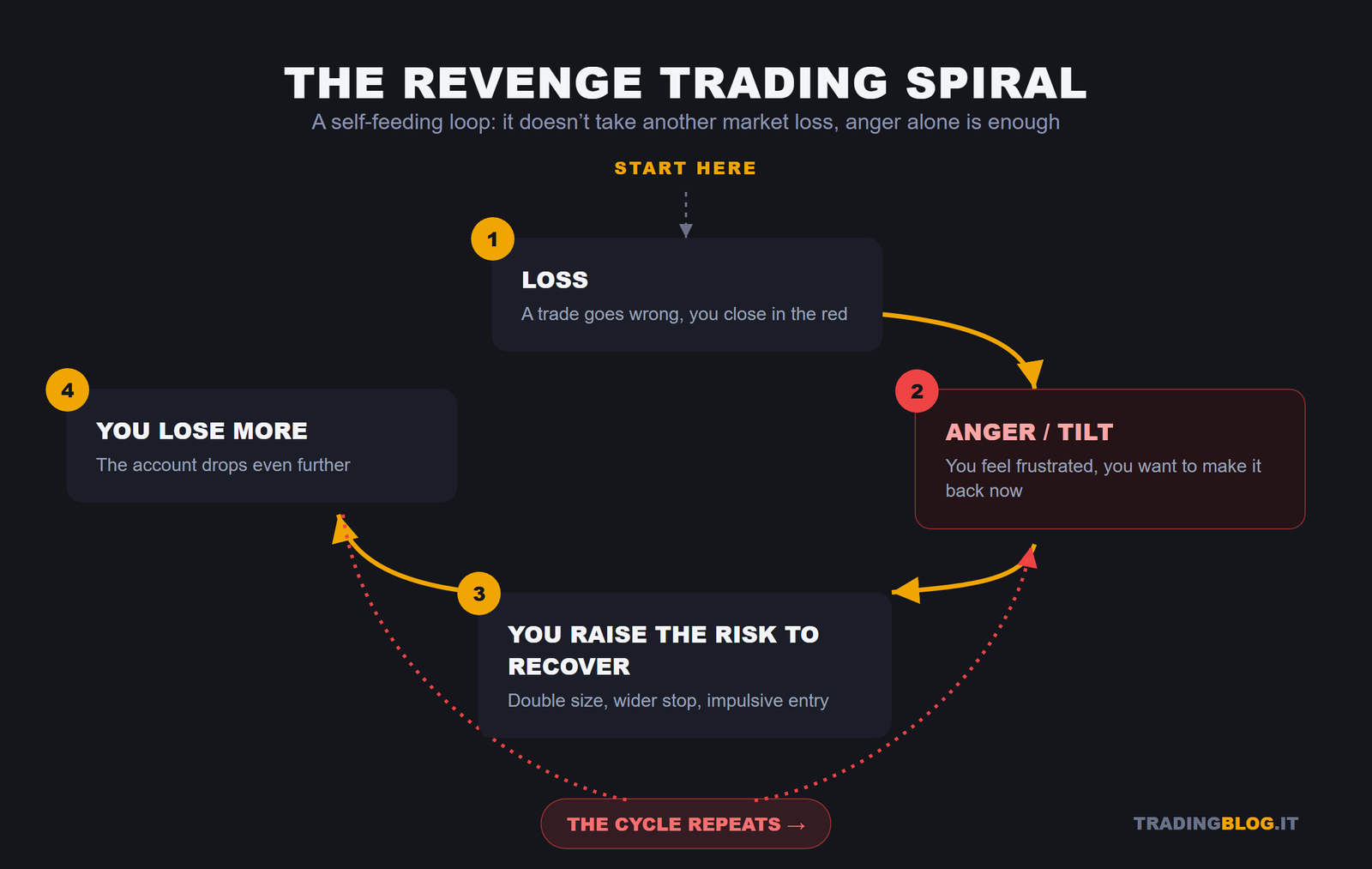
Put together, these three mechanisms create a spiral: you lose, you get angry, you raise the risk to recover fast, you lose more, you get even angrier.
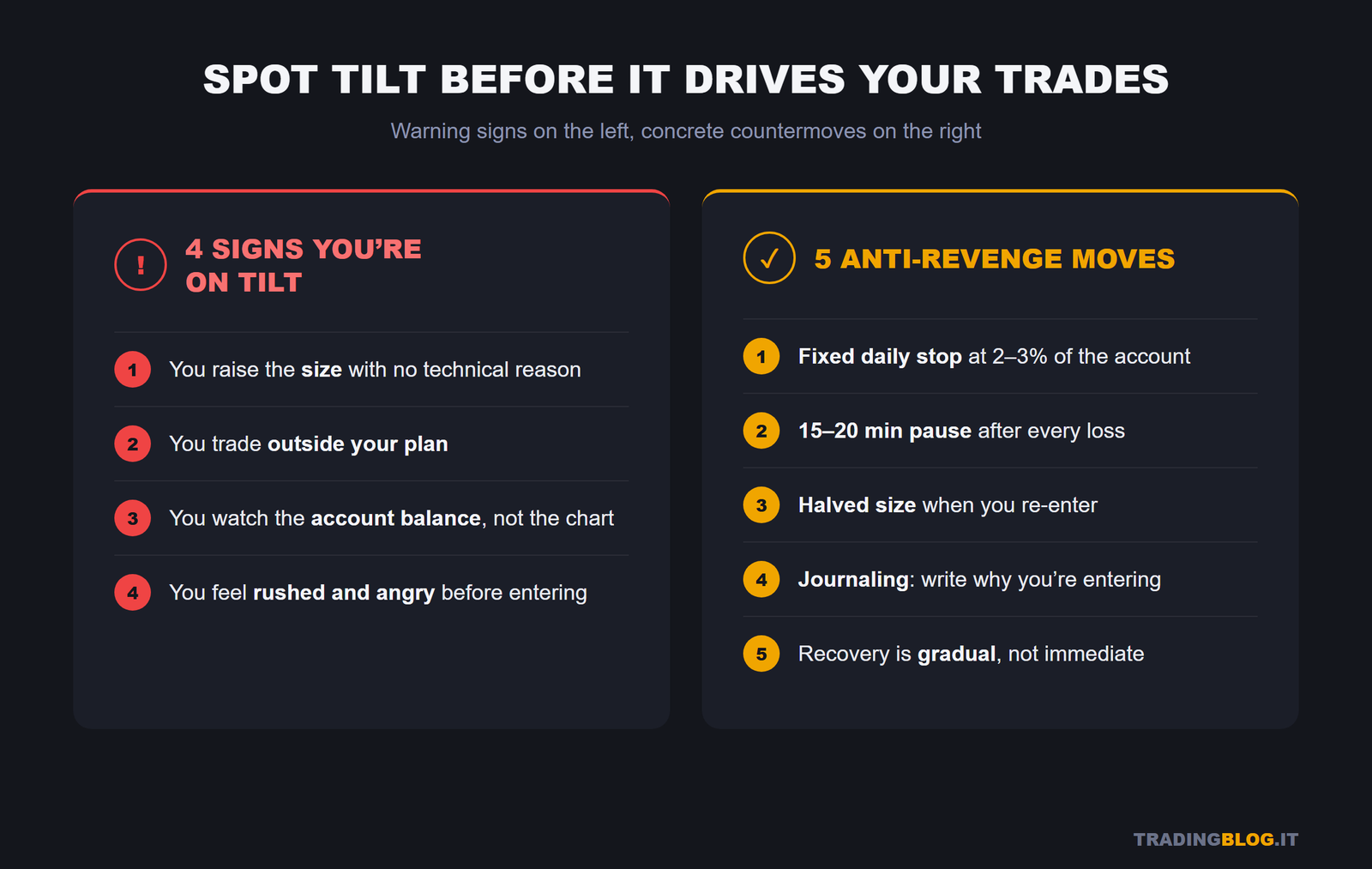
4 signs you’re on tilt
Recognizing the state is half the work. You might check these warning bells:
- You raise the size with no technical reason. The lot grows not because the setup is better, but because “this way I recover faster.”
- You trade outside your plan. You take trades you wouldn’t even look at with a cool head.
- You watch the account, not the chart. Your compass has become the P&L in euros, not market structure.
- You feel rushed and angry. Your body tells you: clenched jaw, short breath, the feeling of “having to make it back right now.”
If you recognize two or more at the same time, you’re most likely not trading. You’re taking revenge.
The 5-move anti-revenge protocol
The goal isn’t “more self-control”, which under stress evaporates. The goal is to build rules that decide for you when your head can’t be trusted.
1. Fixed daily stop. You might define a maximum daily loss in advance, for example 2-3% of the account. Once that threshold is hit, close the platform. Full stop. The decision has already been made by calm-you for angry-you.
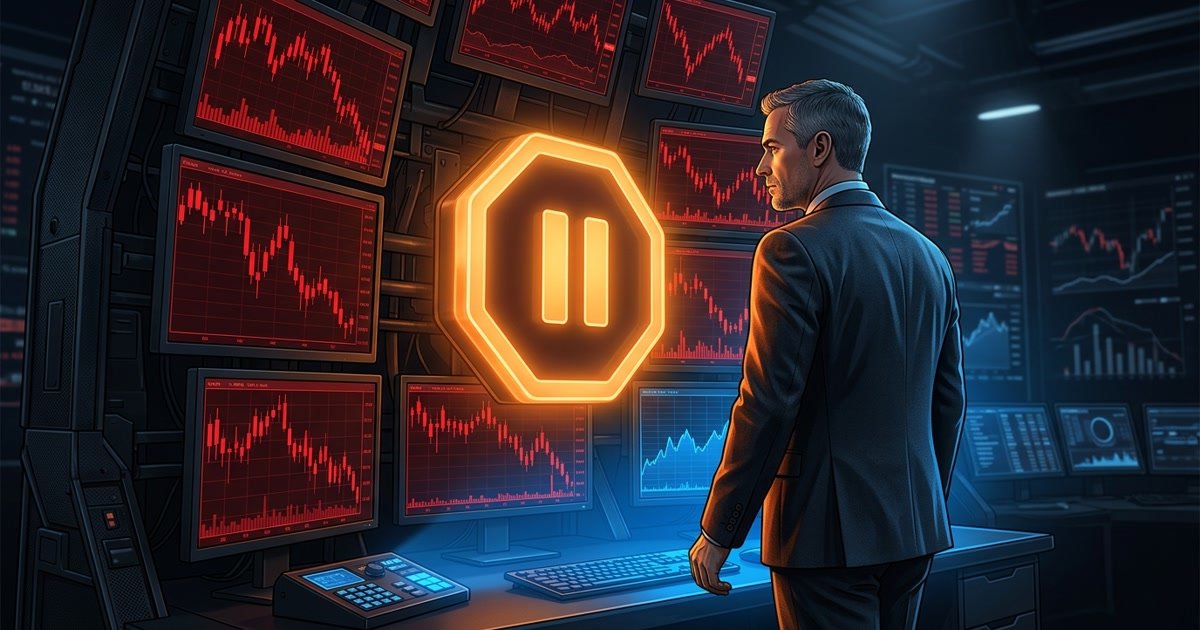
2. Timed pause after a loss. After a stop, get up. A 15-20 minute timer before you can even think about the next trade. The emotional peak, physiologically, deflates on its own if you give it time. The break is there to rest your mind, not just to let the minutes go by: actually stand up, walk, look out of the window. If you eyeball the duration you will be back in three minutes, so let a timer decide for you: Thunder Focus, our free Pomodoro timer, keeps work and breaks apart and tells you when you can go back to trading.
3. Reduced size on re-entry. If you go back to trading after a losing streak, you might consider halving the size until you’re back in rhythm. You recover confidence, not the money lost. And rather than eyeballing the lot, work it out from the risk you set yourself with the Forex Lot Size Calculator.
4. Journaling. Before every trade after a loss, write one line: “why am I entering?” If the answer is “to recover,” you have your answer, and it’s not a setup.
5. The slow-recovery rule. Internalize that a loss isn’t “recovered” in one trade. It’s absorbed across dozens of disciplined trades. Rushing is the symptom, not the cure.
A numerical example
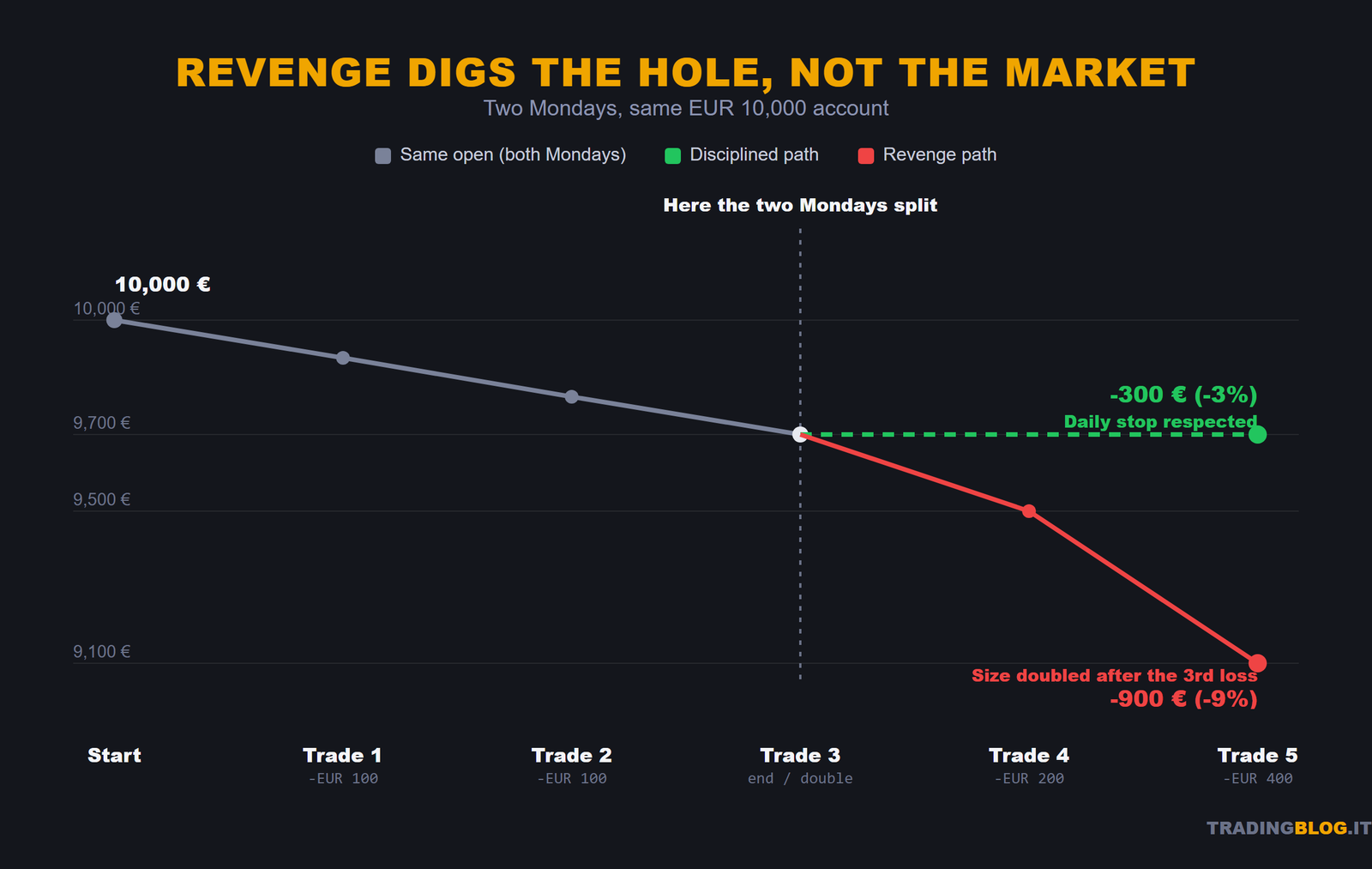
A €10,000 account. You risk 1% per trade, so €100.
Monday you take three stops in a row: -€300, you’re at -3% on the day. So far, normal trading math.
Then the spiral starts. “With €100 a trade I’ll never recover.” You double up: €200 per trade. Another stop, -€200. Now you’re at -€500 and even more on edge. You double again: €400. That one blows up too. -€900 in a single day, 9% of the account, when your rule said 2-3%.
The key point: the three initial losses were the cost of the job. The real hole, the one that hurts for weeks, was dug by revenge, not the market.
With the daily stop at 3%, that Monday would have closed at -€300 and Tuesday you’d have started fresh, intact.
To try this week
Write down your daily stop-loss, a precise figure in euros or percentage, and stick it on a post-it on your monitor. This week, if you hit it, close everything. One single rule, applied for real, is worth more than ten good intentions.
Disclaimer: purely informational and educational content. It does not constitute financial advice or an invitation to trade. Trading involves the risk of capital loss.