Posts

A slack tightrope sagging into an amber safety net strung too close beneath it, while further ahead the same rope runs taut toward a lit platform.

The reflex break even: the cautious move that costs you your best trades

Hi trader,

this is the first piece in a new series.

It’s called “The mistake I keep seeing”, and the name says it all: once a month I’ll walk you through a move I see a lot of traders make over and over.

I won’t give you the recipe for doing it right.

I’ll show you the mistake so clearly that next time you’ll recognise it while you’re making it.

And we start with the most common one of all.

The scene

You know it.

You get in. Price moves your way. You’re in profit.

That warm feeling shows up, relief. “Ok, I was right.”

And right after it comes the fear: “what if it turns around now?”

So you make the move. You grab the stop and drag it to your entry price. Break even.

You feel good. Careful. Professional.

Price makes a small pullback, tags your stop, and you’re out flat (actually a touch below, once you count commissions).

And then, without you, it goes straight to the target.

You watch it go. And you tell yourself: “well, at least I didn’t lose”.

There it is. That sentence is the problem.

Why the break even stop feels right

Break even is probably the most famous management rule in trading.

You’ll find it in every book, every course, every video: “as soon as you’re up as much as you were risking, so at +1R, move your stop to break even, and the trade can’t lose you money anymore”.

And it has a logic everyone likes, because it speaks to the part of you that’s scared.

A winning trade that turns into a loser hurts like hell. Much more than a trade that never got going.

Break even promises you’ll never feel that pain again.

The problem is that it keeps the promise, but you pay the bill somewhere else.

Where the cost is

Let’s take it step by step, because the cost comes in three pieces.

First piece: the stop ends up in the noise.

Price never goes from A to B in a straight line. It breathes. It takes two steps forward and one back, even when the direction is right.

When you move the stop to your entry on reflex, you put it right inside that breathing.

You’re not protecting yourself from the wrong trade.

You’re getting yourself kicked out of the right one.

Second piece: you don’t see the cost.

This is the sneaky part.

A full stop-out you can see: it’s a loss, it’s red, it hurts, you write it down.

A flat exit, on the other hand, you log as “nothing”. Break even, no harm done.

But it isn’t nothing. Often it’s a winning trade you took away from yourself.

Your journal doesn’t say “I missed a target”. It says zero. So you never question it.

Third piece: the spiral.

This is where the damage becomes structural.

After a few flat exits with price then reaching the target, you get a thought that sounds smart: “my targets are too ambitious”.

And you start cutting them.

But if you cut the targets and the initial stop stays the same, the ratio between what you risk and what you make collapses. And at that point, to make money you have to win a lot more often than before.

A round-number example: with a 1:2 ratio you only need to win one trade in three to break even. Cut the target in half and you need to win one in two.

The system that was working stops paying. And you blame the system.

It’s like being on track in a kart: you feel the car move mid-corner, you get scared and lift off. It feels like caution. In reality you lose your line, you come out slow, and on the next lap you brake even earlier. Your lap time gets worse because of the fear, not because of the car.

Management rules are not universal

This is the line I’d like you to take home.

A management rule belongs to a system.

“Stop to break even at plus one” comes from specific contexts, inside someone else’s method. There it can make sense.

Copying it into a different system means using someone else’s rule on your trade.

I’m not telling you break even is wrong. I’m telling you that “everybody does it” isn’t a reason for you to do it.

The right question isn’t “should I move the stop to break even?”.

It’s “is this move consistent with the way I built the trade?”.

The opposite mistake, which is even worse

While we’re here, let me warn you about the opposite extreme.

Reading a piece like this and concluding “so I never touch the stop, in fact, if it goes badly I’ll give it more room” is an even bigger mistake.

The initial stop sits where your idea stops being valid. If price gets there, the idea is dead.

Widening it doesn’t mean trusting the trade. It means swapping the trade you planned for one you would never have opened.

Tightening is a choice you have to think through. Widening, never.

The test that opens your eyes

Ok, vamos. I’ll leave you a small assignment, and fair warning: the result usually stings.

On your next twenty trades, add two columns to your journal.

  1. Did I move the stop to break even? Yes or no.
  2. If I got out flat, did price reach my target without touching the initial stop first? Yes or no.

That’s it. Nothing else.

At the end, count how many times you answered “yes” to both.

And also note the times break even actually saved you from a full stop-out. The real tally is the difference between the two.

That difference usually comes as a surprise. And not a good one.

If you don’t have a place to keep these two columns, use the TradingBlog Diary: it’s free, it lets you write down your observations and not just the result, and above all it gets you out of the memory trap. Because from memory you never remember the flat exits. You only remember the ones that saved you.

So when do you move it?

I know, now you’d like the answer.

When I move it, and why exactly there, is another story. It depends on how I build the trade from the start, and taken out of context it would just be another rule to copy without understanding it. Which is exactly the mistake we’ve been talking about.

For today, all I ask is that next time you feel that relief and your hand goes to the stop, you stop for a second.

And ask yourself whether you’re protecting the trade or your fear.

An exit at zero is not nothing. Often it is a winning trade you took away from yourself, and your journal never shows it.

— tradingblog.itPosta su X

Suerte Amigo!

Tiziano Brunno

Tradingblog

Want to put your market reading to the test?

Measure yourself against other traders inside an Arena in a demo environment, with no real capital at risk. Discover the Performance Arena Events by The Thunder Trader.

Discover The Thunder Trader →

Disclaimer: purely informational and educational content. It does not constitute financial advice or an invitation to trade. Trading involves the risk of capital loss.


A climbing rope secured with steel carabiners to two bolts on a dark rock face, in the haze and backlit in amber.

Buying crypto without getting hurt: how much to put in, how much to risk, where to keep it

Hi trader,

the question I get asked most about crypto isn’t “what should I buy”.

It’s “how much should I put in?“

And I always answer with another question: how much are you willing to lose?

That’s where almost everyone stops. Some people laugh. Some answer “nothing, I’m not buying it to lose money”.

Well, the whole problem is in that answer.

Nobody buys to lose. But if you haven’t decided beforehand how much you can lose, you find out the number afterwards. And you risk finding it out from the market, on the worst day.

Last lesson we saw what moves the price. Today we get practical, and the basic rule is just one: first you decide how much you can lose, then how much you buy. Never the other way round.

Ok, vamos.

First of all: look at what it’s capable of

I’m not asking you to guess where it’s going. I’m asking you to look at where it has already been.

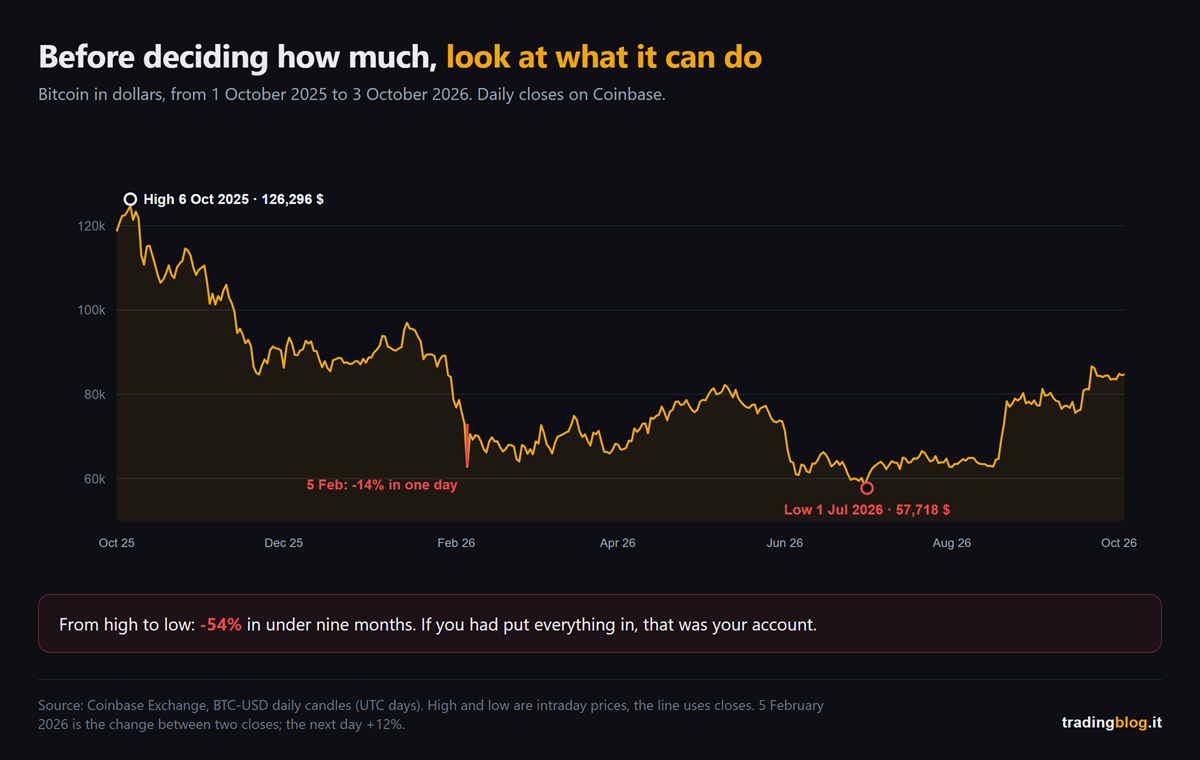
Chart of the bitcoin price in dollars from 1 October 2025 to 3 October 2026 on Coinbase: from the 126,296 dollar high on 6 October 2025 to the 57,718 dollar low on 1 July 2026, a 54% fall, with the 14% one day drop on 5 February 2026 highlighted in red
Bitcoin from 1 October 2025 to today, daily closes on Coinbase. In less than nine months it lost 54% from high to low, and on 5 February 2026 it gave up 14% in a single day.

On 6 October 2025, on Coinbase, bitcoin hit 126,296 dollars.

On 1 July 2026 it hit 57,718. Down 54%.

In between, on 5 February 2026, it lost 14% in a single day. And the next day it got back 12%.

I’m not telling you this to scare you. I’m telling you because these numbers are your account, if you put everything in.

If you’d bought at the top with all your capital, by July you’d have had less than half of it. And not because of a mistake in your analysis: just because that’s how bitcoin moves.

Size comes from risk, not from gut feeling

Let me explain it the way we do it on futures, because it works exactly the same.

One. Decide what slice of your capital you’re willing to lose if you’re wrong. A percentage, not a random number. How much it is, that’s your call: it depends on how much capital you have, what you need it for and how well you sleep at night. What matters is that it’s decided beforehand and written down somewhere.

Two. Decide where you’re wrong. Meaning the price at which your idea no longer holds. That’s the stop.

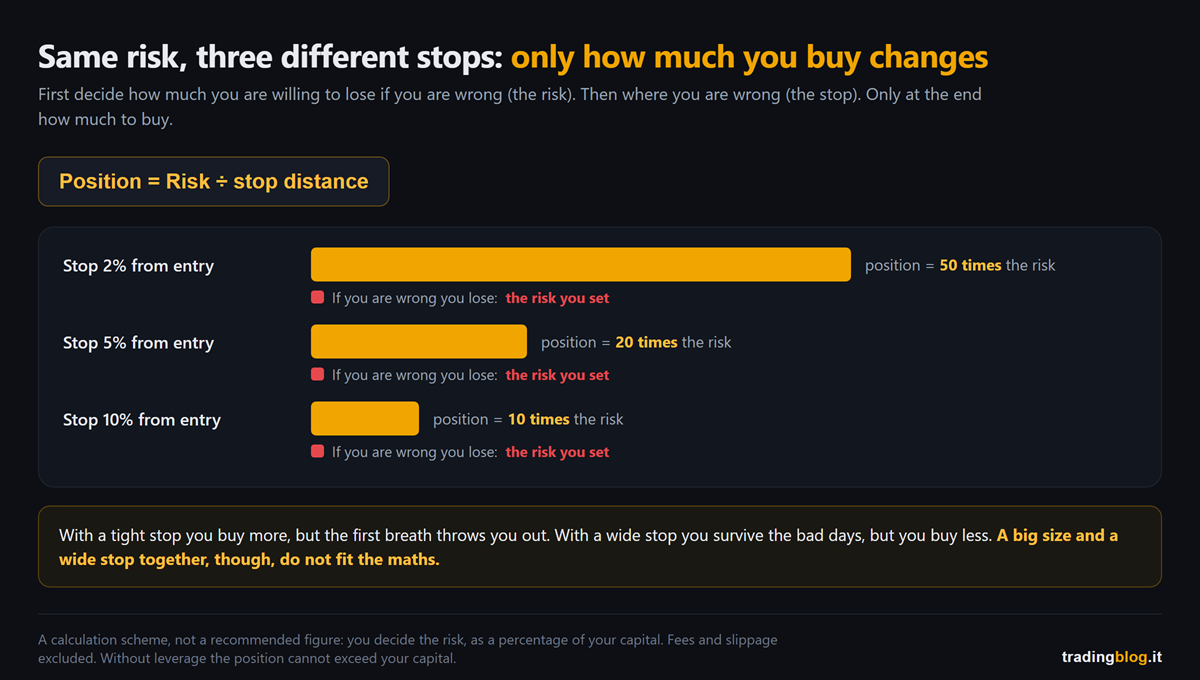
Three. Only now do you work out how much to buy: risk divided by the stop distance. If you measure the distance as a percentage, you get how much the position is worth; if you measure it in dollars per coin, you get how many coins.

Position sizing scheme: position equals risk divided by stop distance. With a 2% stop the position is 50 times the risk, at 5% 20 times, at 10% 10 times, and in all three cases if you are wrong you lose the risk you set
Same risk, three different stops. With the stop 2% from entry the position can be worth 50 times the risk, at 5% 20 times, at 10% 10 times. If you’re wrong you always lose the same amount: only how much you buy changes.

Look at the figure, because here’s the thing almost nobody has clear.

Risking a certain amount doesn’t mean buying that amount. With a tight stop you can buy more, with a wide stop you have to buy less. If you’re wrong, the loss is the same, plus fees and any slippage on the stop.

One limit: without leverage the position can’t be bigger than the capital you have. If the formula gives you a number bigger than your account, that’s not a green light for leverage: it means the stop is too tight or the risk too high.

And go back to 5 February. With a 2% stop you were out at the first breath that day, and the next day price had already got back 12%. With a wider stop you survive days like that, but you have to buy less. A tight stop lets you buy more, but on a market that does 14% in a day it gets hit for nothing. The ones who get wiped out are the ones who keep the big size and then widen the stop, or don’t set one at all.

And what if you buy with no stop, to hold? That’s a legitimate choice. But then the stop distance is the whole way down to zero. And that’s not a textbook hypothesis: the -54% you saw above isn’t the worst of it, between 2021 and 2022 bitcoin lost 77%, between 2017 and 2018 it lost 84%. So the question becomes: if it halves tomorrow, how much of my capital goes with it? That number has to be one you can lose without your life changing.

I’ve been doing this calculation by hand on futures for years. On crypto, with quantities full of decimals and the euro dollar exchange rate in the middle, doing it by hand is how you get it wrong. That’s why we built the Crypto Risk Manager: you enter capital, risk percentage, entry and stop, and it tells you how much to buy. If you use leverage, it also warns you when the liquidation price falls before your stop, meaning when the stop you’ve set will never get hit. It’s free, and it takes thirty seconds. A lot less than it takes to blow an account on a size picked on feel.

I won’t repeat myself on leverage: leverage and liquidations, how you get wiped out. I’ll just tell you that to buy a crypto you don’t need leverage. It’s for people who want to do more with the capital they have, and they pay for that more with the risk of getting out before they’d decided to.

Where you keep what you’ve bought

Size protects you from price. But price isn’t the only way to lose money with crypto.

Remember the distinction we’ve been carrying since the first lesson: the ledger is one thing, whoever guards your access to it is another. Nobody has managed to rewrite the bitcoin ledger so far. The ones that get hacked all the time are exchanges, custody services and keys.

If you leave your crypto on the exchange, what you have is a row in its database: it owes you coins. If the exchange goes bust, the problem becomes yours. I covered this properly in the exchange, the place where you buy.

And it doesn’t take a collapse. On 21 February 2025, according to the FBI, around 1.5 billion dollars in crypto was stolen from a big exchange. The blockchain had nothing to do with it: what got hacked was the system the exchange used to sign withdrawals from its own holdings. That time it said it had covered its customers. With FTX, which collapsed in November 2022, the first repayments, for small claims, started in February 2025. And they were calculated in dollars, at the price on the day of the collapse: if you had bitcoin, you got back what it was worth then plus interest, not the bitcoin.

If you send them to an address only you hold the keys to, on the ledger they stay yours and no exchange owes you anything anymore. But with the keys, all the responsibility passes to you. How not to lose them and how not to give them away is in keys and wallets.

Which of the two you choose is your business. But custody is a risk decision just like size, and it has to be made beforehand, not on the day everyone rushes to withdraw.

What you do starting tomorrow morning

Write down the percentage. How much of your capital you’re willing to lose on one trade. One line, before you open the exchange.

Decide the stop before the size. If you don’t know where you’re wrong, you don’t know how much to buy.

Decide who holds the keys before you buy. And if you leave your crypto on the exchange, do it knowing that what you have is a company’s promise.

Where we go next time

Last lesson of the series. We’ve put a limit on what price can take from you, and chosen who you trust with the keys. What’s left is the sneakiest thing of all: the scams that still work. Signatures that authorize someone else to drain your address, fake support, projects that vanish with the money.

How much should I put in is the wrong question. The right one is how much am I willing to lose, and you ask it before you click buy.

— tradingblog.itPosta su X

Back to the start.

To the people who answer “nothing, I’m not buying it to lose money” I always say the same thing.

Perfect. Then write down how much. Because the market will ask you for that number anyway.

Only, if you didn’t write it down, it picks it for you.

Suerte Amigo!

Tiziano Brunno

Tradingblog

Want to put your market reading to the test?

Compete and challenge other traders inside an Arena in a demo environment, with no real capital at risk. Discover the Performance Arena Events by The Thunder Trader.

Discover The Thunder Trader →


Disclaimer: purely informational and educational content. It does not constitute financial advice or an invitation to trade. Trading involves the risk of capital loss.