Fed today: almost nobody expects a move, and that’s exactly where the risk hides
Hi trader,
today is one of those days.
At eight in the evening, our time, the Federal Reserve has its say on rates. And as usual you’ll find the chart sitting flat all afternoon catching its breath, and then in five minutes it does what it hasn’t done in five days.
But let me tell you right away the thing that matters, because it’s counterintuitive.
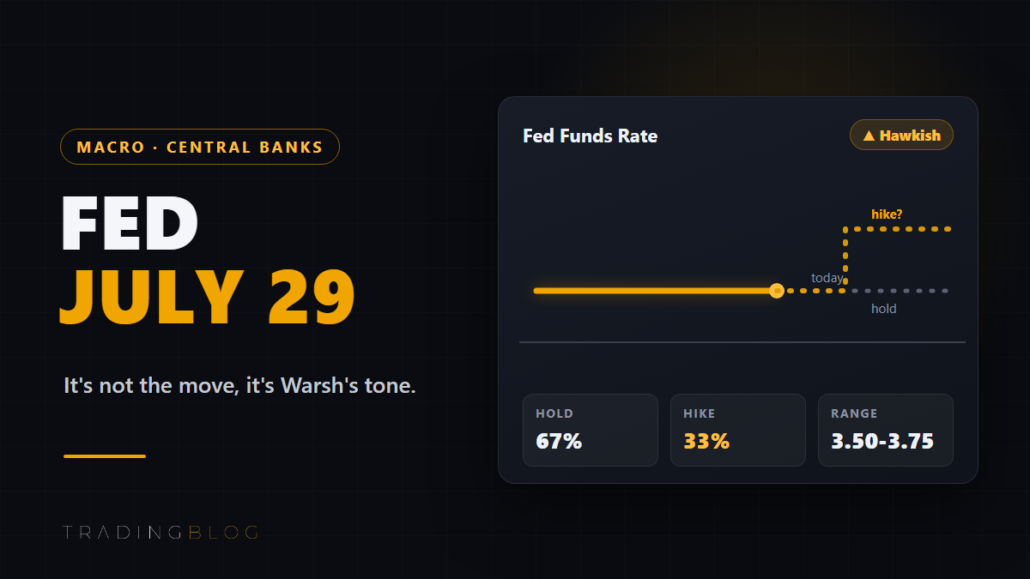
Today’s decision, most likely, won’t be a surprise. The market takes it for granted that the Fed leaves rates where they are, frozen in the 3.5%-3.75% range. It would be the fifth time in a row it doesn’t touch them.
So the number, the one that ends up in the headlines, we pretty much already know.
Then where’s the risk? In the tone. In what Kevin Warsh says half an hour later, in the press conference, and in how he says it.
Let me walk you through it properly.
Why the decision is almost a non-event
Let’s take it in order.
When something is the most likely outcome, largely priced in, the market has already accounted for it. The dollar, gold, the indices, they’re already positioned for a rate hold. If what everyone expected comes out, the reaction to the number itself is a shrug.
The point is somewhere else. The Fed doesn’t just decide what to do today. It sends a message about what it will do tomorrow. And that message arrives through three channels:
- the exact words of the statement, where even one changed sentence carries weight
- Warsh’s press conference, the tone, the answers to the awkward questions
- the set of projections, when there are any, and today there aren’t: July is a non-SEP meeting, no dot plot, the next projections land in September. Which is exactly why the words matter even more.
That’s where the market moves. Not on “they held steady”, but on “and now what should we expect”.
The context this meeting arrives in
Why is this whole thing delicate? Because the air has changed over the last few weeks, and you’ve seen it on the markets.
Inflation isn’t dead. Oil spiked on the tensions in the Middle East and then dropped just as fast the moment a truce was on the table, over 7% down in a single session on Monday, but it’s still well above where it started the year and it takes very little to send it running again. And more oil means more pressure on prices. Warsh, for his part, hasn’t minced words: he’s repeated that prices are still too high.
And here’s the detail that keeps everyone on edge: at the previous meeting a few members of the committee said they were open to raising rates later in the year. Not cutting them. Raising them.
You get the picture. The market bets they don’t move today, but it’s holding its breath to see how hard the Fed will bang its fist on the table on the “and if we have to, we’ll raise them”.
The three scenarios to keep ready
I’m not handing you entry signals, far from it. I’m handing you the map, so whatever comes out you don’t get caught with your mouth open.
Scenario 1, rates on hold and a soft tone. The Fed leaves everything as is and softens the rhetoric a bit, maybe acknowledges the economy is slowing. This is the scenario the market would greet with relief: dollar down, gold up, some breathing room for the indices. The least likely, given the premises.
Scenario 2, rates on hold but a hard tone. This is the base case. They don’t touch anything, but Warsh holds his ground: inflation still high, the door open to a hike, no rush to ease. Here the dollar stays solid or strengthens, gold struggles, the indices work with the handbrake on. It’s not a bomb, it’s pressure that keeps going.
Scenario 3, the surprise. A surprise hike today, or a tone so aggressive it prices in an imminent hike. Not the base case, but far from remote: the market gives it about one in three. And if it lands it’s a shock: dollar spiking, gold and indices under heavy pressure, sharp risk-off. It’s the high-impact scenario, the one you don’t want to be overexposed to right now.
In practice
It’s not gospel, but these evenings often follow a script: a violent, nervous first reaction to the statement, the market slamming from one side to the other while it digests the words, and only after the press conference does the move take a cleaner direction. Whoever hammers in on the first tick often gets chewed up and spat out in two minutes.
What I’m watching tonight
Little theory, three concrete things.
The words of the statement. Not the decision, the nuances. A sentence removed or added compared to last time says more than a thousand comments.
Warsh’s tone in the conference. He’s the one who moves the dollar, often more than the facts. If he leans on inflation, the message is clear even without touching rates.
The reaction of the dollar and gold in real time. They’re the thermometer. They tell me, minute by minute, whether the market bought it or not. Price is the verdict, the rest are opinions.
And here’s something worth more than any forecast: events like this must not catch you by surprise. A serious macro calendar tells you in advance when the hit is coming and how heavy it is, so you don’t end up with an elephant-sized position open thirty seconds before the announcement. On the Desk you’ve got the calendar with the real impact of every event for free, and it’s the difference between knowing rain is coming and getting caught in the storm in your underwear. No noise, just data.
Three points to take home
- Rates on hold are the most likely outcome but not a certainty (the market prices about a one-in-three hike), so the market mover isn’t the number, it’s the tone the Fed wraps around it.
- The context is hawkish: sticky inflation, oil whipsawing, and part of the committee thinking about hiking, not cutting. The base case is rates on hold with hard rhetoric.
- It’s a high-volatility, false-move kind of evening: reduced size, no heroics on the first tick, and let price hand down the verdict.
July 29 isn’t a day like any other. You don’t have to trade it, you have to know about it. The market isn’t going anywhere: if you don’t have a clear picture, it’ll still be there tomorrow.
If you want to train your reading of these days without risking a single real euro, the Events on The Thunder Trader run in a demo environment, on forex, CFD and crypto: you go head to head with other traders and learn to sit inside the volatility with a cool head. And if you’re starting from zero, the free ebook Win the Arena lays out the method for you.
I’ll stop here. Tonight, before you press any button, ask yourself the right question: what is the market pricing in, and what happens if the Fed says the opposite?
Suerte Amigo!
Tiziano Brunno
Tradingblog
Disclaimer: purely informational and educational content. It does not constitute financial advice nor an invitation to trade. Trading carries the risk of capital loss.