Before I open a chart I ask myself four questions

Hi trader,
for years I opened the platform at nine and watched what happened.
It sounds like the mark of a real discretionary trader, somebody who reads the market live and does not let opinions get in the way. It even sounds good.
The problem is that the bad days almost never started at nine.
They started from the fact that at nine I did not know what film I had walked into. I did not know a number was coming out at 14:30, I did not know I was in a week where the market had no intention of going anywhere, I did not know that the level I was about to short was the same one where everything had stopped three weeks earlier.
Then I built myself a routine.
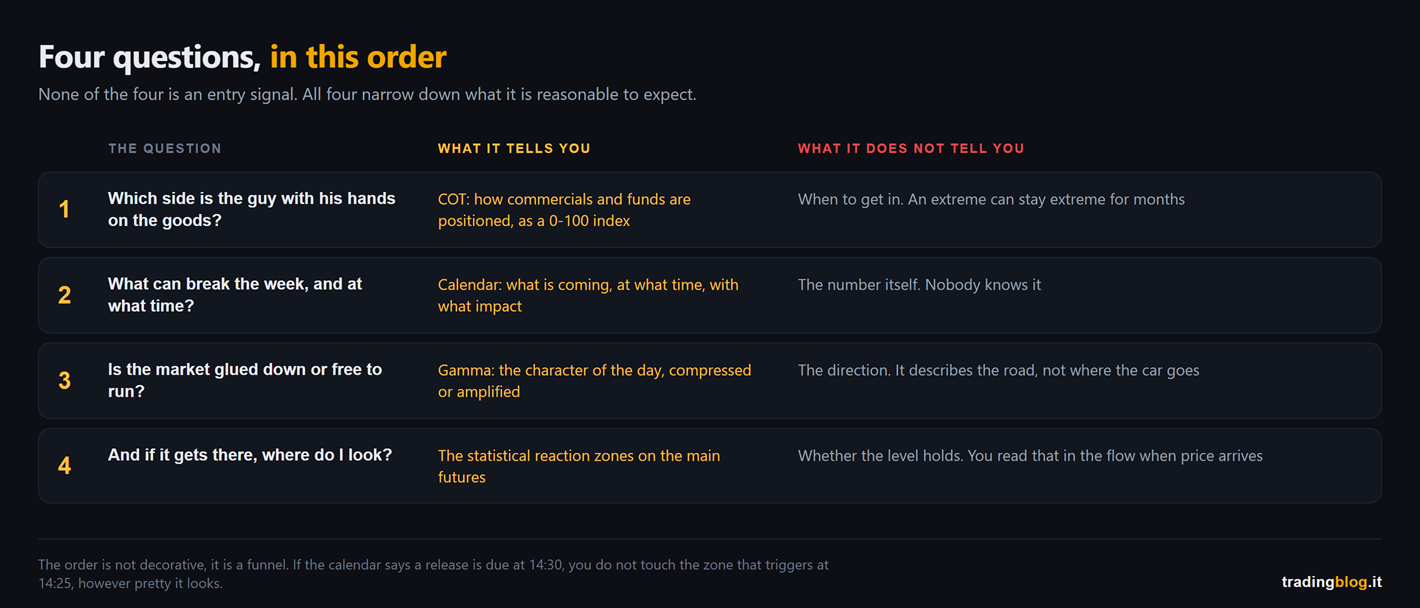
Ten minutes, four questions, before touching a chart. I do not predict anything and I do not decide anything. I just narrow down what it is reasonable to expect.
Today I am giving you the whole thing, with the questions in order, because the order matters.
Ok, vamos.
Two lines of transparency before we start
I get the answers to the four questions from one place, the Thunder Desk, which is The Thunder Trader’s free dashboard. So it is ours, and it is only right that you know that before reading the rest rather than after.
It is free, there is nothing to buy inside it, and to get in you need a name, an email and a password, with the email confirmed by clicking the link you receive.
That said, the four questions hold up anyway, even if you go and dig the answers out by hand across four different sites the way I did for years. The Desk took the collecting work off me, not the thinking. The thinking is the part that concerns you, and it is most of this article.
Question 1: which side is the guy with his hands on the goods?
Every Friday the CFTC publishes the Commitments of Traders, that is, how the large operators are positioned on futures.
Two families matter.
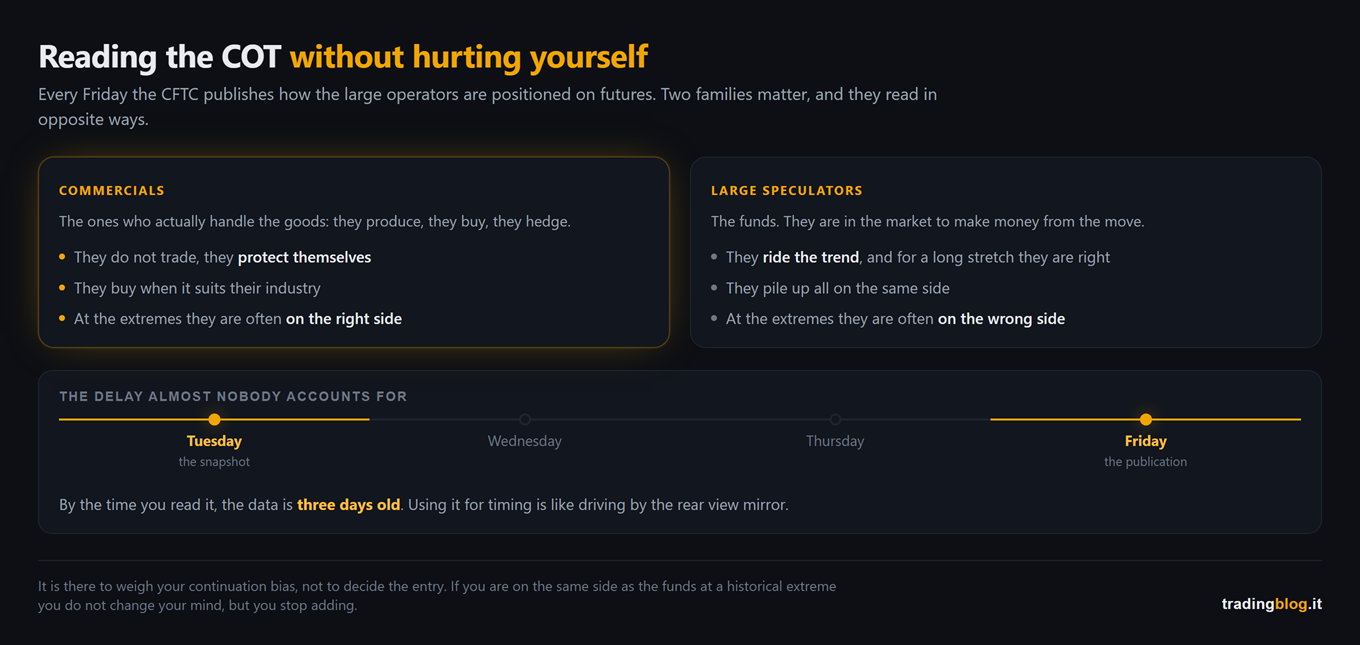
Commercials are the ones who actually handle the goods: whoever produces oil, whoever buys wheat, whoever has to hedge a currency. They are not there to trade, they are there to protect themselves, and that is what makes them interesting, because they buy when the price is low for industrial convenience, not out of enthusiasm.
Large speculators are the funds. They ride the trend, and they tend to be right for a long time and wrong at the extremes.
The Desk takes this stuff, which in its original format is an indigestible table, and boils it down to an index from 0 to 100.
Now the part that actually matters, which is how not to use it.
It is not an entry signal. Extreme positioning can stay extreme for months, and in the meantime price carries on perfectly happily in the direction you reckon should be reversing. Anybody who shorts because “commercials are record short” is betting on nothing.
And remember the delay. The data is a snapshot taken on Tuesday and published on Friday afternoon. By the time you read it, it is three days old. Using it for timing is like driving by the rear view mirror.
I use it for one thing only: to weigh my continuation bias. If I am long in a market where the funds are piled up on my own side at a historical extreme, I do not change my mind, but I stop adding and I tighten how I manage it.
Question 2: what can break the week, and at what time?
This is the dumbest of the four questions and it is the one that has saved me the most money.
You do not need to predict the number. Nobody can, and anybody telling you otherwise is selling you something.
You need to know the time.
The value of the calendar is defensive: not being in the market thirty seconds before a release that in two minutes does fifty points in a direction decided at random. It is not analysis, it is hygiene.
In the Desk the events come with the impact and with an explanation of what they mean, which is the part missing from almost every calendar out there: knowing that a number is coming is worth nothing if you do not know why that number matters and what the market is expecting.
If you want to see how a release gets read before it comes out, we did a worked example with the US jobs report.
The rule I apply, and I suggest you steal it: before every entry, I check whether anything is coming in the next thirty minutes. It costs three seconds.
Question 3: is the market glued down or free to run?
This is the question almost nobody asks, and it is the one that explains why some days feel cursed.
Whoever sells options has to hedge, and they hedge by buying and selling the underlying as price moves. The direction of that hedging is not always the same, and it changes everything.
When dealers are long gamma, to stay hedged they have to buy when the market drops and sell when it rises. The result is a market that puts itself out: days compress, moves get pulled back, highs do not last.
When they are short gamma, the opposite happens: they have to sell into weakness and buy into strength. Instead of being absorbed, the move gets amplified, and those are the days when everything happens faster than you expect.
The Desk gives you the three numbers you need to work out which of the two worlds you are in: Net Gamma, the Zero Gamma threshold where you cross from one regime to the other, and the two walls, Call Wall and Put Wall, the zones where so much of this stuff piles up that they often act as a ceiling or a floor.
Careful about what it is telling you, though, because this is the classic misreading.
It does not tell you the direction. It tells you the character of the day. It is the difference between knowing where the car is going and knowing whether the road is tarmac or ice.
We explained it properly in the piece on gamma exposure, and if you are interested in why certain days explode in the last hour, part two is in the piece on zero days to expiry options.
Question 4: and if it gets there, where do I look?
Last, and it comes last for a reason.
A level on its own has never saved anybody. We said it two weeks ago talking about the value area and the VPOC: the level is not the signal, it is the place worth looking at.
The Desk puts the statistical reaction areas on DAX, ES, NQ and the Dow, so you get to the open knowing where the hot spots are instead of finding out while price is banging into them.
Then the reading is on you, and you do it with what we built over the summer: when price arrives at the zone, the question is always the same, who is in a hurry and who is sitting still waiting. Which is the whole point of bid/ask candles and of CVD.
Why the order matters
The four questions are not a shopping list, they are a funnel. Each one narrows the next.
If positioning says everybody is on the same side, I know the surprises will come from the other one.
If the calendar says there is a release at 14:30, I do not touch the zone that triggers at 14:25, however pretty it looks.
If gamma says we are in a compressed regime, the target I had marked sixty points away probably is not getting hit today, and my plan has to be built around that.
And only at the end do I look at the levels, which without the first three answers are just lines on a screen.
What the Desk does not do, stated plainly
It does not give you signals. It does not tell you to buy or sell. It has no view on where the market is going tomorrow, and if it did I would not tell you anyway.
It is a place where four pieces of information that normally live on four different sites live on one screen, updated every day, with a note next to them saying what they mean.
The rest, which is the decision, stays yours. Which is also what their disclaimer says, and for once it is not a disclaimer put there for the lawyers: statistical and informational data for educational purposes, no advice and no signals.
How you get in
Go to desk.thethundertrader.com, create the account with name, email and password, and confirm by clicking the link that lands in your inbox. If you do not confirm you do not get in, so check your spam folder too.
Inside there is a language selector at the top: Italian, English and Spanish.
What you do from tomorrow morning
One thing only, and it is not about the Desk.
Take ten minutes before the open and answer the four questions in writing. Four lines, not an essay. Which way is positioning, what is coming out and when, what regime this is, where the levels are.
Then in the evening reread those four lines next to how the day actually went.
Do it for two weeks and something annoying will happen: you will find out that a good share of the trades that hurt you were already ruled out by your own four lines, written that morning, by you. You had just ignored them.
That is exactly what happened to me, and it was more useful than any new indicator. If you keep them in your diary rather than on a scrap of paper, in a month you have a statistic instead of a memory.
The chart tells you where price is. It does not tell you what film you walked into.
Let me close with the thing that convinced me to stop improvising in the morning.
It was not a big loss. Big losses hurt but teach you little, because they tell you that you were unlucky.
It was a run of small losses, all identical, all in the same place: entered well, technically right, ten minutes before a macro release I had not looked at.
I was not missing a method. I was missing ten minutes.
Suerte Amigo!
Tiziano Brunno
Tradingblog
Want to put your market reading to the test?
Compete and challenge other traders inside an Arena in a demo environment, with no real capital at risk. Discover the Performance Arena Events by The Thunder Trader.
Disclaimer: purely informational and educational content. It does not constitute financial advice or an invitation to trade. Trading involves the risk of capital loss.