Stablecoins: who guarantees what, and what happens the day it breaks
Hi trader,
for quite a while I parked my money in stablecoins between one trade and the next, and if you had asked me why they were safe I would have answered: because they hold the peg to the dollar.
Which is like saying a bridge holds up because there is a sign on it saying it holds up.
The last lesson, bitcoin and ethereum are not two versions of the same thing, ended with a promise: now it is the turn of the ones that promise never to move.
And the right question is not “what is it worth”. It is who guarantees what.
Ok, vamos.
First question: what is behind it
A reserve backed stablecoin works like this: you give a dollar to the issuer, the issuer creates a token, and puts aside something that is worth a dollar.
The point is that something.
Take the largest one. As of 30 June 2026, according to the document signed by whoever carried out the attestation, the reserve is worth 187.8 billion dollars. Of that, 61% is US Treasury bills with an average maturity under three months and 14% is repurchase agreements. So far it is what you expect.
But roughly 25% of the reserve, meaning 47 billion, is none of those things. It is gold, bitcoin, listed shares, secured loans and a line item called, literally, “other investments”, which the document defines as whatever does not fall into any of the other categories. And the listed shares, again according to the document, are themselves an indirect way of being exposed to gold, bitcoin and other assets.
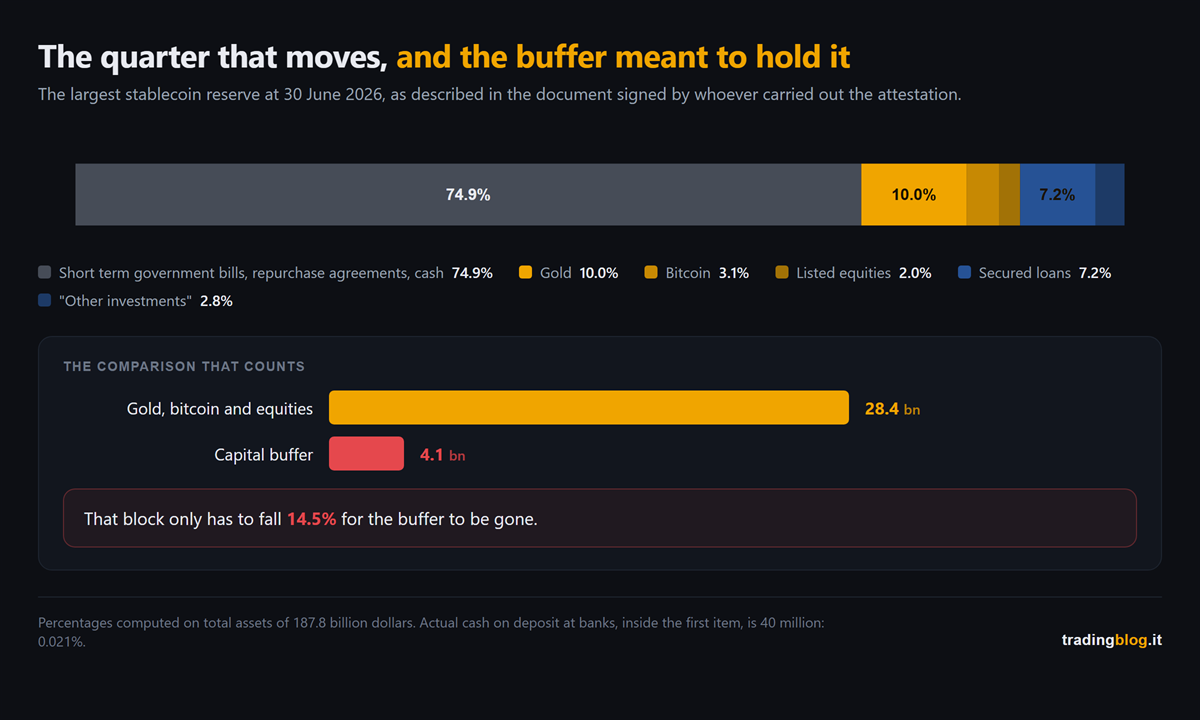
And now look at the buffer, meaning how much the reserve exceeds the tokens issued: 4.1 billion, 2.19% of assets.
Gold, bitcoin and shares together make 28.4 billion. That block only has to lose 14.5% for the buffer to be gone.
This is not theory. In the first half of 2026 the result for the period was negative by 3.2 billion, and that buffer went from 8.2 to 4.1 billion between the end of March and the end of June. It halved in three months, because a slice of the reserve sits inside things that move.
One last figure, and it is the one that surprised me most: the actual cash in the bank inside that reserve is 40 million out of 187.8 billion. That is 0.021%.
And the second largest one is built the other way round. As of 31 July 2026, 84% of the reserve sits inside a government money market fund, where however the bulk of it is not government securities it owns: it is repurchase agreements secured by government securities, fifty-two billion against seven. Another 15% is actual cash deposited in a bank.
But look at its buffer: 77 million out of 71.8 billion, meaning 0.108%. Barely more than one thousandth.
Two opposite models. One keeps a wider margin and invests it in things that move. The other keeps almost no margin and sits almost entirely in very short term government instruments. Neither of the two is “the dollar”.
Second question: who checks it
Here there is one word that makes all the difference.
An attestation is not an audit.
An attestation is a snapshot on a date: an auditor verifies that on that day the balances were the ones stated, and signs. It is serious work, not a rubber stamp. But it is a single point in time: it covers that day and it covers what it was asked to look at. With two details that matter: the criteria for that check are written by the party being examined, and the notes that explain the numbers stay outside the perimeter.
An audit has a different perimeter: the whole financial year, the accounts as a whole, a wider responsibility.
The difference is not how rigorous the party signing is. It is how big the piece of reality they are looking at is.
Careful though, because something changed here recently and the version going around is out of date. Until not long ago people said the largest one had never been audited. That is no longer true, but it is not quite the way they tell you either: in August 2026 it announced it had completed its first audit, handed to a large audit firm, with an unqualified opinion. It covers the company that issues and the 2025 financial year, not the whole group and not today’s numbers. And above all the report has not been made public: we know it exists because the issuer says so. The second largest one, on the other hand, really is audited, because it is a company listed in New York.
So the distinction has to be read on two levels: the annual accounts are now audited for both, while the numbers published during the year remain attested: every quarter for the largest one, every month for the second. The figures you read above come from an attestation, not from an audit.
Third question, and the one that really counts: can you get your dollar back?
This is the part that changed how I think.
The mechanism that is supposed to keep the price at one dollar is simple: if the token falls to 98 cents, somebody buys it, goes to the issuer, gets redeemed at one dollar and pockets the difference. By buying, they push the price back up.
It only works if that somebody can be you.
And with the largest one you cannot. It accepts direct redemption requests only from verified clients, with a minimum of a hundred thousand dollars, and charges a fee equal to the greater of a thousand dollars and 0.1%. Which on the minimum means one per cent. It is written in its own terms, the ones in force in September 2026.
With the second largest one the wall is a different one, but it is there all the same: direct redemption goes through an institutional relationship, not through your account.
If you hold a thousand dollars of stablecoins, you do not have that mechanism. You have the market, where the price is made by whoever is buying.
And on the wrong weekend, whoever is buying will pay you a lot less than a dollar. In two minutes we will see how much less, because it has already happened.
March 2023, the three days that explain everything
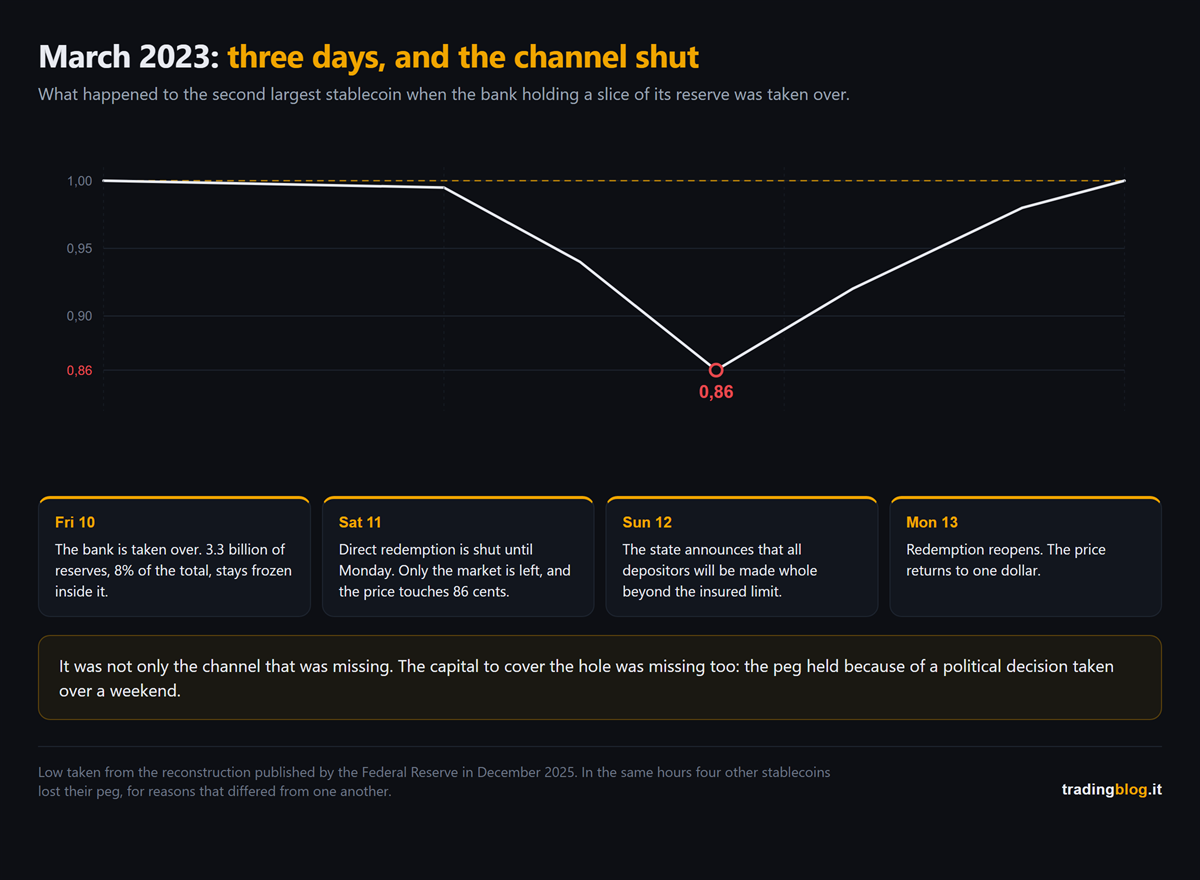
On Friday 10 March 2023 an American bank is taken over by the regulator. That same evening the issuer of the second largest stablecoin announces that 3.3 billion of reserves, 8% of the total, are stuck inside that bank.
Redemption requests explode. But it is Friday evening: direct redemption is closed until Monday.
All that is left is the market. On the Saturday the price touches 86 cents, according to the reconstruction done afterwards by the Federal Reserve. And within a few hours another four stablecoins lose the peg, for three different reasons: one because it was holding that coin inside as collateral, one because it was exposed to another bank that went under in those same days, and two because they were drained by the people using them to get out of the first one.
On the Sunday the American authorities announce that all depositors will be made whole beyond the insured limit. On the Monday redemptions reopen and the price goes back to one dollar.
Three days. And the thing to take home is more uncomfortable than the way it usually gets told.
It is not that all the assets were there and the only thing missing was the channel to reach them. Both things were missing. On one side direct redemption was closed. On the other, those 3.3 billion were enormous compared to the resources of whoever had to cover them: at the end of the previous year the issuer had closed its accounts with negative equity. It committed in writing to cover the shortfall with its own resources and outside capital, but a commitment written on a weekend is not cash in the till.
The price went back to one dollar because the state decided to guarantee the deposits beyond the insured limit. Not because the market calmed down on its own, and not because the numbers added up anyway.
That day, whether the peg held came down to a political decision taken over a weekend.
And do the rules help?
They do, but they cover one part only.
In Europe MiCA imposes reserves, redemption obligations and supervision on issuers, and about what changes in practice I wrote when it came into force, in MiCA is LIVE: what changes for your stablecoins.
But in May 2026 an issuer properly authorised under MiCA lost the peg on both of its coins. Not because the money was missing from the till, but because a compromised key made it possible to create out of nothing millions of tokens that had nothing behind them. The system that was supposed to authorise that creation was happy with one signature out of three.
And watch how you read that: the rules look at how the issuer is built and where it keeps the money. At how a key is configured, much less. And one key was enough to create money out of nothing.
What you do from tomorrow morning
Always ask yourself the three questions, in that order. What is behind it, who checks it, and whether direct redemption is something you can actually use yourself. The third is the one I had never asked myself, and it is the one that decides what happens to you on the bad day.
Do not treat a stablecoin like a bank account. It is not covered by any deposit guarantee scheme. It is a company’s debt to you, and it is worth what that company is worth.
If you park money there, know for how long. One night is one thing. Three months in exchange for a yield is another, and that yield always comes from a risk somebody is taking in your place.
Where we go next time
We have seen the ledger, the keys, the place where you buy, the two jobs and the coins that stay still.
Next time we look at the thing you actually care about: what moves the price. Flows, derivatives, liquidations.
A stablecoin is not a dollar. It is a company’s promise to give you a dollar, and it is worth whatever that company is worth on the day you ask for it.
Let me close with the question I asked myself that evening, reading the reserve document for the first time.
It was not “are they solid?”.
It was: if tomorrow morning I wanted mine back, who do I ask, and would they answer?
The answer was that I had nobody to call. All I had was a price on a screen, and the hope that somebody would buy it off me at a dollar.
Suerte Amigo!
Tiziano Brunno
Tradingblog
Want to put your market reading to the test?
Compete and challenge other traders inside an Arena in a demo environment, with no real capital at risk. Discover the Performance Arena Events by The Thunder Trader.
Disclaimer: purely informational and educational content. It does not constitute financial advice or an invitation to trade. Trading involves the risk of capital loss.