Bitcoin and ethereum are not two versions of the same thing

Hi trader,
for a while I bought ethereum for a reason that now makes me laugh: it cost less.
Bitcoin was up there, ethereum a few thousand, and in my head the reasoning worked: this one is expensive, that one still has to catch up.
It was not a thesis.
It was me reading a price badly.
A thesis is a sentence you can write on a piece of paper and that somebody can take apart. “It costs less so it will go up” cannot be taken apart by anybody, because it does not say anything.
This is the lesson that made me get it. If you missed the last one, the exchange, go and read it: that one shows you where you buy. This one shows you what you buy.
Ok, vamos.
The difference they tell you about, and that has not held up this past year
The version going around is simple. Bitcoin is scarce, ethereum is not. One has a ceiling of 21 million written in stone, the other can be created forever. End of story.
So let us go and look at how much of each actually got created.
In the twelve months to 16 September 2026, the supply of bitcoin grew by 0.82%.
Ethereum’s grew by 0.81%.
Practically the same number. Whoever held one and whoever held the other got diluted by the same amount.
And if you look at the pace of the last thirty days, ethereum is even slightly higher: 0.87% annualised.
So the difference that counts is not that one. If it were that one, this past year there would have been no difference at all.
The real difference is who decides that number
In bitcoin the number is written down. Today 3.125 new bitcoin every block, and every 210,000 blocks it halves. Anybody with a calculator can tell you how many bitcoin will exist in 2100.
The next time it halves is at block 1,050,000. In mid September 2026 there were around 82,500 blocks to go, and at that pace we land somewhere around April 2028. Note how I wrote it: “around”. You count in blocks, not in days, and anybody who hands you the exact date with the time on it is selling you a precision that does not exist.
And that rule does not hold because somebody promised it. It holds for the reason we saw in the first lesson: everybody has their own copy of the ledger, and everybody enforces the rules on their own account. Changing them takes more than somebody big wanting it, almost everybody has to go along.
2026 gave us the proof. On 8 August a proposal to change the rules, BIP-110, reached the stage where miners have to say yes or no. It picked up 2.53% against a threshold of 55%. And that 55% is only the threshold miners signal with: the rules are then enforced by whoever verifies the transactions, which is yet another set of people. That is why the chain trying to break away broke away on its own instead of dragging bitcoin along with it: it produced two blocks in eight hours and stopped there. Bitcoin’s core rules have not changed since November 2021.
Keep it in mind though, because it cuts both ways: whoever sells you “immutable” is selling you “it does not adapt” in the same package.
In ethereum that number is the balance of two forces
Here there is no ceiling, and it is not a detail to be hidden: it is simply a different design.
On one side the protocol creates new ETH to pay whoever keeps the network standing. How much depends on how much ETH is put up as a guarantee. In mid September 2026 that is 43.1 million, meaning 35% of the total, and there are another 1.85 million queuing to get in, with over a month of waiting.
On the other side the network destroys a slice of the fee on every transaction.
The balance between the two can go either way, and it depends on how much the network gets used. Congested, expensive network: more gets destroyed than created, supply falls. Smooth, cheap network: more gets created than destroyed, supply rises.
And this is the part that is worth the whole lesson on its own.
In March 2024 an upgrade made it almost free for second level networks to lean on the main one. And the point is not only that people moved over there: it is that those networks, which used to pay the main one a steep bill to park their data on it, have paid a fraction of that ever since. In mid September 2026 they do 62 times the operations of the main network, and on those networks a transfer costs less than a cent.
Result: on any ordinary day in September 2026 around forty ETH get destroyed on the main network, against an average of 2,481 a day since the mechanism has existed.
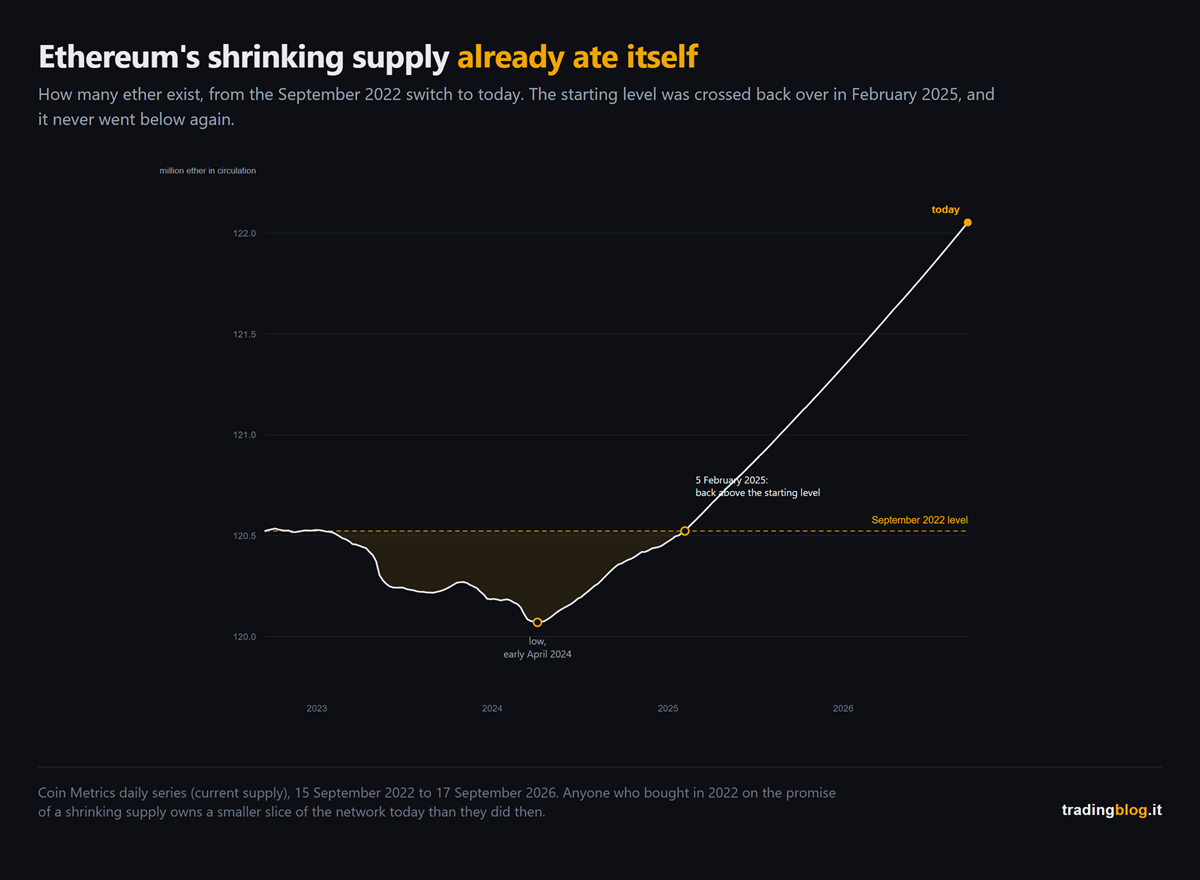
Ethereum’s supply hit its low in early April 2024. Since 5 February 2025 it has been back above the level it was at on the day the way it works changed, and it has not gone below it again.
Anybody who bought in 2022 after being told supply was going to shrink owns a smaller slice of the network today than they did then.
And watch out, because the balance has two sides and the other one moved in the meantime too: the ETH put up as a guarantee went from around 31 million in the spring of 2024 to over 43 million today, and the more of it is put up, the more the protocol creates. Supply went back to rising for two reasons pushing the same way, less destruction and more issuance. In 2023, with the network congested and far less ETH put up as a guarantee, the balance really did flip. Today the bar is higher, because the issuance you have to beat is the one coming from over 43 million ETH put up and no longer the one coming from 31.
It is not that somebody moved the goalposts. It is that the shrinking was never a guaranteed property of the system, it was a consequence of the traffic jam. The mechanism that the story said would shrink supply only works while the network is congested: when the network started running well, that mechanism nearly stopped.
Two jobs means two different ways of being wrong
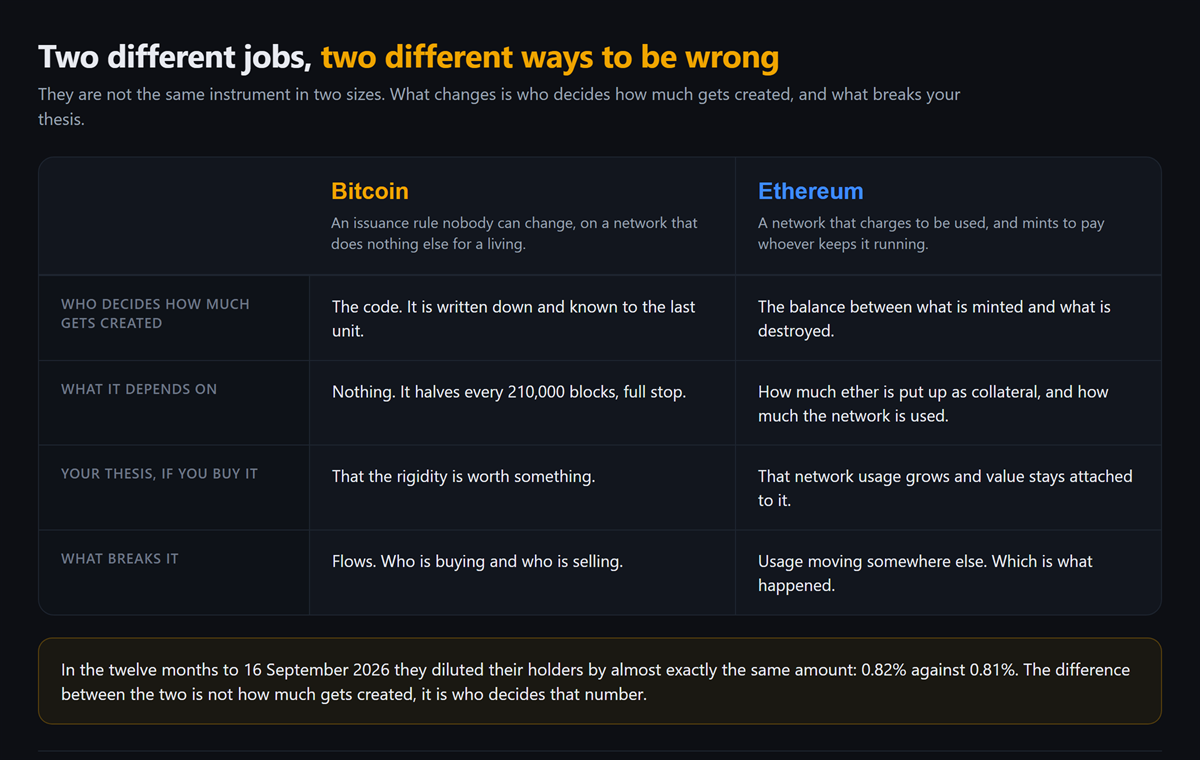
Bitcoin is an issuance rule nobody can change, on a network that does no other job for a living. If you buy it, your thesis is that the rigidity is worth something. What breaks it is flows, meaning who buys and who sells: as of 16 September 2026 the US spot bitcoin ETFs are in net outflow of around two billion dollars year to date, and about what ETF flows really say I have already written here.
Ethereum is a network that charges for being used. If you buy it, your thesis is that the use grows and that the value stays attached to it. What breaks it is that use no longer passing through there, or passing through and paying a fraction of what it used to, which is exactly what happened.
Two instruments, two theses, two different things to watch. It is not the same position in two sizes.
What neither of the two is
Bitcoin is not insurance against central banks. In 2026 the Fed held the hard line and on 16 September it raised rates, the first hike in more than three years. Bitcoin, in the same year, fell. It behaves like a risk asset tied to how much liquidity is going around, not like an insurance policy that is immune to it.
Ethereum is not a share with a coupon. The protocol yield has dropped to 2.59% a year, and the BlackRock fund that actually puts it up as a guarantee passes 1.45% a year on to investors (figure as of 16 September 2026). The difference is not all fee, and that is the interesting part: a slice is taken by the fund and by whoever does the work for it, another is simply ether the fund keeps free, without putting it up as a guarantee, so it can pay back whoever walks out. And meanwhile the underlying, year to date, is down double digits. A yield of 1.45% a year, on something that is down more than ten times that in nine months, is not a coupon, it is a fig leaf.
And there is a short circuit: the more capital goes in as a guarantee chasing that yield, the more the protocol creates, and the less it pays everybody already inside. The dividend waters itself down as the shareholders turn up.
What you do from tomorrow morning
Write the thesis before you buy. One single line: “I am buying it because…”. If the line is “because it costs less than the other one”, that is not a line, that is what I used to do.
Ask yourself what would break it. For one it is flows, for the other it is how much the network gets used. They are two things you look at in two different places, and neither of the two is looked at on the price chart.
Do not size them the same just because they sit in the same folder. They are two jobs, and in 2026 the second moved a lot more than the first, in both directions.
Where we go next time
So far we have seen the ledger, the keys, the place where you buy and the two main things you buy there. Next time it is the turn of the ones that promise never to move: stablecoins, and above all who guarantees what.
The difference between the two is not how much of each gets created. It is that in one that number is written down, and in the other it is the result of how the network gets used.
Let me close with the thing that changed my mind.
It was not a chart.
It was realising that of one of the two things I had in my portfolio I could not say, in a single sentence, why on earth it should be worth anything.
And if you cannot say it, you do not have a position.
You have a hope with money inside it.
Suerte Amigo!
Tiziano Brunno
Tradingblog
Want to put your market reading to the test?
Compete and challenge other traders inside an Arena in a demo environment, with no real capital at risk. Discover the Performance Arena Events by The Thunder Trader.
Disclaimer: purely informational and educational content. It does not constitute financial advice or an invitation to trade. Trading involves the risk of capital loss.