What really moves the price of bitcoin: flows, derivatives, liquidations

Hi trader,
I come from futures.
ES, NQ, DAX. Stuff with opening hours, a bell that opens and one that closes, and a weekly report telling you who is positioned on which side.
The first time I sat down to look at bitcoin with futures eyes, the question I asked myself was the most basic one: who is buying it, right now?
And the answer threw me.
A lot of the time, what pushes it is not people buying actual bitcoin. It’s contracts that don’t even deliver bitcoin.
The last lesson, stablecoins and who guarantees what, ended with a promise: now we look at the thing you really care about, what moves the price.
Ok, vamos.
First tap: flows
Since January 2024 you can buy spot bitcoin ETFs in the US. Let me explain it in two lines.
When the ETF trades above the value of the bitcoin it holds, or when a big client asks for shares, an authorized participant creates new ones. And in exchange real bitcoin goes into the fund: since July 2025 the SEC allows it to be delivered directly, before that it went through cash and the fund bought the bitcoin itself. When people get out, the opposite happens.
So a positive net flow means something concrete: somebody had to get hold of that bitcoin.
The numbers, as of 1 October 2026: since they launched, these funds have taken in, net of outflows, 57.7 billion dollars.
But the number that matters if you trade is the daily one. And it swings.
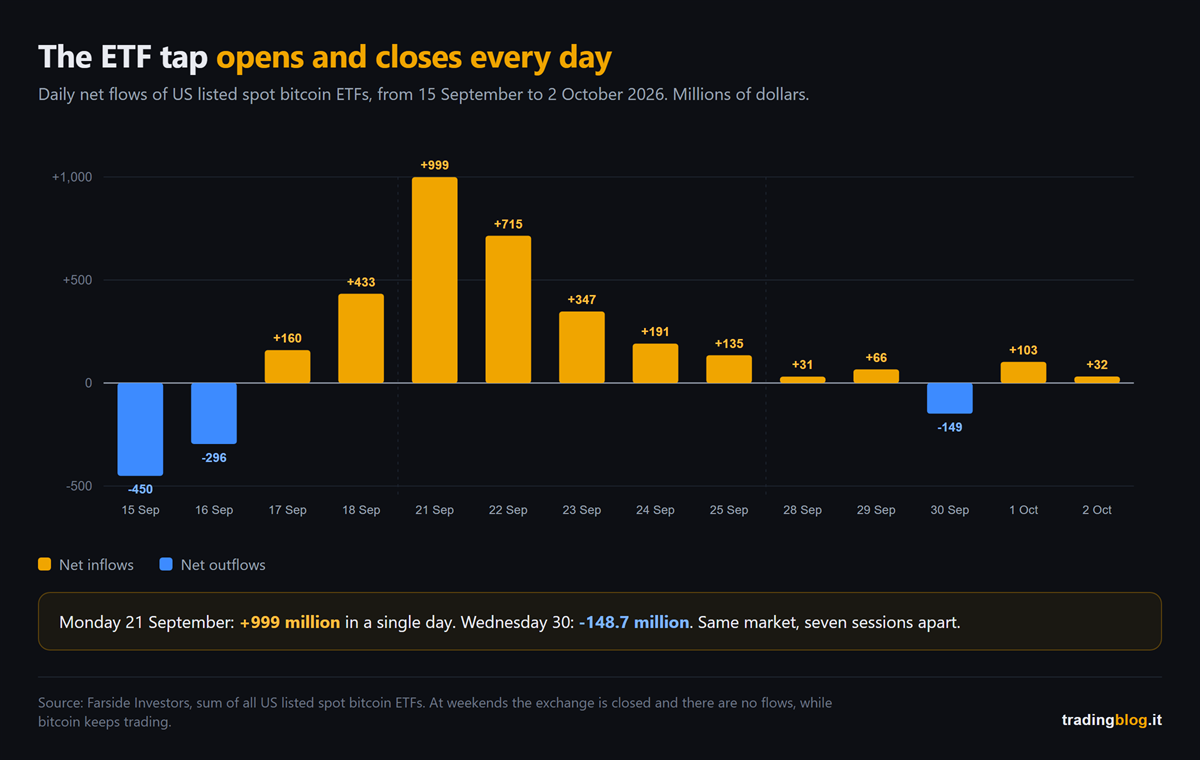
Monday 21 September 2026: almost a billion in, in a single day.
Wednesday 30 September: 148.7 million out.
In the first half of 2026, 5.4 billion net had left these funds, I told you about it here. In the third quarter, 6.36 billion came in.
Three things, before you fall in love with it.
The tap has opening hours. ETFs trade when the US stock market is open. Bitcoin doesn’t stop: it trades at night, at the weekend, at Christmas. When price moves on a Saturday, the ETF has nothing to do with it.
Flows can also chase price. If bitcoin rises for a week, it’s no surprise that more people get into the funds. In that case the flow didn’t push anything: price dragged the flow along behind it.
Not everything that goes in is a bet on higher prices. Some people buy the ETF and at the same moment sell a future, to pocket the difference between the two prices. They couldn’t care less about direction.
Second tap: derivatives
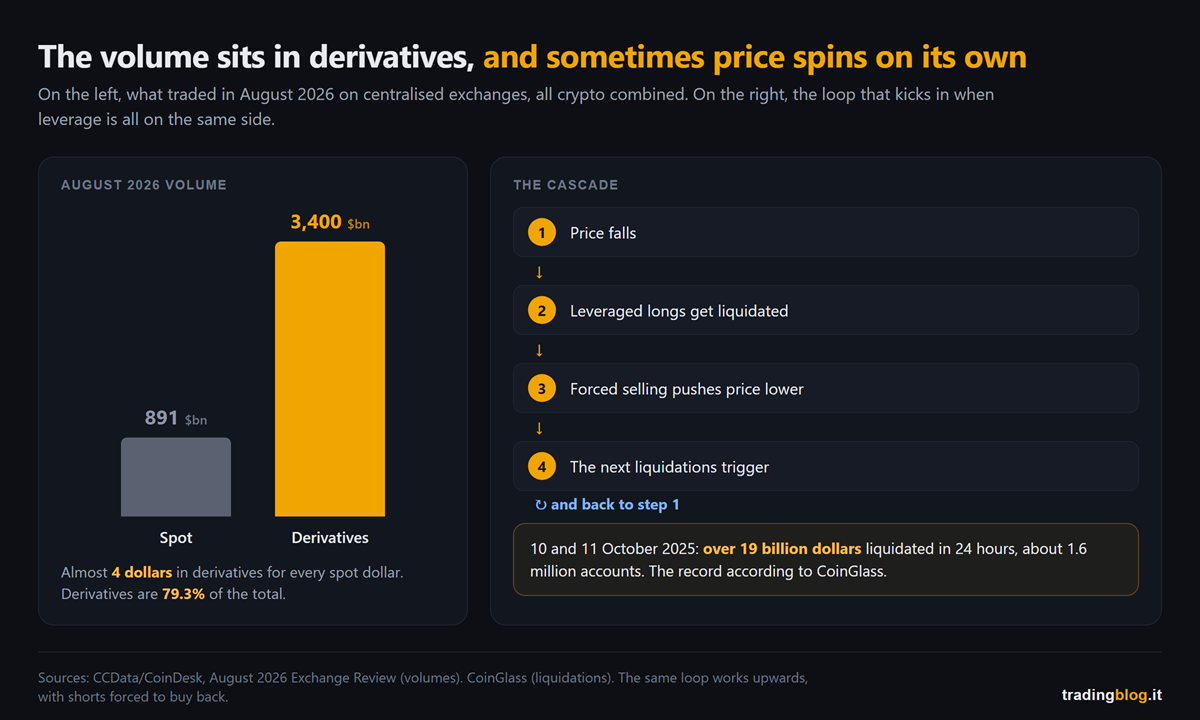
In August 2026, on centralized exchanges and counting all crypto, 891 billion dollars traded spot. On derivatives, 3,400 billion. That’s 79.3% of the total.
For every dollar of crypto actually bought or sold, almost four go round on contracts that deliver nothing.
The king of contracts is called the perpetual. Here’s what it is: a future with no expiry. On ES you roll over every three months, here you don’t, the position stays open until you close it. Or until it gets closed for you.
So how does its price stay glued to the real one? Through the funding rate. On the biggest derivatives exchange it’s paid every eight hours by default: if the rate is positive, longs pay shorts, if it’s negative, the other way round. And the rate goes up when the contract trades above the spot price. That money moves from one trader to another, the exchange doesn’t keep it.
Translated for us futures people: funding is a positioning thermometer that updates every eight hours. It doesn’t tell you who is positioned the way the COT does, it tells you how much leveraged buyers are willing to pay. If it’s high and positive, there’s a queue on the buy side, and that queue is paying to stay in line.
The other number is open interest, the contracts open at that moment. At the end of August 2026, on derivatives exchanges and counting all crypto, it was worth 101 billion dollars. Every open contract has two people inside it, a long and a short, and sooner or later they’ll have to get out. By choice, or not.
Third tap: the ones who get out without deciding to
I’ve already written properly about leverage and liquidations, and I won’t do it all again here: leverage and liquidations, how you get wiped out.
On ES, above an obvious high, sit the stops of the shorts. Price gets there, the stops become buy orders, price jumps again. You know the drill.
On bitcoin it’s exactly the same thing, with three differences: leverage is much higher, the market never closes, and you don’t decide the last stop: the exchange triggers it when your margin runs out, and it’s called a liquidation.
On 10 and 11 October 2025, according to CoinGlass, positions worth more than 19 billion dollars were liquidated in 24 hours, around 1.6 million accounts. The biggest since records began.
And it’s probably an undercount: the biggest derivatives exchange, in its public feed, reports at most one liquidation per second per contract. The others in that second don’t show up.
That day the fuse was lit by a piece of news, the tariffs announced on China. But much of the drop wasn’t done by people with an opinion: it was done by people forced to sell.
And above it all, the weather
The three taps explain the how. The why, sometimes, sits outside crypto.
Bitcoin reacts to macro like a risk asset: rates, the dollar, liquidity. But not like a switch. After the rate hike of 16 September 2026, which on paper takes water away from the taps, bitcoin ETFs had their strongest week of inflows since October 2025.
Macro tells you what the weather is like. It doesn’t tell you where the boat is going.
I wrote about what the Fed hike of 16 September meant and about what a strong dollar does to your trades in the market pieces.
And here’s a tip from someone who’s been burned on leverage: a big US data release moves bitcoin too, and if it catches you on high leverage without you knowing it was due, you pay for the liquidation. The macro calendar with the impact of every event is free inside Thunder Desk. Five minutes before opening a position, not after.
What you do starting tomorrow morning
Read flows with the date and in proportion. A billion in a day makes headlines. Three days later it can be the opposite.
Before getting in, check funding and open interest. If funding is high and open interest keeps rising, there’s a lot of leverage paying to stay open, and the cascade already has fuel in the tank.
Remember that at the weekend the ETF tap is closed, the derivatives one isn’t. When the US stock market is shut, what’s left moving price is the exchanges, and there the heavy lifting is done by leveraged contracts.
Where we go next time
Next time we get practical: buying without getting hurt. How much to put in, how much to risk, and where to keep what you’ve bought.
The price of bitcoin, a lot of the time, is not set by people buying actual bitcoin. It’s set by people holding leveraged contracts open, and above all by people forced to close them.
Let me close with the thing that stuck with me from that first time.
I thought I’d find a new market, with new rules.
I found the same market I already know: positioning, leverage, stops.
Just without the closing bell.
Suerte Amigo!
Tiziano Brunno
Tradingblog
Want to put your market reading to the test?
Compete and challenge other traders inside an Arena in a demo environment, with no real capital at risk. Discover the Performance Arena Events by The Thunder Trader.
Disclaimer: purely informational and educational content. It does not constitute financial advice or an invitation to trade. Trading involves the risk of capital loss.