The hours that matter on futures (and the week New York opens an hour early)

Hi trader,
years ago, one morning at the end of October, I set my alarm for the US open as always, made my coffee nice and slow, and sat down in front of the platform at 15:25, fully focused.
And the market had already been moving for an hour.
Nothing strange had happened. The clocks had changed in Europe, not yet in America, and I hadn’t noticed.
That week comes round this year too. It’s this one.
Ok, vamos.
A word about clocks
I live in the Canary Islands, which run on London time: for me the US cash session opens an hour earlier than for someone in Rome or Madrid.
But this piece was born for readers in continental Europe, and the figures are built that way, so in this piece every time is in Central European Time (Italy, Spain, Germany). If you’re in the UK, Portugal or the Canary Islands, take an hour off everything. Where it helps, I’ve put New York time in brackets.
And one more thing: the volumes you’ll find below I measured myself on the futures’ minute data, the same data I use for all my tests. ES from January to 18 September 2026, DAX over the same period, 170 sessions of ES and 167 of DAX, leaving out the weeks when Europe and America had their clocks out of sync. For each session I worked out what share of the volume trades in each window, and then took the median. It’s not official exchange data: it’s our own measurement on real data.
A typical day, window by window
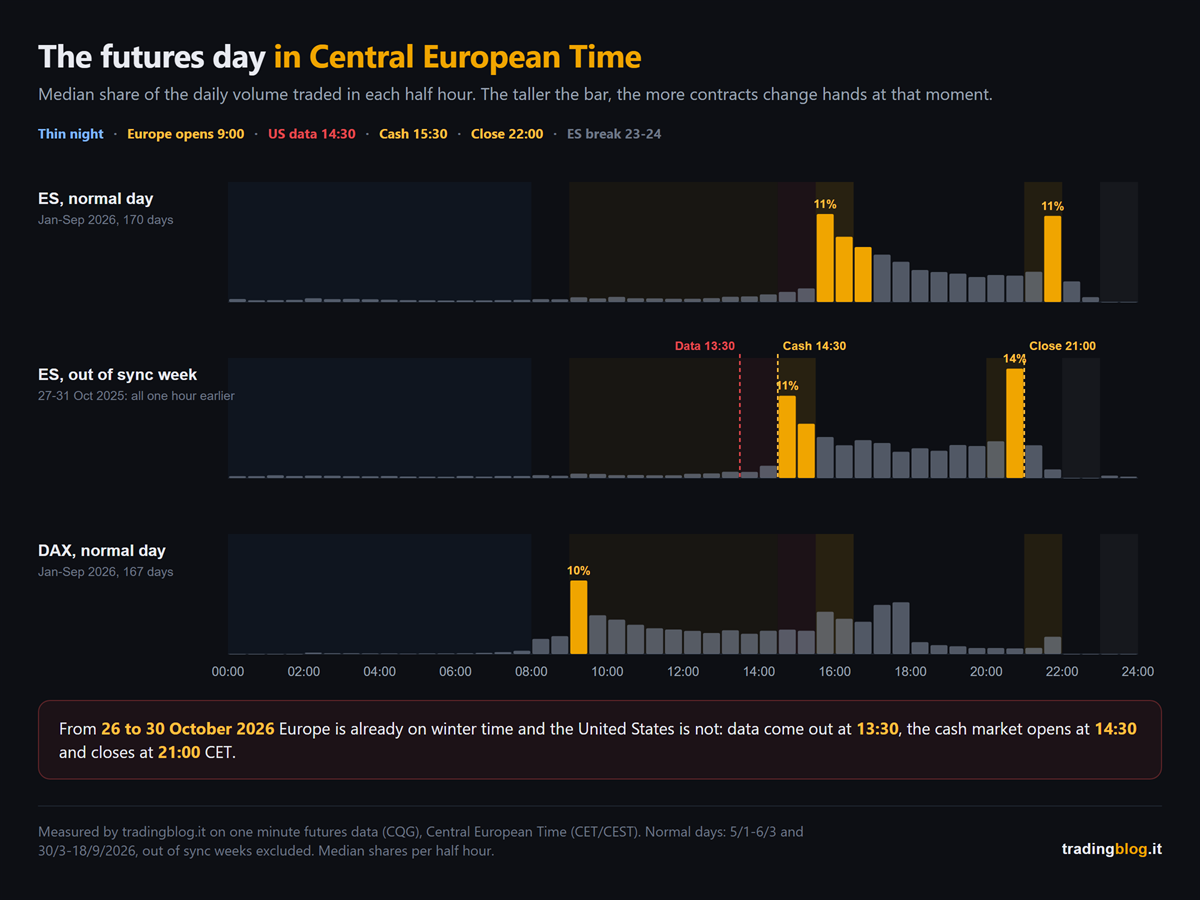
The night, from midnight to 8:00. The ES future reopens at midnight, after an hour’s break. It runs all night, while Asia works and then Europe wakes up. But it’s a thin market: in these eight hours 5% of the day’s volume trades.
Translated: an hour of night is worth, in volume, a tiny fraction of an afternoon hour. When you see a spectacular “overnight breakout”, before getting excited ask yourself how many contracts went through it.
The European morning, from 9:00 to 14:30. This is where the DAX rules. At 9:00 the German stock market opens, and the half hour from 9:00 to 9:30 is the busiest of the DAX’s whole day: on its own it does about 9-10% of the volume. Across the whole window up to 14:30, almost half of the DAX future’s volume trades, 47%.
ES in the same hours? 7%. It’s awake, but it’s waiting.
14:30, the US data. At 14:30 (8:30 in New York), many of the heaviest macro releases come out: employment, inflation, retail sales. Before the stock market opens.
On a typical day, the hour between 14:30 and 15:30 is almost quiet: 3% of ES volume. On data days it’s a different animal, and you know that perfectly well if you’ve ever been caught in one. How to prepare for a release before it comes out we covered with the jobs report and with August inflation.
And here’s a habit that has saved me more money than any setup: before getting in, check what’s coming out in the next half hour. The macro calendar with the time and impact of every release is free in Thunder Desk, you just need to sign up. Just watch out for one thing: times there are London time, so add an hour to match this piece. If you’re in London, they’re already right for you. Three seconds, and you don’t get caught with an open position at market while a release comes out that decides for you in two minutes.
15:30, the cash open. At 15:30 (9:30 in New York) Wall Street opens. This is the king hour.
Between 15:30 and 16:30, 20% of ES daily volume trades. A fifth of the day in one hour. Compared with an average night hour, that’s more than thirty times as much.
And if the DAX seems to wake up in the afternoon, it’s not your imagination: between 15:30 and 16:30 more than 10% of its volume trades. America opens, and Europe follows.
Midday, from 16:30 to 21:00. Volume stays high, but it thins out: in four and a half hours 43% of ES volume trades. Per hour, that’s less than half of the first hour. These are the hours where, at least the way I live them, patience costs the most.
The last hour, from 21:00 to 22:00. The cash session closes at 22:00 (16:00 in New York), and the last hour wakes up again: 15% of the volume. The half hour from 21:30 to 22:00 on its own weighs almost as much as the first half hour after the open, 11%.
After 22:00 the ES future carries on for another hour, but it’s a different market: 3% of the volume. At 23:00 it stops, and at midnight it starts again. Not on Fridays: at 23:00 it closes for the weekend and reopens on Sunday evening.
The out-of-sync week
Now the hook.
In Europe the clocks go back on Sunday 25 October 2026, the last Sunday of October: in the EU it’s set by a directive, and the UK changes on the same day. In the United States they go back on Sunday 1 November 2026, the first Sunday of November.
So from 26 to 30 October there are five hours between Central Europe and New York instead of six (four instead of five from London). And all the US times arrive an hour early on your clock:
the data at 8:30 New York time comes out at 13:30;
the cash session opens at 14:30;
it closes at 21:00;
and the ES future’s break runs from 22:00 to 23:00.
And this year there’s one more detail. On Wednesday 28 October there’s the Fed. The decision comes out at 14:00 in New York, which that week is 19:00 Central European Time, not the usual 20:00.
Europe, on the other hand, doesn’t move. The DAX always opens at 9:00.
This isn’t theory. I looked at the five sessions of the same week last year, from 27 to 31 October 2025. The two busiest half hours on ES became the one from 14:30 to 15:00 and the one from 20:30 to 21:00. The market didn’t change its habits: it kept them, on New York’s clock.
And in March the same thing happens the other way round, but for longer: in 2026 America switched to daylight saving time on 8 March, Europe on the 29th. Three weeks out of sync.
Moral: your routines shouldn’t hang on your home clock. They should hang on the market’s hours.
The rollover, or when the contract changes under your feet
ES has four expiries a year: March, June, September and December. The contract expires on the third Friday of the month.
But volume doesn’t wait for expiry. It moves earlier. CME gives the Monday before the third Friday as the reference date for the switch.
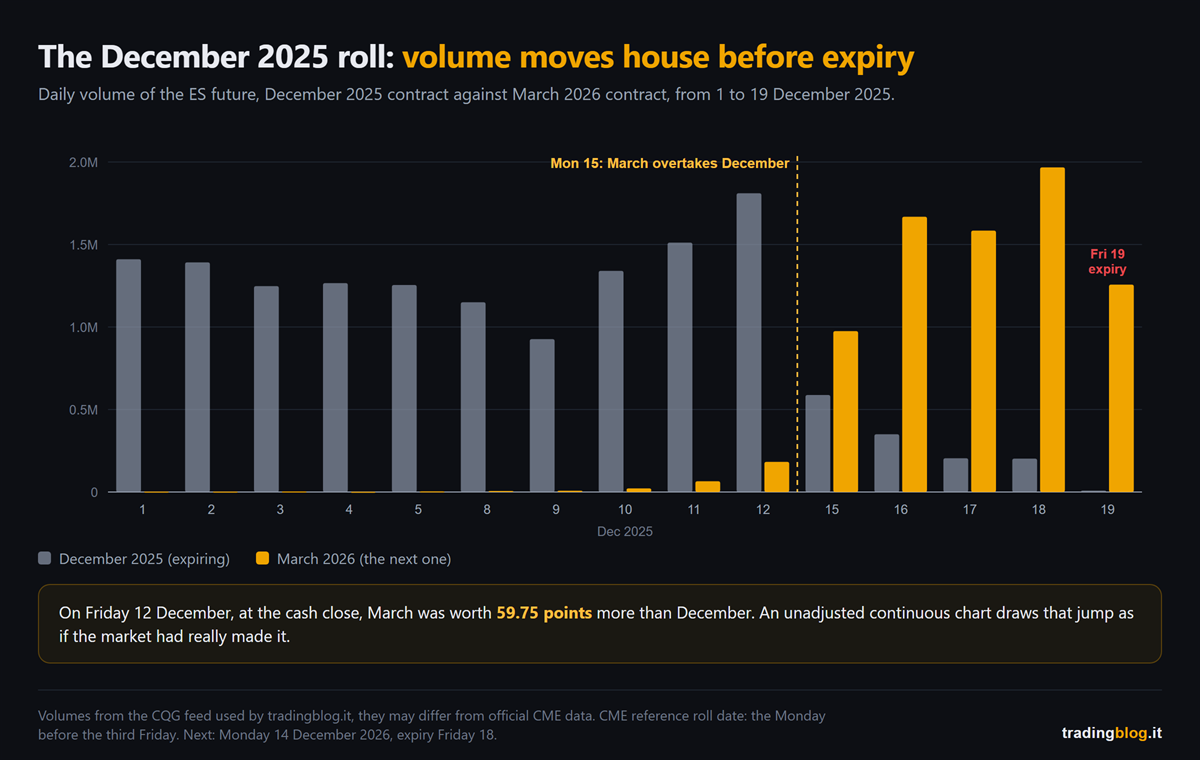
Look at last December. On Friday 12 December 2025 the December contract was still doing most of the volume. On Monday 15, the CME reference date, March overtook it, and from there it never looked back.
And this is where the continuous chart trap comes in, the one that stitches one contract after another to show you a single series.
The two contracts aren’t worth the same. On 12 December 2025, at the cash close, March was worth 59.75 points more than December. If your continuous chart isn’t adjusted, on the day of the switch it draws you a sixty-point jump the market never made. And if it is adjusted, the old prices on the chart aren’t the ones that actually traded.
Neither one is wrong. You just need to know which one you’re looking at, especially if you draw levels and highs on it.
The next one: the December 2026 contract expires on Friday 18 December, and the CME reference date for the switch is Monday 14 December.
Work in the windows, not all day
I’m telling you this as someone who for years sat in front of the screen from 9:00 to 22:00.
You don’t need to. In fact, it hurts.
The hours that matter are few, and they’re almost always the same ones. The rest of the time the market isn’t asking you for anything, and you’re just piling up fatigue for the moment you’ll need a clear head.
I’ve built myself blocks: focused work in the window I care about, a real break when the market is thin. So I don’t cheat on myself I use a timer, and the one we use is free: Thunder Focus. Set it to the windows of your session, and when it rings you get up. Even if the chart is calling you. Especially if the chart is calling you.
What you do starting tomorrow morning
Write down your market’s windows in your own local time, and look at them again every time the clocks change, on either side of the ocean.
The week from 26 to 30 October, move everything an hour earlier. Data at 13:30 CET, open at 14:30 CET.
Before every entry, check the calendar. The next half hour, not the week.
In December, check which contract you’re on. From 14 December the CME reference is March 2027.
The market doesn’t look at your clock. It looks at New York’s, and twice a year the two don’t get along.
Back to that coffee at the end of October.
I didn’t lose money that time. I lost the open, which is worse, because I watched it scroll past afterwards, on the chart, with all the movement I would have wanted to trade.
Since then, on the last Sunday of October, the first thing I do isn’t moving the alarm.
It’s writing down that for one week New York is closer.
Suerte Amigo!
Tiziano Brunno
Tradingblog
Want to put your market reading to the test?
Compete and challenge other traders inside an Arena in a demo environment, with no real capital at risk. Discover the Performance Arena Events by The Thunder Trader.
Disclaimer: purely informational and educational content. It does not constitute financial advice or an invitation to trade. Trading involves the risk of capital loss.