Wednesday’s CPI: the headline will look scary, but the real risk is somewhere else

Hi trader,
the last time I wrote to you about a CPI, on 11 September, the market had the Fed hike at 70%.
And I told you that 70% was the worst place to be caught by a data release.
Five days later the Fed really did hike, the first hike in more than three years, rates at 3.75-4.00%.
This afternoon the September CPI comes out, and the picture has flipped.
The market now puts the end-of-month hike at around 20%.
And I’ll tell you right away why that worries me more, not less.
What comes out today, and when
The US September CPI, the consumer price index.
The Bureau of Labor Statistics publishes it on Wednesday 14 October at 8:30 am New York time, which is 13:30 in London and here in the Canary Islands, and 14:30 in Italy.
Here is what the market expects, compared with August:
| What | Expected September | August |
|---|---|---|
| Headline CPI, year on year | 3.6-3.7% | 3.4% |
| Headline CPI, month on month | +0.6% | +0.4% |
| Core CPI (ex food and energy), year on year | 2.4-2.5% | 2.4% |
| Core CPI, month on month | +0.2% | +0.3% |
On the core, the forecasts are bunched almost entirely around +0.2%.
Keep that in mind, because that is where the risk is hiding.
Oh, and tomorrow, Thursday, producer prices come out too.
So this afternoon does not close the story, it opens a two-day stretch.
Today’s headline will look scary
I’m telling you in advance, so you don’t get a fright at 8:30.
A +0.6% on the month would be the strongest monthly rise since April.
The reason is always the same: gasoline.
In August gasoline in the CPI was already up 27.4% on the year, and energy as a whole 16.3%.
In September gasoline rose again, and at the end of the month diesel hit its all-time record, just above 6.5 dollars a gallon as a national average.
Brent is trading around 105 dollars these days.
On Sunday Trump announced an “energy truce” between Russia and Ukraine, no more attacks on energy facilities.
Moscow did not confirm it, the attacks carried on, and on Monday oil closed higher instead of lower.
And the Middle East, which is what pushed the barrel all the way up there, has not calmed down at all.
In plain words: today’s headline is written by the barrel, and these days the barrel is written by the news from the front lines.
And that is exactly why the headline, for anyone who trades, matters less than it looks.
At the Fed almost everyone knows it’s gasoline.
The market knows it’s gasoline.
The phone notifications will talk about “inflation at a multi-month high”, and they will be right, but that is not the number the end-of-month game is played on.
August’s core was dirty
And here comes the part almost nobody tells you.
In August the core came out at +0.3%, above the +0.2% expected.
The market noticed right away: short-term yields went up, because a core above expectations is exactly what the Fed does not want to see.
But if you open the report and look inside, a slice of that +0.3% was not inflation spreading.
It was two odd items.
Phone services, up 5.4% in a single month because of price hikes and plan changes at AT&T and T-Mobile, added about a tenth of a point to the core on their own.
And hotels, +2.4% after two months of similar declines, which is a rebound more than a trend.
Take those two things out and August goes back to being a normal month.
That is why almost everyone expects a September core at +0.2%: not because inflation is cooling, but because those two items don’t repeat.
It’s like a puncture in qualifying.
The lap time is bad, but it tells you nothing about race pace.
So what do I look at inside today’s core?
One item, before all the others: airline fares.
Because a plane ticket is a service, but there is fuel inside it.
In August flights were already up 23.4% on the year: the barrel has been passing from fuel into services for months, and the question is whether it speeds up.
That is still an indirect effect, fuel going into the price of a service.
The next step is the one the ECB had put into its projections in September, the second-round effect: wages and price lists adjusting.
That is where the price rise stops being gasoline and becomes something else.
Why this time the risk is all on one side
Back to that 20%.
How did we get there?
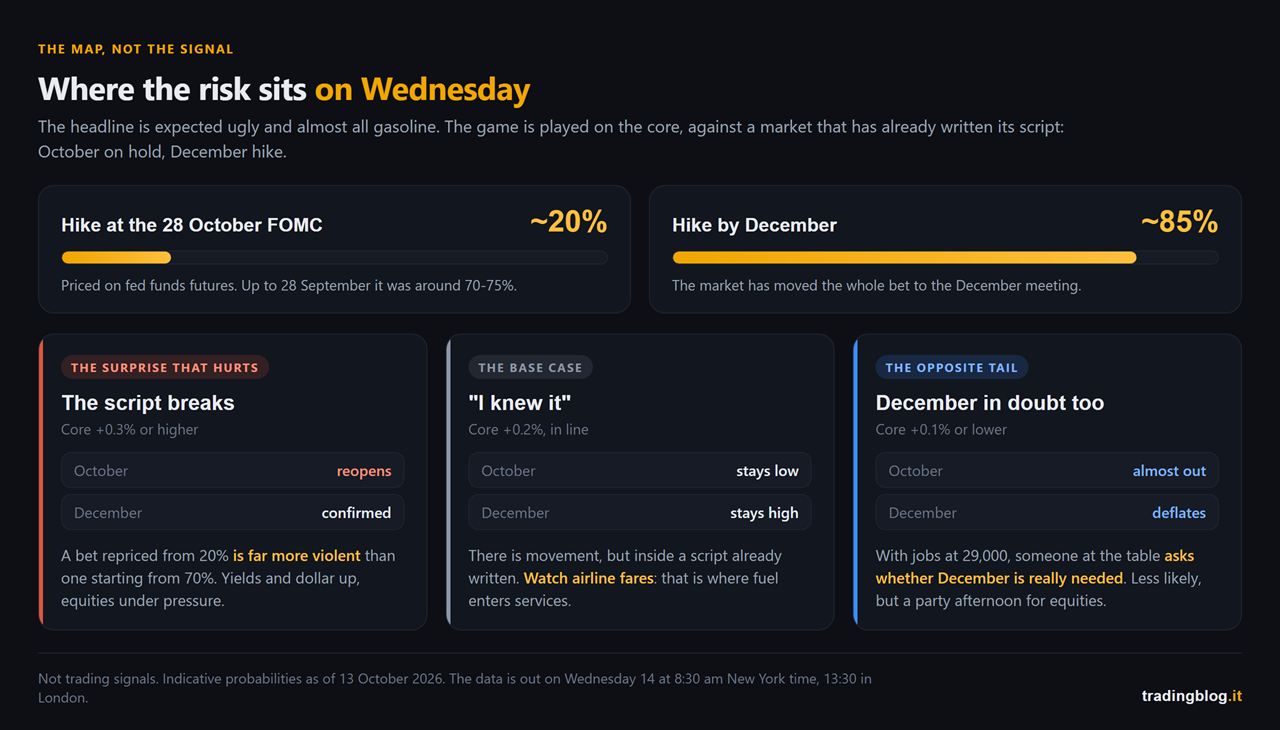
Up to 28 September the market had the end-of-month hike at around 70-75%.
Then in four days three things happened.
On 29 September John Williams, the president of the New York Fed, said there is no urgency and that another move could come towards the end of the year.
The October odds collapsed right there.
The next day August PCE, the index the Fed actually uses for its 2% target, came out a touch below expectations.
And on 2 October the September jobs report came out very weak, 29,000 jobs against an estimate of around 90,000, unemployment up from 4.1% to 4.2%.
Result: October almost priced out, and the whole bet moved to December, where a hike is priced at around 85%.
So the story the market has told itself is this: October on hold, December hike.
Now think about how a price built like that reacts.
If the core comes out at +0.2% today, the market says “I knew it”.
Movement, sure, but inside a script already written.
If it comes out at +0.3% or higher, above almost every forecast, that 20% for October is no longer a 20%.
And a bet that has to be repriced from 20 to 50 in one afternoon is far more violent than one going from 70 to 80.
In September the hike was in the price, and the data could only confirm it or disappoint.
Today the hike is almost priced out, and only one surprise really hurts.
There is also the opposite tail, and it’s not one to dismiss.
Core at +0.1% with a labour market creating 29,000 jobs, and someone at the table will start asking whether December is really needed.
The 85% for December would deflate, and that really would be a field day for equities.
Less likely, but possible.
My point is a different one: the market is leaning on a single story, and the dangerous afternoons are the ones when the story breaks.
A Fed pulled two ways
There’s one last thing that makes this CPI different from September’s.
In September the Fed had one problem: inflation.
Now it has two, and they pull in opposite directions.
On one side prices rising because of energy, with the US 10-year above 5% and the president of the Cleveland Fed, Beth Hammack, saying rates need to be higher because inflation is broadening.
On the other a labour market that this year has created 68,000 jobs a month on average, and that in September created less than half of that.
The minutes of the September meeting say the committee sees another hike by the end of the year.
They don’t say when.
And when a central bank doesn’t say when, the data decides.
Today is the data.
How I handle it
The rules are the usual ones, because CPI days all look alike.
I don’t enter on the 8:30 spike.
First the market reads the headline, which today will be ugly and already expected.
Then it reads the core.
Then, if it’s someone who works properly, it opens the detail and looks at what’s inside.
The move that holds until the evening is almost always born at the second or third pass, not the first.
I show up with the map already drawn.
Calendar, levels, and where the options market has its walls on the S&P and the Nasdaq.
On a day like this part of the move is made by market makers hedging, not by the news, and that’s gamma exposure.
I check it on the Thunder Desk, which is free and puts the macro calendar and gamma on the same screen.
The point isn’t the tool, it’s opening it in the morning, not at 8:29 with the position already open.
I cut size before, not after.
If a position is still alive at 8:30, the spread can widen and the stop can get filled a few ticks further away.
What that scenario really costs me I work out now, with numbers, not by eye.
And I log the reaction, not the result.
What I expected, what came out, what price did in the first five minutes and what it did by 10 am.
Do it today, and do it again at the end of the month with the FOMC.
A few days like this in the diary and your recurring behaviour around macro data shows up on its own.
Three takeaways
- Today’s headline will be ugly, and it’s already written. Headline expected at +0.6% on the month and 3.6-3.7% on the year, almost all energy, meaning gasoline. That’s not where October is decided.
- August’s core was inflated by two items that don’t repeat. A +0.2% today doesn’t mean inflation is cooling, and inside it airline fares are worth watching, the point where the barrel enters services.
- The market has already decided: October on hold, December hike. With October at around 20%, the surprise that hurts most is a core at +0.3% or higher. You don’t need to guess it, you need to know beforehand what you do if it comes.
If you missed the previous episodes, the piece on the August CPI is where the headline versus core discussion started, and the piece on the September hike explains why from here on every inflation print weighs double.
The dangerous number is not the one the market fears. It’s the one the market has stopped fearing.
I’ll close with what I tell myself every time I see a calm market before a release.
Calm doesn’t mean safe.
It means everyone has bet on the same story.
Suerte Amigo!
Tiziano Brunno
Tradingblog
Want to put your market reading to the test?
Compete and challenge other traders inside an Arena in a demo environment, with no real capital at risk. Discover the Performance Arena Events by The Thunder Trader.
Disclaimer: purely informational and educational content. It does not constitute financial advice or an invitation to trade. Trading involves the risk of capital loss.