Posts

The trader of the future with the amber and violet visor looks at a monumental glowing vault door which, seen from the side, turns out to be a paper thin panel standing on nothing, with emptiness behind it

The exchange: where you buy, and what happens if it goes down

Hi trader,

last lesson we left off on a sentence that now needs explaining properly: on an exchange the keys are theirs.

If you missed the earlier pieces, keys and wallets is what you need to make sense of this one.

Today we look inside the box. What an exchange actually is, what happens when you click buy, and what happens to your money the day it shuts down. Because it is not a theoretical scenario: it has already happened, more than once, and people lost everything.

Ok, vamos.

The thing almost nobody has clear

An exchange is not the blockchain.

It is a company. With servers, employees, a legal department and, above all, a database.

And that is not a pedantic distinction, because it has an enormous consequence: when you buy on an exchange, nothing happens on the blockchain.

Zero. No row gets written on the public ledger. No network fee. No confirmation to wait for.

Two numbers change in their database: the euro one goes down, the bitcoin one goes up. And the bitcoin it shows you are not “yours”: they are a share of a pile the exchange keeps for all its customers together, and it holds the keys.
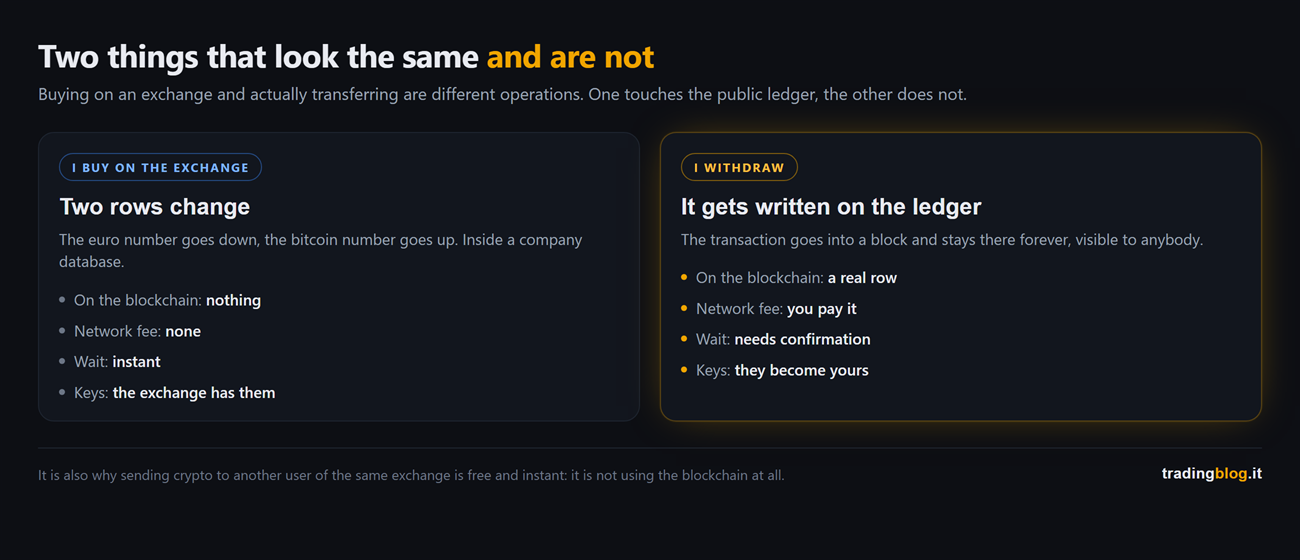
Comparison between buying on an exchange, where only two rows change in the company database without touching the blockchain, with no fee and no wait but the keys held by the exchange, and withdrawing, where the transaction is actually written on the public ledger, the network fee is paid, confirmation is needed and the keys become yours
The two things that look the same. On the left a purchase on an exchange: two rows change in the company database, the blockchain never notices. On the right a real transfer: the row gets written on the public ledger, with a fee and a confirmation time.

Inside, though, it is a real market

And this is where it gets interesting for somebody who trades, because you already know the mechanism.

Inside the exchange there is an order book, exactly like on futures: a list of who wants to buy and at what price, and who wants to sell and at what price.

And there are the two ways of being in the market we covered in the order flow series: there is the one who places a limit order and waits at their price, and the one who sends a market order and pays to get in now.

If that feels familiar it is because it is: it is the exact same dynamic as bid/ask candles, aggressive against passive.

There is also a practical detail worth money, and it has to be stated precisely because it gets told badly out there.

Many exchanges apply two different fees: a lower one for whoever adds liquidity to the book and a higher one for whoever removes it. The jargon calls them maker and taker.

Careful though, because they do not coincide with limit and market. If you place a limit order inside the spread, it executes immediately against the book and pays the expensive fee, exactly like a market order. You only get the cheap fee if your order sits there waiting and somebody else executes against it.

And it is not a universal rule either: on some exchanges, including the most used one in the world, the two fees at base tier are identical, so that advantage does not exist at all. On others the gap is double. Go and look at your own fee table, it is a boring page that tells you what you are actually paying.

Why sending to another user is free

This also explains something that confuses a lot of people.

If you send crypto to somebody on the same exchange, it is often instant and costs nothing. If you send it out, you pay and you wait.

By now you know why: in the first case you are not using the blockchain at all. Two rows are just changing in their internal database, which costs them nothing.

In the second case the transaction really does have to be written on the ledger, and that is where you pay.

Custodial, and what it means for you

The exchange holds everybody’s keys, and it keeps them in two places: some in vaults connected to the internet, so it can serve withdrawals quickly, and most of it in vaults kept offline, far harder to drain.

As long as everything works, this does not concern you at all.

The day it stops working, this is the only thing that concerns you.

What happens if it goes down

Here we get to the serious part, and I will say it without dancing around it.

You are not a depositor. In practice you are much closer to a creditor.

When a bank fails, in Europe there is a deposit guarantee up to a hundred thousand euros. On an exchange that safety net does not exist: no guarantee fund, no compensation scheme, and it is not me saying it, it is the European authorities themselves in a consumer warning.

The European rules that came into force in recent years did introduce a real protection though, and it would be dishonest to leave it out: anybody authorised in Europe is required to keep client crypto separate from its own, so that its creditors cannot get their hands on it if it fails.

It is serious protection, and it did not exist before. But it depends on two things: that the provider really is authorised in Europe, and that it really did follow the rules. If it did not, you find out on the day of the collapse, and at that point you join the queue and wait for a court to decide who gets what, and over how many years.

Outside Europe there is often not even that. In the United States, in 2023, a judge ruled that the crypto deposited by customers of a failed platform belonged to the company and not to them: those customers ended up in line like every other creditor.

And it is not theory.

Mt. Gox, which in 2014 handled most of the world’s bitcoin trading, collapsed losing hundreds of thousands of customer bitcoin. Creditors waited more than ten years to see part of their money again.

FTX, in November 2022, was one of the three largest exchanges in the world, with sports sponsorships and famous faces. It collapsed in a week when it came out that customer money had gone where it should not have. The founder was convicted.

Neither of them looked at risk the day before. That is exactly the point.

And now the detail that can actually save you

When these things happen, the site does not shut down. Something sneakier happens: first they freeze withdrawals, and only then comes the bankruptcy. In between there are days or weeks in which your balance is right there on the screen, you can see it, and you cannot touch it.

It is not an impression, it is the documented sequence of every 2022 collapse: withdrawals frozen on 8 November, bankruptcy filing on the 11th. Another platform froze in June and failed in July, a month later.

So if one day you read that an exchange has “temporarily suspended withdrawals for maintenance”, that is not maintenance. It is the last warning, and it usually arrives when it is already late.
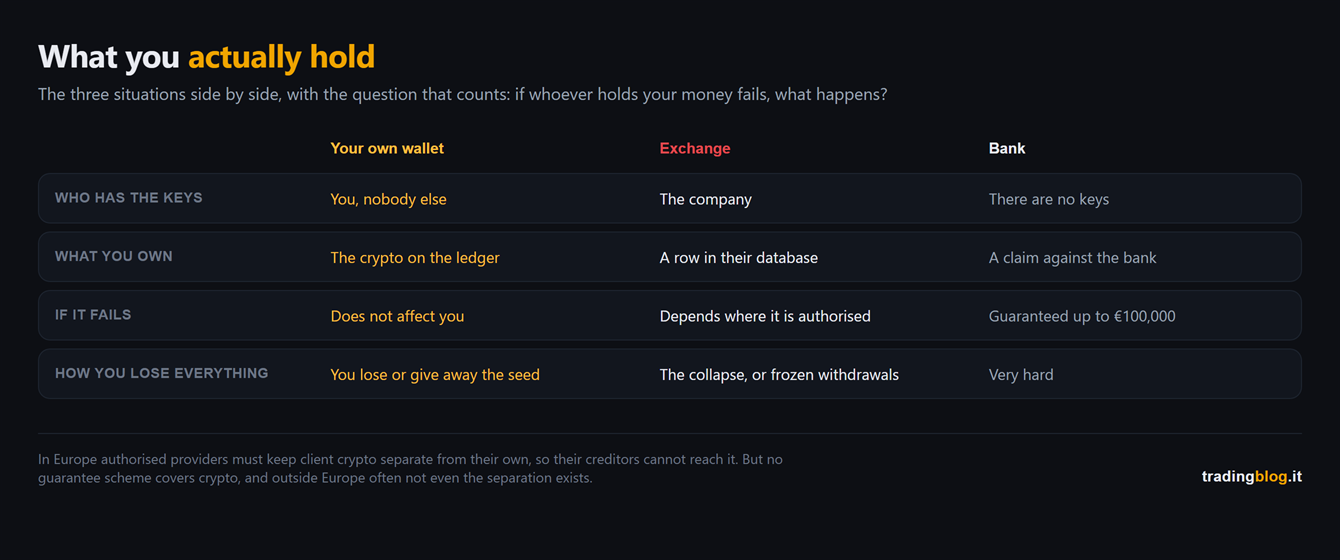
Table comparing a personal wallet, an exchange and a bank across four rows: who holds the keys, what you actually own, what happens if whoever holds the money fails, and how you can lose everything
What you actually hold in the three cases: crypto in your own wallet with your own keys, crypto on an exchange, money in a bank. For each one who holds the keys, what you legally own and what happens if whoever holds it fails.

How to choose one, and how to sit on it

I will never tell you which one to use, and be wary of anybody who does it lightly, because they almost always have an affiliate link in their pocket.

Here are the criteria.

Look at where it is regulated. Europe now has a framework of rules for anybody offering crypto services, and we covered it when it came into force, in the piece on MiCA and stablecoins. A provider authorised in Europe is not bulletproof, but it has obligations that one registered on an island does not.

Proof of reserves is not a promise of solvency. Many exchanges publish a check showing how much they hold. Careful though: it shows what they own, not what they owe, and at one precise instant. A company can have the reserves and have debts bigger than the reserves. It is useful, it is not a guarantee.

Turn on two step verification, but with an app, not with SMS. A phone number can be stolen by convincing the mobile operator to move it to another SIM, and it is a scam that has been going on for years.

And above all: keep on the exchange only what you need to operate. The rest you take out, where the keys are yours. This is the practical consequence of all three lessons so far.

Two clarifications though, because people make two opposite mistakes with this advice.

The first: it does not only apply to bitcoin. The balance almost everybody leaves sitting on an exchange is in euros or stablecoins, and the reasoning there is identical, with the added risk of whoever issues the stablecoin. Taking your crypto out and leaving the bulk inside in stablecoins is not securing anything.

The second: taking it out moves the risk, it does not delete it. Outside, the keys are yours, and so are the ways of losing them we saw last week. If you throw away the recovery phrase, there is not even a queue at the courthouse.

What you do from tomorrow morning

Two things, and the first one is a calculation that takes a minute.

Look at how much you have on the exchange and ask yourself: if they shut the site tomorrow morning, would this amount ruin me? If the answer is yes, that amount is too high, no matter how reliable the company seems to you.

Then make a small withdrawal to your own wallet. Not to move the money: to learn the procedure with pocket change, when you are not in a hurry and not scared. The day you actually want to do it will probably be a day when everybody is withdrawing at once, and that is not a good moment to learn.

And since it is the only irreversible thing I am asking you to do, three hard rules while you do it. Copy the address from the wallet, do not type it by hand. Check that the network selected on the exchange is the same one your wallet expects, because sending on the wrong network is the number one way money disappears on a first withdrawal. And after pasting, read the first and last characters again: there is malware that swaps the address in your clipboard while you copy it.

Where we go next time

So far we have talked about infrastructure: the ledger, the keys, the place where you buy. Next time we move on to what is inside, and to the first distinction that matters: bitcoin and ethereum are not two versions of the same thing, they are two different jobs.

On an exchange you do not have the keys. You have a company’s promise to give you your crypto when you ask for it.

tradingblog.itPosta su X

Let me close with the thing that convinced me to take out the money I do not use.

It was not fear of a collapse, and it is not distrust of any company in particular.

It was a question I asked myself looking at the screen: if this site does not open tomorrow, what do I have in my hands?

The answer was: a screenshot. And the screenshot is not yours.

Suerte Amigo!

Tiziano Brunno

Tradingblog

Want to put your market reading to the test?

Compete and challenge other traders inside an Arena in a demo environment, with no real capital at risk. Discover the Performance Arena Events by The Thunder Trader.

Discover The Thunder Trader →


Disclaimer: purely informational and educational content. It does not constitute financial advice or an invitation to trade. Trading involves the risk of capital loss.


Large ornate key made of amber light dissolving at one end into twelve small carved luminous tiles, floating above an open iron chest that is completely empty, on dark stone

Keys and wallets: what you actually own

Hi trader,

for more than a year I kept my crypto on an exchange and I was convinced I owned it.

I did not.

I had a number on a screen, which is a different thing, and I only realised it when I tried to work out what happens to that number if the company showing it to me shuts down.

This is the lesson that explained it to me. It is the second in the series, and if you missed the first one, what a blockchain is, read that first: here I take for granted that the ledger is made of rows and not of coins.

Ok, vamos.

The question nobody asks

If there are no coins on the ledger, only rows, and the rows are written by the network, then what exactly do you own?

Not an object. Not a file. Not a token inside an app.

You own the ability to sign. Meaning the ability to prove to the network that those rows can be moved by you and by nobody else.

That ability is a secret number, and it is called a private key.

What is inside a wallet

Here is the first misunderstanding to clear out, and the name itself does not help: wallet means wallet, but there is no money inside it.

There are keys.

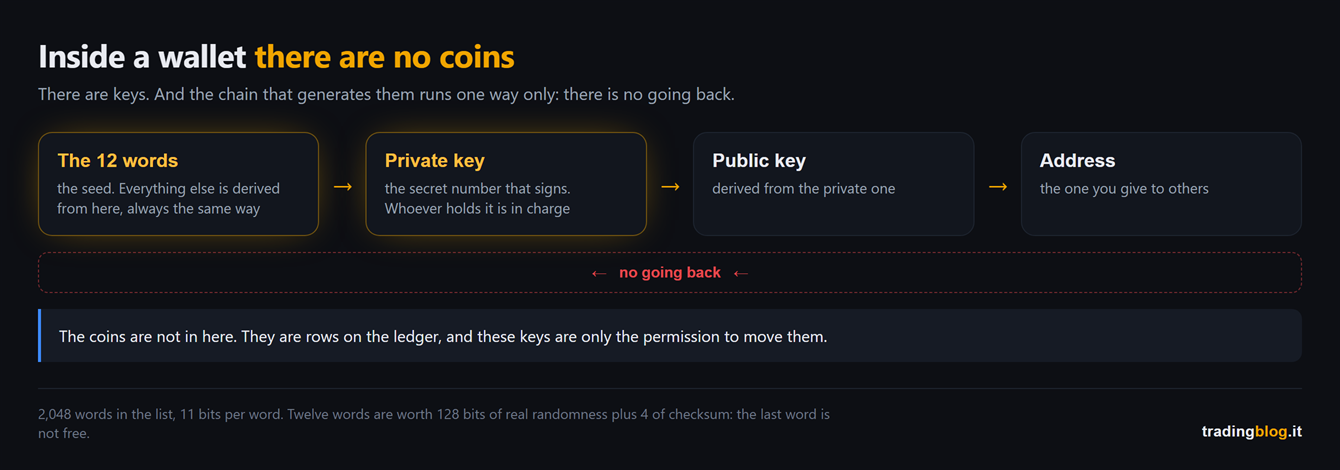
The mechanism runs one way, and this is the beautiful part. From the private key you derive the public key. From the public key you derive the address, the one you give to other people so they can send you things.

Every arrow works in one direction only. From the address you do not get back to the key, and it is not a question of how clever you are: with today’s computers the age of the universe would not be enough.

Four step chain starting from the twelve seed words and leading to the private key, then the public key and finally the address, with arrows running one way only and a warning that there is no going back, plus the note that the coins are not in the wallet but on the ledger
From the twelve word phrase you derive the private keys, from each of those the public key, and from that the address. The arrows run one way only: there is no going back. The coins are not inside the wallet, they are on the ledger.

So when you say “I moved my bitcoin into the wallet” you are saying something imprecise. The bitcoin did not move anywhere: they are still rows on the ledger. What changed is which key can move them.

The twelve words

Now the part that really counts.

When you open a new wallet, the first thing it makes you do is write down twelve words (sometimes twenty four). It is called the seed, or recovery phrase.

Those words are not a reminder of your password. They are the wallet.

From those twelve words the software derives, with a calculation that is always the same, all of your private keys. All of them. The ones you have now and the ones you will generate in two years.

Which means something very practical: the phone is irrelevant. If it gets stolen, you get another one, you type in the twelve words and you find everything exactly as it was. But if you lose the words and the phone breaks, there is no “I forgot my password” button. There is nobody to call. It is over, full stop.

One detail that shows how well designed this is: the words come from a fixed list of 2,048, and the last one is not free, it carries a check code calculated from the previous ones. Twelve words are worth 128 bits of real randomness, a number with thirty nine digits of possible combinations.

Guessing it is not hard. It is out of the question.

Get one thing into your head though: the words have to be generated by the device, not by your brain. The check on the last word rejects almost every invented phrase, but not all of them, and that is not the point anyway. A phrase thought up by a human being is guessable, because our imagination is far poorer than randomness, and over the years the people who tried it found their wallets emptied.

Two clarifications that are worth real money.

The first. Some wallets let you add a passphrase to the twelve words, an extra word of your own, what some people call the twenty fifth word. If you use it, the twelve words on their own no longer open anything, so it has to be kept as carefully as the rest. And be careful, because if you get it wrong it does not say “error”: it opens an empty wallet, which is the best possible way to give yourself a heart attack.

The second. If you restore your words into a different app from the one you started with and you see zero, almost always you have lost nothing: it is the app looking at a different branch of the same tree of keys. Before you panic, try again in the app you started from.

“Not your keys, not your coins”

You will hear this repeated like a prayer. Now you have what you need to understand it, and it takes two lines.

When you buy on an exchange, the keys are theirs. The number you see in your account area is not a row on the ledger: it is a row in the exchange’s database, saying how much they owe you.

You do not own bitcoin. You own a claim against a company.

As long as that company works, the two things look identical, which is why nobody thinks about it. The day it stops working, it turns out they were not identical at all.

I am not telling you exchanges are evil: you go through them to buy, it is normal, I use them too. The problem is not buying there. It is leaving there what you cannot afford to lose.

The three ways people lose everything

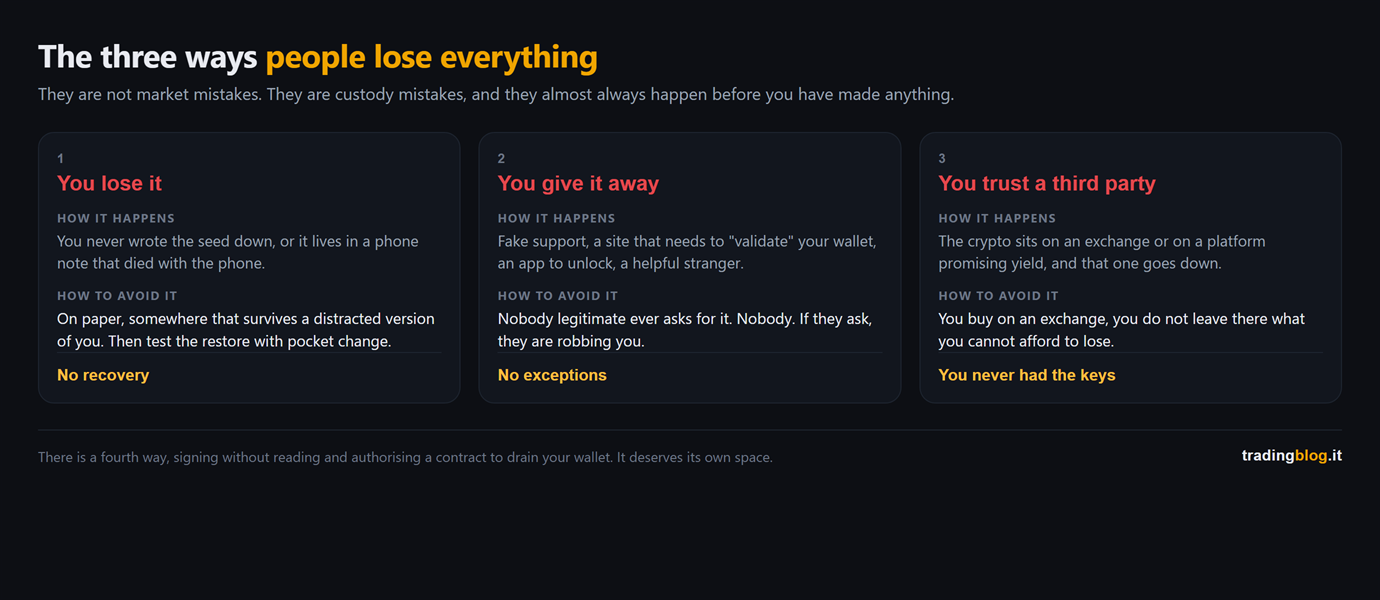
There are not a hundred of them. There are three, and they all look like a custody mistake, not a market one.

The three cards of the ways people lose everything: losing the seed, giving it away to whoever asks, and trusting a third party that goes down. For each one how it really happens, how to avoid it, and the blunt consequence
The three ways people lose everything, side by side: you lose the seed, you give the seed away, you trust a third party that goes down. For each one, what actually happens and the rule that avoids it.

One. You lose it. You never wrote it down, or you wrote it on a scrap of paper that got wet, or it lived in a phone note that died with the phone. No recovery possible. It is the stupidest way and also the most common.

Two. You give it away. And here you carve one rule into your head, and it holds forever: nobody legitimate will ever ask you for your seed. Not support, not a site that needs to “validate” your wallet, not a helpful person messaging you, not an app you have to unlock. Nobody. If somebody asks you for it, that person is robbing you, with no exceptions and no special cases.

Three. You trust a third party. The crypto sits on an exchange, or on a platform promising yield, and that one goes down. You did not lose your keys: you never had them.

There is a fourth way, subtler, which is signing without reading and authorising a contract to drain your wallet. We will cover it in the lesson on scams, because it deserves its own space.

What you do from tomorrow morning

Four things, in order, and the third one is the one almost nobody does.

Write the seed on paper. Not a photo, not the cloud, not your phone notes, not a message to yourself. Paper, somewhere that survives a distracted version of you.

And get clear on what you have just created: that piece of paper works like cash. Whoever finds it does not have to guess a password and does not have to break anything, they type in the words and take everything in two minutes, from anywhere in the world. So “somewhere safe” means actually safe, not the top drawer of your desk.

Do not tell it to anybody and do not type it anywhere, other than into the wallet itself when you are restoring.

Test the restore before you put anything serious in there. Put in pocket change, delete the app, install it again, restore with the words and see whether you find everything. It is the only way to know you wrote them down correctly, and finding out afterwards is too late.

If the amount starts to matter, get a dedicated device. The kind where the key never leaves the object and you confirm operations with a physical button. The right question is not “how much does it cost” but “how much am I keeping on it”.

On this one a hard rule though: buy it only from the manufacturer’s site. Never used, never from a marketplace, never from some guy online because it was cheaper. A tampered device arrives with the seed already written down by somebody else, and you pour your money onto it convinced you are safe. It is a scam that exists and that works.

Where we go next time

If the exchange’s keys are its own, then it is time to understand properly what an exchange is, how it really works and what happens if it fails. That is next week’s lesson, and anybody who lived through certain stories already knows why it matters.

A wallet does not hold coins. It holds the ability to sign, and either you have it or somebody else has it in your place.

tradingblog.itPosta su X

Let me close with the thing that sorted my head out on this subject.

In trading we spend our days worrying about market risk: the stop, the size, the drawdown. Then somebody keeps everything on an exchange and never thinks about it, because that risk does not flash on the screen.

But it is a risk like any other, and it has one nasty feature: it does not make you lose a percentage.

It makes you lose everything, all at once.

Suerte Amigo!

Tiziano Brunno

Tradingblog

Want to put your market reading to the test?

Compete and challenge other traders inside an Arena in a demo environment, with no real capital at risk. Discover the Performance Arena Events by The Thunder Trader.

Discover The Thunder Trader →


Disclaimer: purely informational and educational content. It does not constitute financial advice or an invitation to trade. Trading involves the risk of capital loss.
Long row of identical stone slabs lit in amber, lined up in the dark like the pages of an endless ledger, each one carved with the same mark as the one before it

What a blockchain is, without the hype

Hi trader,

let me start with a confession that makes me look like an idiot.

I bought my first crypto without the faintest idea of what a blockchain was.

I knew it was going up. That was enough.

It is like driving for years without knowing there is an engine under the bonnet: as long as everything works, you don’t need to know. The day it stops in the middle of the road, though, you are the guy standing there waiting for somebody to explain what happened.

So this piece starts a series. Eight lessons, one a week, Monday morning, from the ground up.

No formulas. No untranslated jargon. Only the things that, if you don’t know them, sooner or later cost you money.

Ok, vamos.

The problem somebody was trying to solve

Forget the word blockchain for a second and think about something banal: how do you send a hundred euros to a friend?

You go to the bank, or you open the app. And the bank does exactly one thing: it writes on a ledger that you have a hundred euros less and your friend has a hundred more.

Nothing physical moves. A line gets updated.

Which means whoever holds the ledger is in charge. They can freeze you, they can get it wrong, they can decide that today you are not a likeable person.

The question somebody asked was: can you keep a ledger without there being an owner of the ledger?

A blockchain is the answer to that question. That is all it is.

What it is, in one line

It is a public ledger, copied identically onto thousands of computers around the world, that anyone can read and nobody can correct on their own.

Read the three parts again, because they are the whole lesson: public, copied, not correctable.

There is no safe inside it. There are no digital gold coins parked somewhere. There are lines, exactly like at the bank.

The difference is who keeps them and how they agree with each other.

Why it cannot be rigged

Here is the most common misunderstanding, and I fell for it too: people think it is secure because it is “encrypted”.

That is not the reason. The reason is far more agricultural.

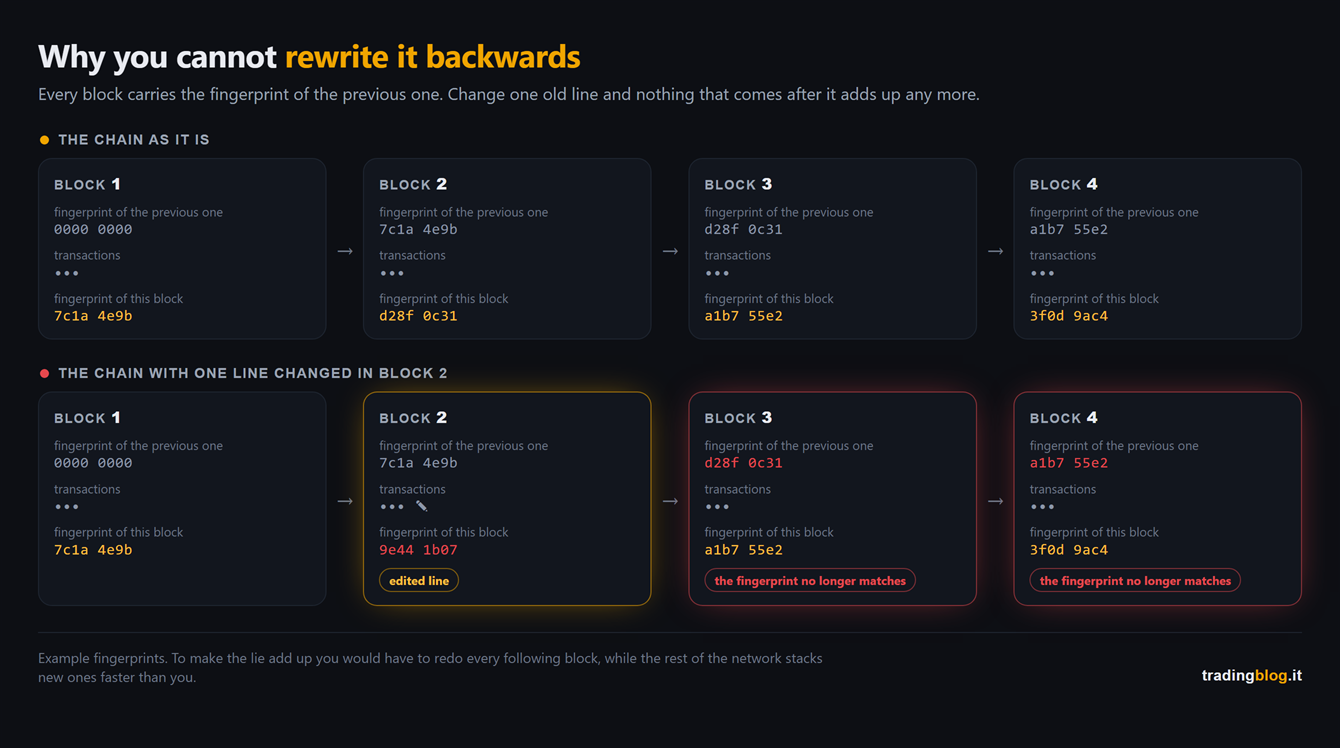
First: it is copied. If I edit my copy of the ledger to give myself a thousand bitcoin, my version no longer matches the other thousands in circulation. When the network compares, mine gets thrown out like a fake note among ten thousand real ones. Nobody needs to catch me: it catches itself.

Second: it is chained. Transactions get grouped into blocks, and every block carries inside it the fingerprint of the previous one. It is like a stack of sheets where every sheet has the exact summary of the sheet below written at the top.

Now try changing a line on a sheet from three months ago.

That sheet’s fingerprint changes, so the sheet above it no longer adds up. And so neither does the one above that. To make the lie work you would have to redo every sheet that came after, while the rest of the world keeps stacking new ones faster than you can.

Two chains of four blocks compared: on top the intact chain, where the fingerprint written in each block matches the previous one, below the same chain with one line edited in block 2, where the fingerprint changes and every following block no longer adds up
A chain of four blocks, each carrying the fingerprint of the previous one. Below, the same chain with one line edited in the second block: the fingerprint no longer matches and every following block becomes invalid.

That is why it is called a chain of blocks. For once, the name says exactly what the thing does.

Security is not in the secret. It is in the repetition and the comparison.

And now the bill

This is the part the dream sellers skip, and it is the one that explains half of what you see happening.

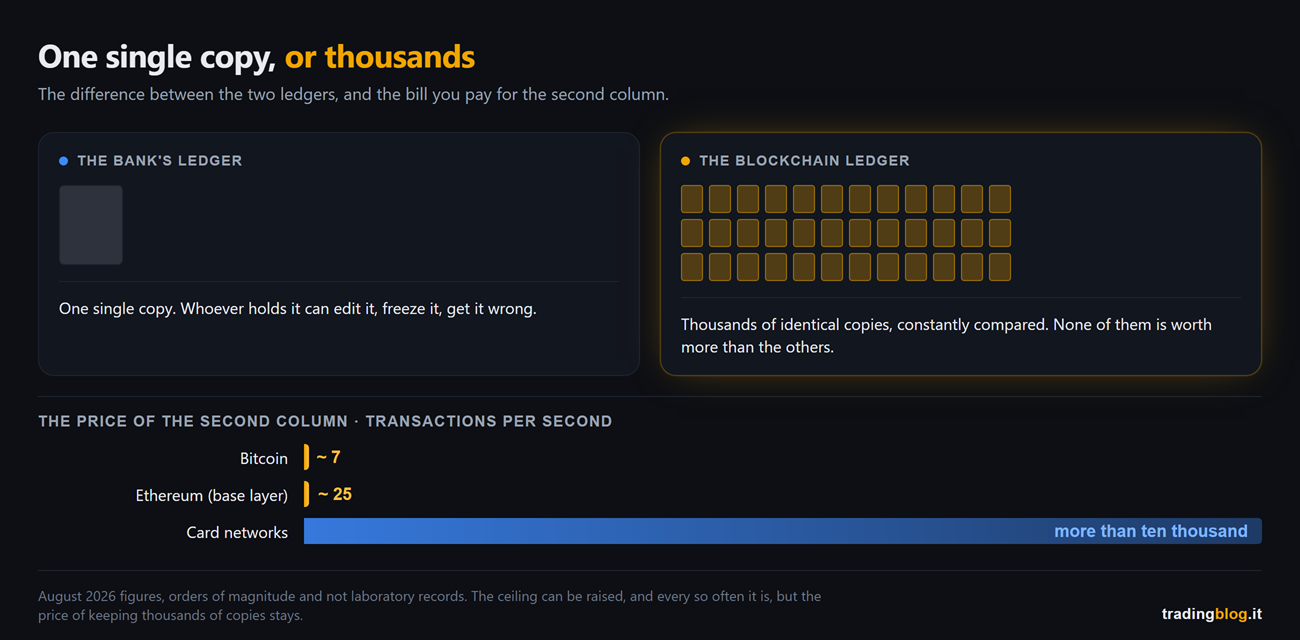
Keeping thousands of copies of the same ledger, and making them agree continuously, is monstrously inefficient.

The ceiling can be raised, and every so often they do raise it. But the underlying price stays: you pay in slowness and in fees what you save in trust.

Look at the numbers, they explain it better than a thousand words.

Bitcoin handles roughly 7 transactions per second, and a new block comes out about every ten minutes.

Ethereum, on its base layer, sits around 25, already double what it was two years ago because the per block ceiling was raised.

Card networks chew through more than ten thousand per second on average, and far more at peak.

These are August 2026 numbers: this stuff ages fast, so take them with the date attached.

Comparison between the bank ledger, a single copy held by one owner, and the blockchain ledger, dozens of identical copies constantly compared, with transactions per second in August 2026 underneath: about 7 for bitcoin, about 25 for ethereum, more than ten thousand for the card networks
Comparison between the bank’s ledger, a single copy held by one owner, and the blockchain’s ledger, thousands of identical copies compared with each other. Underneath, transactions per second: about 7 for bitcoin, about 25 for ethereum, more than ten thousand for the card networks.

These are not numbers meant to say “blockchain is rubbish”. They are numbers to tell you that it is a tool with a specific job, and that job is not buying coffee.

You use a ledger with no owner when the owner is exactly the problem you want out of the way. For everything else, a credit card works perfectly well and costs less.

The three things that become useful tomorrow

Fine, so what changes in practice for you, someone who maybe just buys the stuff?

One. Now you know why fees swing. On bitcoin space in a block is limited and only one comes out every ten minutes. When there is a queue an auction decides who gets in, and whoever pays more per byte taken up goes first, not whoever pays more in absolute terms. On ethereum the mechanism is different, the base price is set by the protocol, but for you the substance is the same: when there is traffic you pay more.

Two consequences worth money. First: the fee does not depend on how much you send. Moving ten euros and moving ten million costs the same, because you pay for the weight of the transaction, not the value. Second: the network fee is not set by the exchange, but the withdrawal fee it charges you is another thing entirely, often fixed and often far higher than the real cost. Go and check that one.

Two. Now you know why that transfer says “pending”. It is not travelling anywhere. It is in a queue, waiting for somebody to slot it into a block.

Three, and this is the most important one of all. A confirmed transaction cannot be reversed. There is no complaints department. If you get scammed, if you click the wrong thing at two in the morning, or if you send on the wrong network, that money is simply gone.

On a single wrong character you are actually covered: addresses have a check code inside them and the wallet stops you before it sends. On the network, no. When you withdraw from an exchange a dropdown asks you which network to send on, and getting that dropdown wrong is the number one way a beginner burns money on their first transfer.

The very same property that makes the ledger impossible to rig, short of holding more computing power than the rest of the network put together, makes it impossible to correct when you are the one making the mistake.

And here is a distinction almost nobody makes: what cannot be rigged is the ledger. Everything sitting on top of it and around it, exchanges, wallets, contracts, bridges between chains, gets broken into regularly. When you read about an exchange being cleaned out, it is not the blockchain that gave way.

In trading, that is the one line in this whole piece that can save you real money.

Where we go next time

If the ledger has no owner, the next question comes by itself: how does the ledger know that a line was written by you and not by me?

That is where keys come in, and it is next week’s lesson. It is also the one where you find out what “not your keys, not your coins” actually means, a sentence everybody repeats and few have understood.

If instead you already want a look at what moves the price of this stuff, I wrote about it in bitcoin and ETF flows, which is a different planet from this lesson but it is where these conversations end up.

A blockchain is not secure because it is secret. It is secure because it is copied, and that same copying is why it is slow and expensive.

tradingblog.itPosta su X

Let me close with the thing I repeat to myself every time somebody tries to sell me the word blockchain as if it were magic.

It is not magic. It is an accounting ledger with a common sense rule inside it: if many people hold it and compare it constantly, nobody can rewrite it in secret.

Everything else, decentralised finance, tokens, stablecoins, sits on top of that one line.

And when somebody explains the stuff on top without ever having explained this, it is usually because they have something to sell you.

Suerte Amigo!

Tiziano Brunno

Tradingblog

Want to put your market reading to the test?

Compete and challenge other traders inside an Arena in a demo environment, with no real capital at risk. Discover the Performance Arena Events by The Thunder Trader.

Discover The Thunder Trader →


Disclaimer: purely informational and educational content. It does not constitute financial advice or an invitation to trade. Trading involves the risk of capital loss.
Huge dim reservoir: a dark silent torrent pours out through a breach in the wall, while from a small pipe on the opposite side a thin thread of glowing amber liquid trickles in, tiny by comparison

The flip happened, just not where you were looking

Hi trader,

back in mid July I left you with an open question.

Is Ethereum the unlucky brother who missed the train, or a compressed spring ready to snap?

Well, part of the answer has arrived. And as usual it did not arrive where we were all looking.

The headline you read

For the first time since they exist, ETFs on ether collected more in a month than ETFs on bitcoin.

The headline has been going around for weeks, in English and in Italian, almost always with the same word: flip.

And it is true. It is not a hoax, the data is there.

The problem is that the headline stops there, and the number keeps going.

Now let’s open the number up

July 2026. Here are the two figures, side by side.

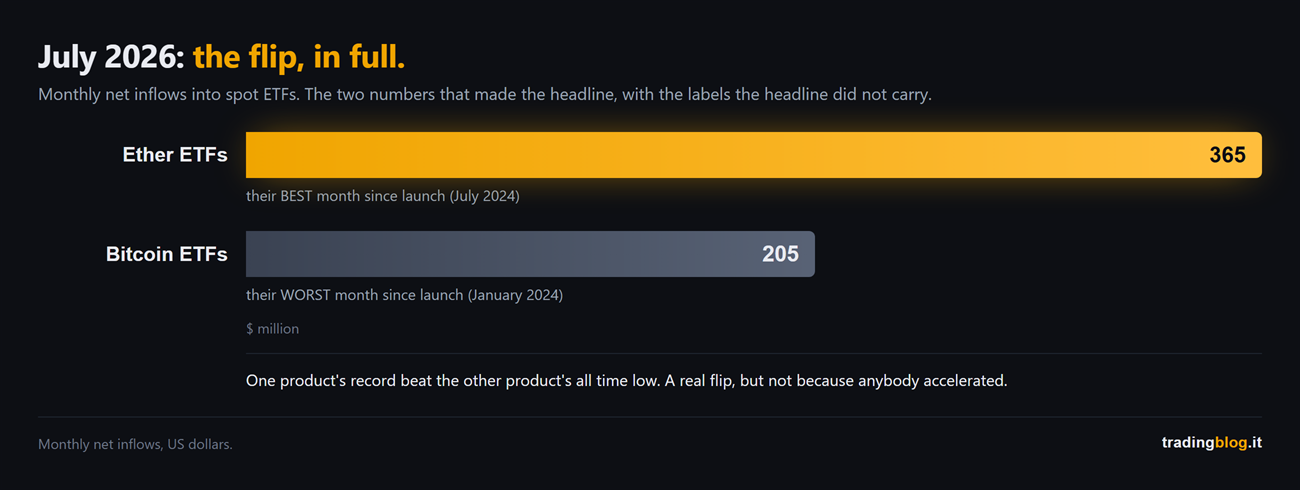
Ether ETFs: 365 million dollars of net inflows.

Bitcoin ETFs: 205 million.

A flip, indeed. Now look at the two labels nobody put underneath.

Those 365 million are ether’s best month since its ETFs exist, meaning since July 2024.

Those 205 million are bitcoin’s worst month since its ETFs exist.

Bar chart of July 2026 net inflows: ether ETFs at 365 million dollars, their best month since July 2024, against bitcoin ETFs at 205 million, their worst month ever
The two bars of July 2026 net inflows, ether ETFs at 365 million against bitcoin ETFs at 205 million, with the two labels underneath: for ether it is the best month ever, for bitcoin the worst ever.

Read that sentence again, because everything is in there.

One product’s record beat the other product’s all time low.

It is not the Ferrari that overtook the McLaren down the straight. It is the McLaren that stopped in the pits, and the Ferrari, going at its own top speed, found itself in front.

It is still an overtake. But if you bet on the driver for the wrong reason, next lap you get surprised.

And the price, what does it say?

Here comes the part I actually care about, because it is the part that touches your account.

If flows are in charge, and ether won the month on flows, ether should be flying.

Ether, in mid August, sits just above 1,900 dollars.

The 2025 peak was around 5,000.

Bitcoin meanwhile sits around 64,000, against a high of 126,080 reached in October 2025.

So the flow won and the price did not notice.

That is not a freak event, and it is exactly the same family of things we have been talking about on this blog for a month. What moves your chart often is not on your chart, and when you finally manage to see it, you find out it is smaller than they told you.

The reason is banal: proportions

Three hundred and sixty five million dollars sound like a lot because we reason with our salary in mind.

On ether’s market, which capitalises hundreds of billions, that is a tap. It is not a dam.

There are single ugly sessions where more value than that moves on ether in a few hours.

So the right question is never “how much came in?”.

It is “how much came in compared to what?”.

And here is the number nobody made a headline out of, which is by far the biggest in the whole story.

The real number, the one with no headline

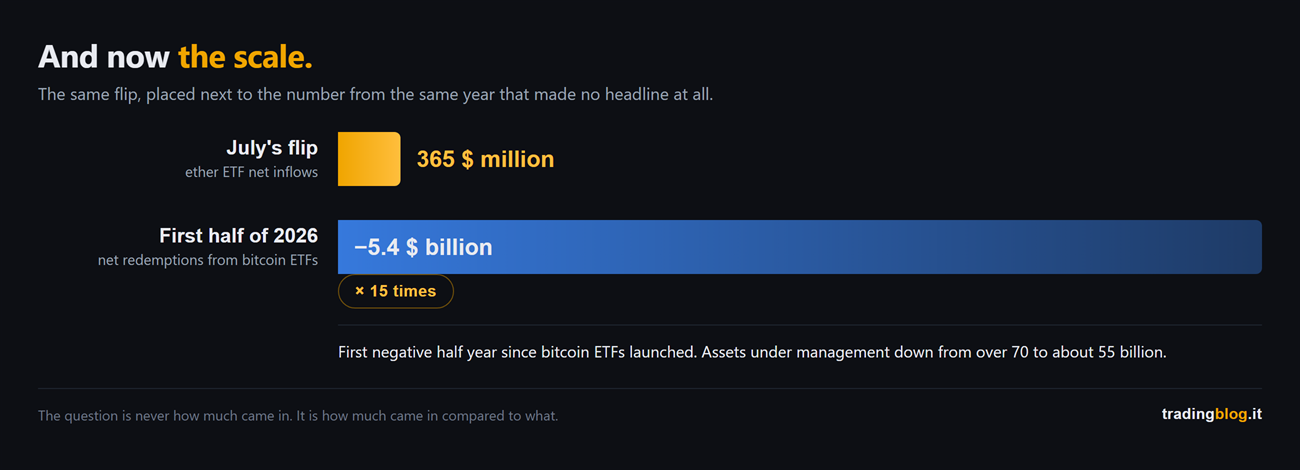
In the first half of 2026 bitcoin ETFs lost 5.4 billion dollars net.

It is the first half year in the red since they exist, meaning since January 2024.

Assets under management fell from over 70 billion to roughly 55 by the end of June.

Scale comparison between the 365 million dollars collected by ether ETFs in July 2026 and the 5.4 billion net that left bitcoin ETFs in the first half of the same year: the first bar is fifteen times smaller
Scale comparison between the 365 million collected by ether ETFs in July and the 5.4 billion net that left bitcoin ETFs in the first half of 2026. The first bar is fifteen times smaller.

Look at the figure and hold on to that proportion, because it is worth more than ten articles.

The “flip” worth 365 million is fifteen times smaller than the river that had been flowing out of the other side in the meantime.

One made the news. The other did not.

And it always works that way, by the way: the news is the rare event, the big number is the boredom nobody reports.

Where the flip is actually real

Now let me tell you the one thing in this piece you can use.

If you take the price of ether and divide it by the price of bitcoin, you get the famous ETH/BTC ratio. It is the clean way of asking which of the two is doing better, without the dollar dirtying your reasoning.

That ratio, back in May, sat around 0.024.

It now sits around 0.030.

There is your flip. It is there, not in the dollar price.

Ether gained roughly a quarter against bitcoin, and over the same period it lost value against the dollar. The two things sit together perfectly well, because they are two different bets.

And this is the real operational lesson, which has nothing to do with crypto and everything to do with any market you touch:

if you buy A because you think it will beat B, the right bet is A against B, not A against the dollar.

Whoever went long ether against bitcoin in May was right and took it home.

Whoever went long ether and nothing else had the exact same insight, was right on the thesis, and lost money anyway.

If one sentence survives this article, make it that one.

The explanation going around, and how much I buy it

The people who do this for a living tell it roughly like this: whoever sells bitcoin ETFs is selling exposure to a store of value that was not storing value, while whoever buys ether ETFs is buying an infrastructure that yields something, between 2 and 2.6 per cent net from staking, and on which stablecoins settle.

It is a coherent explanation. I quite like it too.

But let’s agree on what it is: it is a narrative that fits the data well, not a proof.

Narratives that fit the data well are the most dangerous ones out there, because they look like understanding when they are only telling the story backwards. If the ratio goes back to 0.024 tomorrow, all of us, me included, will find an equally elegant reason to explain it.

And August?

I am not going to comment on August, and I’ll tell you why.

In the first week of the month bitcoin ETFs collected over 750 million.

In the week around mid August almost 390 million left.

Two opposite headlines, both of them true, eight days apart.

Anyone quoting you a single week to prove that money is coming in, or going out, is picking the week that suits them.

It is the exact same flaw as the statistic I was talking about on Wednesday about levels: a figure without the period it was built from is not data, it is a position dressed up as data.

If you want to watch flows, watch them by month and by half year. Below that threshold it is noise, and noise makes you enter badly.

What I actually do with it

Not much, and let me be honest about it.

ETF flows are slow context. They tell you who is quietly accumulating over quarters, not whether you buy or sell tomorrow morning.

Asking flows for timing is like asking the clock in your living room what the weather is like outside.

What does change things, if you touch the crypto world at all, is size. Because here the “worst month ever” and the “best month ever” sit inside the same quarter, and the volatility behind those headlines is the same one that liquidates you at night while you sleep.

If you trade this with leverage, do the size calculation before you enter and keep it small: I put the Crypto Risk Manager online exactly for that, it is free and it tells you in ten seconds how much you can afford to be wrong by.

It is not the tool that makes you money. It is the one that keeps you at the table long enough for your thesis, if it is right, to have the time to become right.

Let me close where I opened

In July the question was: unlucky brother or compressed spring?

Today’s honest answer is a spring that is loading, but only slightly, and against bitcoin, not against the dollar.

The flip on flows is real and it is the first time. But it happened at all time lows for both of them, inside a half year in which billions left the sector, and the dollar price did not even wave at it.

If you want the full picture, the July piece on ether still stands on its premises, and the one on bitcoin and ETF flows is the frame right before this one.

An overtake at the lows of both is not a race won. It is a race where only one of the two stopped running.

tradingblog.itPosta su X

And the moral, which is always the same one since I started writing on this blog.

Headlines give you the verb. Numbers give you the subject and the object.

If you only read the verb, you know something happened and you know neither to whom nor how much, and that is the stuff you go and open positions with.

Suerte Amigo!

Tiziano Brunno

Tradingblog

Want to put your market reading to the test?

Compete and challenge other traders inside an Arena in a demo environment, with no real capital at risk. Discover the Performance Arena Events by The Thunder Trader.

Discover The Thunder Trader →


Disclaimer: purely informational and educational content. It does not constitute financial advice or an invitation to trade. Trading involves the risk of capital loss. Flow data quoted is current as of 18 August 2026.