
What a blockchain is, without the hype
Hi trader,
let me start with a confession that makes me look like an idiot.
I bought my first crypto without the faintest idea of what a blockchain was.
I knew it was going up. That was enough.
It is like driving for years without knowing there is an engine under the bonnet: as long as everything works, you don’t need to know. The day it stops in the middle of the road, though, you are the guy standing there waiting for somebody to explain what happened.
So this piece starts a series. Eight lessons, one a week, Monday morning, from the ground up.
No formulas. No untranslated jargon. Only the things that, if you don’t know them, sooner or later cost you money.
Ok, vamos.
The problem somebody was trying to solve
Forget the word blockchain for a second and think about something banal: how do you send a hundred euros to a friend?
You go to the bank, or you open the app. And the bank does exactly one thing: it writes on a ledger that you have a hundred euros less and your friend has a hundred more.
Nothing physical moves. A line gets updated.
Which means whoever holds the ledger is in charge. They can freeze you, they can get it wrong, they can decide that today you are not a likeable person.
The question somebody asked was: can you keep a ledger without there being an owner of the ledger?
A blockchain is the answer to that question. That is all it is.
What it is, in one line
It is a public ledger, copied identically onto thousands of computers around the world, that anyone can read and nobody can correct on their own.
Read the three parts again, because they are the whole lesson: public, copied, not correctable.
There is no safe inside it. There are no digital gold coins parked somewhere. There are lines, exactly like at the bank.
The difference is who keeps them and how they agree with each other.
Why it cannot be rigged
Here is the most common misunderstanding, and I fell for it too: people think it is secure because it is “encrypted”.
That is not the reason. The reason is far more agricultural.
First: it is copied. If I edit my copy of the ledger to give myself a thousand bitcoin, my version no longer matches the other thousands in circulation. When the network compares, mine gets thrown out like a fake note among ten thousand real ones. Nobody needs to catch me: it catches itself.
Second: it is chained. Transactions get grouped into blocks, and every block carries inside it the fingerprint of the previous one. It is like a stack of sheets where every sheet has the exact summary of the sheet below written at the top.
Now try changing a line on a sheet from three months ago.
That sheet’s fingerprint changes, so the sheet above it no longer adds up. And so neither does the one above that. To make the lie work you would have to redo every sheet that came after, while the rest of the world keeps stacking new ones faster than you can.
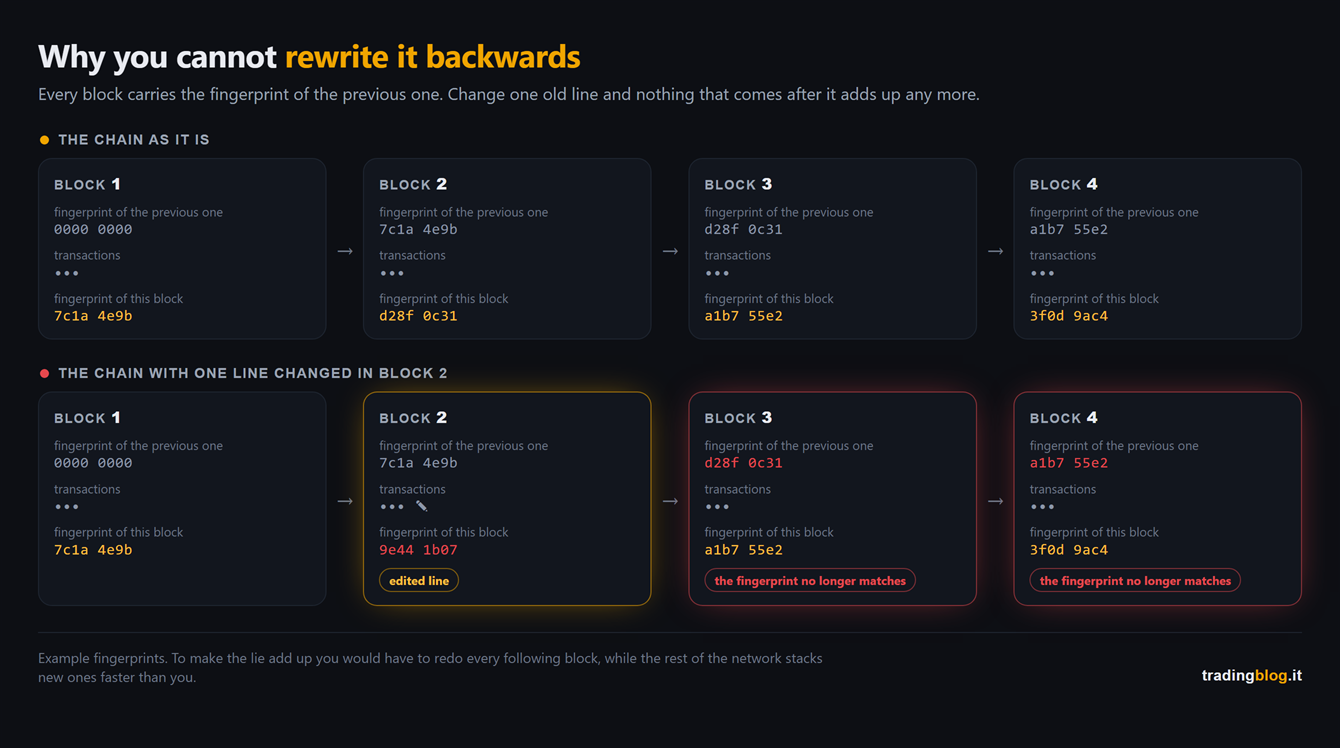
That is why it is called a chain of blocks. For once, the name says exactly what the thing does.
Security is not in the secret. It is in the repetition and the comparison.
And now the bill
This is the part the dream sellers skip, and it is the one that explains half of what you see happening.
Keeping thousands of copies of the same ledger, and making them agree continuously, is monstrously inefficient.
The ceiling can be raised, and every so often they do raise it. But the underlying price stays: you pay in slowness and in fees what you save in trust.
Look at the numbers, they explain it better than a thousand words.
Bitcoin handles roughly 7 transactions per second, and a new block comes out about every ten minutes.
Ethereum, on its base layer, sits around 25, already double what it was two years ago because the per block ceiling was raised.
Card networks chew through more than ten thousand per second on average, and far more at peak.
These are August 2026 numbers: this stuff ages fast, so take them with the date attached.
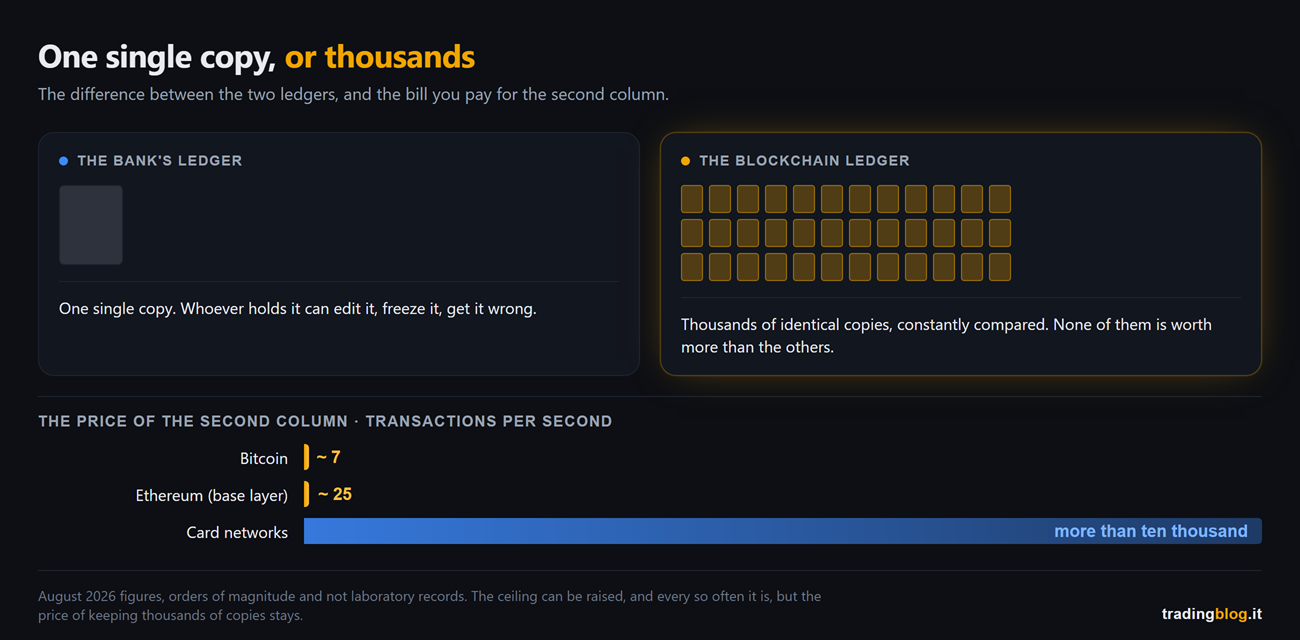
These are not numbers meant to say “blockchain is rubbish”. They are numbers to tell you that it is a tool with a specific job, and that job is not buying coffee.
You use a ledger with no owner when the owner is exactly the problem you want out of the way. For everything else, a credit card works perfectly well and costs less.
The three things that become useful tomorrow
Fine, so what changes in practice for you, someone who maybe just buys the stuff?
One. Now you know why fees swing. On bitcoin space in a block is limited and only one comes out every ten minutes. When there is a queue an auction decides who gets in, and whoever pays more per byte taken up goes first, not whoever pays more in absolute terms. On ethereum the mechanism is different, the base price is set by the protocol, but for you the substance is the same: when there is traffic you pay more.
Two consequences worth money. First: the fee does not depend on how much you send. Moving ten euros and moving ten million costs the same, because you pay for the weight of the transaction, not the value. Second: the network fee is not set by the exchange, but the withdrawal fee it charges you is another thing entirely, often fixed and often far higher than the real cost. Go and check that one.
Two. Now you know why that transfer says “pending”. It is not travelling anywhere. It is in a queue, waiting for somebody to slot it into a block.
Three, and this is the most important one of all. A confirmed transaction cannot be reversed. There is no complaints department. If you get scammed, if you click the wrong thing at two in the morning, or if you send on the wrong network, that money is simply gone.
On a single wrong character you are actually covered: addresses have a check code inside them and the wallet stops you before it sends. On the network, no. When you withdraw from an exchange a dropdown asks you which network to send on, and getting that dropdown wrong is the number one way a beginner burns money on their first transfer.
The very same property that makes the ledger impossible to rig, short of holding more computing power than the rest of the network put together, makes it impossible to correct when you are the one making the mistake.
And here is a distinction almost nobody makes: what cannot be rigged is the ledger. Everything sitting on top of it and around it, exchanges, wallets, contracts, bridges between chains, gets broken into regularly. When you read about an exchange being cleaned out, it is not the blockchain that gave way.
In trading, that is the one line in this whole piece that can save you real money.
Where we go next time
If the ledger has no owner, the next question comes by itself: how does the ledger know that a line was written by you and not by me?
That is where keys come in, and it is next week’s lesson. It is also the one where you find out what “not your keys, not your coins” actually means, a sentence everybody repeats and few have understood.
If instead you already want a look at what moves the price of this stuff, I wrote about it in bitcoin and ETF flows, which is a different planet from this lesson but it is where these conversations end up.
A blockchain is not secure because it is secret. It is secure because it is copied, and that same copying is why it is slow and expensive.
Let me close with the thing I repeat to myself every time somebody tries to sell me the word blockchain as if it were magic.
It is not magic. It is an accounting ledger with a common sense rule inside it: if many people hold it and compare it constantly, nobody can rewrite it in secret.
Everything else, decentralised finance, tokens, stablecoins, sits on top of that one line.
And when somebody explains the stuff on top without ever having explained this, it is usually because they have something to sell you.
Suerte Amigo!
Tiziano Brunno
Tradingblog
Want to put your market reading to the test?
Compete and challenge other traders inside an Arena in a demo environment, with no real capital at risk. Discover the Performance Arena Events by The Thunder Trader.
Disclaimer: purely informational and educational content. It does not constitute financial advice or an invitation to trade. Trading involves the risk of capital loss.