Posts

Huge dim reservoir: a dark silent torrent pours out through a breach in the wall, while from a small pipe on the opposite side a thin thread of glowing amber liquid trickles in, tiny by comparison

The flip happened, just not where you were looking

Hi trader,

back in mid July I left you with an open question.

Is Ethereum the unlucky brother who missed the train, or a compressed spring ready to snap?

Well, part of the answer has arrived. And as usual it did not arrive where we were all looking.

The headline you read

For the first time since they exist, ETFs on ether collected more in a month than ETFs on bitcoin.

The headline has been going around for weeks, in English and in Italian, almost always with the same word: flip.

And it is true. It is not a hoax, the data is there.

The problem is that the headline stops there, and the number keeps going.

Now let’s open the number up

July 2026. Here are the two figures, side by side.

Ether ETFs: 365 million dollars of net inflows.

Bitcoin ETFs: 205 million.

A flip, indeed. Now look at the two labels nobody put underneath.

Those 365 million are ether’s best month since its ETFs exist, meaning since July 2024.

Those 205 million are bitcoin’s worst month since its ETFs exist.
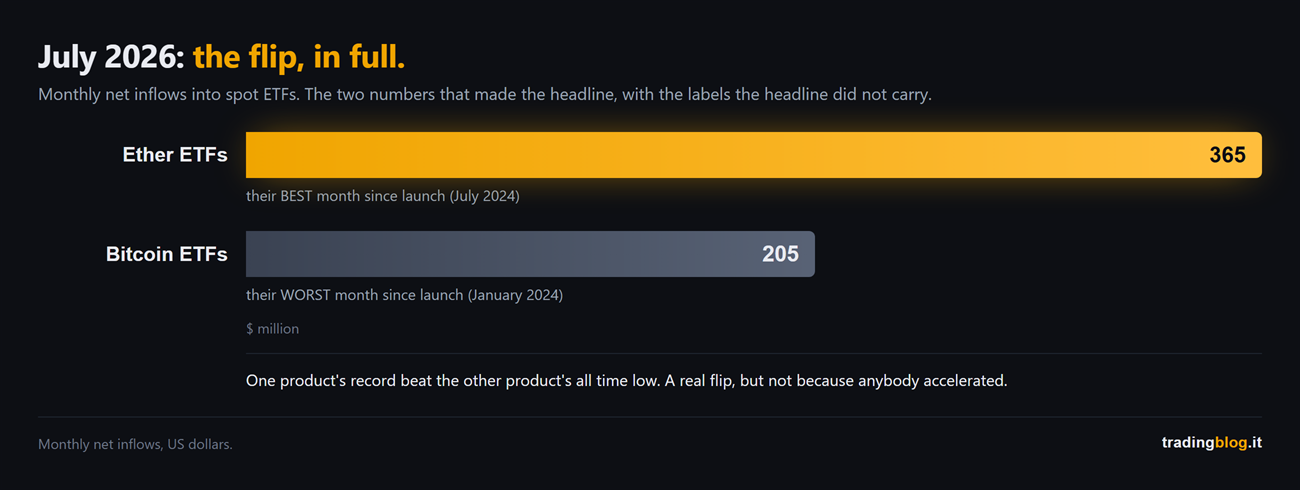
Bar chart of July 2026 net inflows: ether ETFs at 365 million dollars, their best month since July 2024, against bitcoin ETFs at 205 million, their worst month ever
The two bars of July 2026 net inflows, ether ETFs at 365 million against bitcoin ETFs at 205 million, with the two labels underneath: for ether it is the best month ever, for bitcoin the worst ever.

Read that sentence again, because everything is in there.

One product’s record beat the other product’s all time low.

It is not the Ferrari that overtook the McLaren down the straight. It is the McLaren that stopped in the pits, and the Ferrari, going at its own top speed, found itself in front.

It is still an overtake. But if you bet on the driver for the wrong reason, next lap you get surprised.

And the price, what does it say?

Here comes the part I actually care about, because it is the part that touches your account.

If flows are in charge, and ether won the month on flows, ether should be flying.

Ether, in mid August, sits just above 1,900 dollars.

The 2025 peak was around 5,000.

Bitcoin meanwhile sits around 64,000, against a high of 126,080 reached in October 2025.

So the flow won and the price did not notice.

That is not a freak event, and it is exactly the same family of things we have been talking about on this blog for a month. What moves your chart often is not on your chart, and when you finally manage to see it, you find out it is smaller than they told you.

The reason is banal: proportions

Three hundred and sixty five million dollars sound like a lot because we reason with our salary in mind.

On ether’s market, which capitalises hundreds of billions, that is a tap. It is not a dam.

There are single ugly sessions where more value than that moves on ether in a few hours.

So the right question is never “how much came in?”.

It is “how much came in compared to what?”.

And here is the number nobody made a headline out of, which is by far the biggest in the whole story.

The real number, the one with no headline

In the first half of 2026 bitcoin ETFs lost 5.4 billion dollars net.

It is the first half year in the red since they exist, meaning since January 2024.

Assets under management fell from over 70 billion to roughly 55 by the end of June.
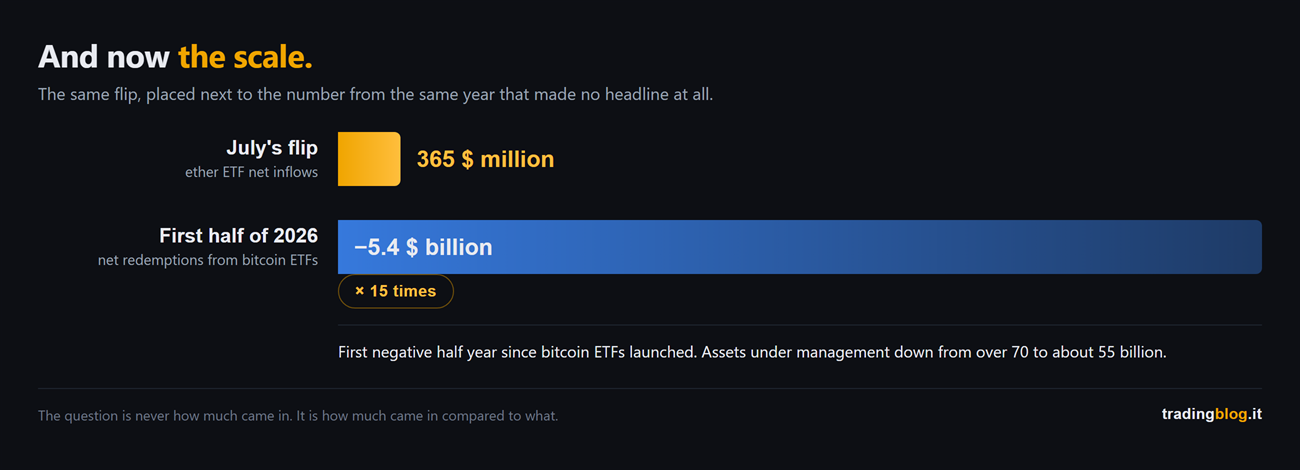
Scale comparison between the 365 million dollars collected by ether ETFs in July 2026 and the 5.4 billion net that left bitcoin ETFs in the first half of the same year: the first bar is fifteen times smaller
Scale comparison between the 365 million collected by ether ETFs in July and the 5.4 billion net that left bitcoin ETFs in the first half of 2026. The first bar is fifteen times smaller.

Look at the figure and hold on to that proportion, because it is worth more than ten articles.

The “flip” worth 365 million is fifteen times smaller than the river that had been flowing out of the other side in the meantime.

One made the news. The other did not.

And it always works that way, by the way: the news is the rare event, the big number is the boredom nobody reports.

Where the flip is actually real

Now let me tell you the one thing in this piece you can use.

If you take the price of ether and divide it by the price of bitcoin, you get the famous ETH/BTC ratio. It is the clean way of asking which of the two is doing better, without the dollar dirtying your reasoning.

That ratio, back in May, sat around 0.024.

It now sits around 0.030.

There is your flip. It is there, not in the dollar price.

Ether gained roughly a quarter against bitcoin, and over the same period it lost value against the dollar. The two things sit together perfectly well, because they are two different bets.

And this is the real operational lesson, which has nothing to do with crypto and everything to do with any market you touch:

if you buy A because you think it will beat B, the right bet is A against B, not A against the dollar.

Whoever went long ether against bitcoin in May was right and took it home.

Whoever went long ether and nothing else had the exact same insight, was right on the thesis, and lost money anyway.

If one sentence survives this article, make it that one.

The explanation going around, and how much I buy it

The people who do this for a living tell it roughly like this: whoever sells bitcoin ETFs is selling exposure to a store of value that was not storing value, while whoever buys ether ETFs is buying an infrastructure that yields something, between 2 and 2.6 per cent net from staking, and on which stablecoins settle.

It is a coherent explanation. I quite like it too.

But let’s agree on what it is: it is a narrative that fits the data well, not a proof.

Narratives that fit the data well are the most dangerous ones out there, because they look like understanding when they are only telling the story backwards. If the ratio goes back to 0.024 tomorrow, all of us, me included, will find an equally elegant reason to explain it.

And August?

I am not going to comment on August, and I’ll tell you why.

In the first week of the month bitcoin ETFs collected over 750 million.

In the week around mid August almost 390 million left.

Two opposite headlines, both of them true, eight days apart.

Anyone quoting you a single week to prove that money is coming in, or going out, is picking the week that suits them.

It is the exact same flaw as the statistic I was talking about on Wednesday about levels: a figure without the period it was built from is not data, it is a position dressed up as data.

If you want to watch flows, watch them by month and by half year. Below that threshold it is noise, and noise makes you enter badly.

What I actually do with it

Not much, and let me be honest about it.

ETF flows are slow context. They tell you who is quietly accumulating over quarters, not whether you buy or sell tomorrow morning.

Asking flows for timing is like asking the clock in your living room what the weather is like outside.

What does change things, if you touch the crypto world at all, is size. Because here the “worst month ever” and the “best month ever” sit inside the same quarter, and the volatility behind those headlines is the same one that liquidates you at night while you sleep.

If you trade this with leverage, do the size calculation before you enter and keep it small: I put the Crypto Risk Manager online exactly for that, it is free and it tells you in ten seconds how much you can afford to be wrong by.

It is not the tool that makes you money. It is the one that keeps you at the table long enough for your thesis, if it is right, to have the time to become right.

Let me close where I opened

In July the question was: unlucky brother or compressed spring?

Today’s honest answer is a spring that is loading, but only slightly, and against bitcoin, not against the dollar.

The flip on flows is real and it is the first time. But it happened at all time lows for both of them, inside a half year in which billions left the sector, and the dollar price did not even wave at it.

If you want the full picture, the July piece on ether still stands on its premises, and the one on bitcoin and ETF flows is the frame right before this one.

An overtake at the lows of both is not a race won. It is a race where only one of the two stopped running. Tiziano Brunno

And the moral, which is always the same one since I started writing on this blog.

Headlines give you the verb. Numbers give you the subject and the object.

If you only read the verb, you know something happened and you know neither to whom nor how much, and that is the stuff you go and open positions with.

Suerte Amigo!

Tiziano Brunno

Tradingblog

Want to put your market reading to the test?

Compete and challenge other traders inside an Arena in a demo environment, with no real capital at risk. Discover the Performance Arena Events by The Thunder Trader.

Discover The Thunder Trader →


Disclaimer: purely informational and educational content. It does not constitute financial advice or an invitation to trade. Trading involves the risk of capital loss. Flow data quoted is current as of 18 August 2026.


Ethereum, the Brother Left Behind: Can It Still Catch Up?

🤓 Nerd Mode

While Bitcoin grabs all the spotlight, the spot ETFs and the “digital gold” narrative, Ethereum has been left behind. And not by a little. The ratio between the price of Ethereum and that of Bitcoin, the famous ETH/BTC ratio, has been sitting near its multi-year lows for months.

The question everyone is asking is a single one: is it the loser brother who missed the train, or a compressed spring ready to snap? Let’s answer without picking sides.

Why Ethereum fell behind

It is not bad luck, there are precise reasons. Bitcoin has a story an institutional investor understands in ten seconds: limited supply, “digital gold”, store of value. It is a simple narrative, and it is precisely that simplicity that attracted the spot ETFs and the big money.

Ethereum is another beast. It is a platform, not just a coin: applications, stablecoins and decentralized finance run on top of it. More powerful, but also much harder to sum up in one line. On top of that, it has had to live with competition from other faster and cheaper blockchains and with regulatory uncertainty, in particular around the issue of staking and how the SEC treats it.

🧩 Explained Simply: the ETH/BTC ratio

The ETH/BTC ratio measures how much Ethereum is worth relative to Bitcoin, ignoring the dollar. It is the most honest chart for understanding who is winning inside the crypto world.

If the ratio rises, Ethereum is outperforming Bitcoin. If it falls, it is losing ground. Looking only at the dollar price is misleading: in a market where everything goes up, Ethereum can look strong too, but if it rises less than Bitcoin it is actually losing the relative race. The ETH/BTC ratio strips out the noise and tells you the truth.

What it would really take for the flip

For Ethereum to run harder than Bitcoin again, enthusiasm is not enough. It takes concrete catalysts:

Catalyst Why it matters
Real flows into spot ETH ETFs It is not enough for the ETF to exist: it takes capital that actually comes in, as happened for Bitcoin
Regulatory clarity on staking If staking is cleared by the SEC, Ethereum becomes an asset that “yields”, far more attractive
A strong, simple narrative Stablecoins and payments running on Ethereum could give it the one-line story it lacks today

The compressed spring, in short, exists. But a compressed spring stays compressed until something makes it snap. And timing, in the markets, is the hardest thing to get right.

The risks no influencer tells you about

Coming second does not guarantee the overtake. In technology the “almost leader” sometimes catches up, and other times is simply overtaken by someone else. Ethereum has huge advantages, but also fierce competitors and a complexity that is a double-edged sword.

Whoever buys Ethereum “because it absolutely has to catch up with Bitcoin” is making a bet on the when, not just on the if. And betting on the when is the fastest way to get hurt, even when you are right about the direction.

How to frame it in your trading

Three rules to avoid turning a correct thesis into a loss:

1. Watch the ETH/BTC ratio, not just the dollar price. That is where the race inside the crypto world is decided. We also talked about it in our analysis of Bitcoin and the ETF flows.

2. Size the position before you enter. Crypto moves hard in both directions: the wrong size on Ethereum can cost you dearly in a single night.

Open the Forex Lot Size Calculator

3. Track and stay objective. On “when the flip will come” it is easy to fall in love with your own thesis. Log your trades in the TradingBlog Diary and let the numbers talk, not the hopes.

The market can stay irrational longer than you can stay solvent. John Maynard Keynes

Want to put your market reading to the test?

Compete and challenge other traders inside an Arena in a demo environment, with no real capital at risk. Discover the Performance Arena Events by The Thunder Trader.

Discover The Thunder Trader →

Bitcoin che si dissolve in flussi di luce assorbiti dai vault degli ETF

Bitcoin in 2026: ETF Flows Now Set the Price

🤓 Nerd Mode

June 2026 will be remembered as the month Bitcoin stopped listening to Twitter and started listening to Wall Street.

BTC closed June 30 around $58,500, down roughly 20% on the month. Not just any pullback: we’re talking about the worst month relative to historical seasonality, according to Fortune. And the interesting part isn’t the number. It’s the culprit.

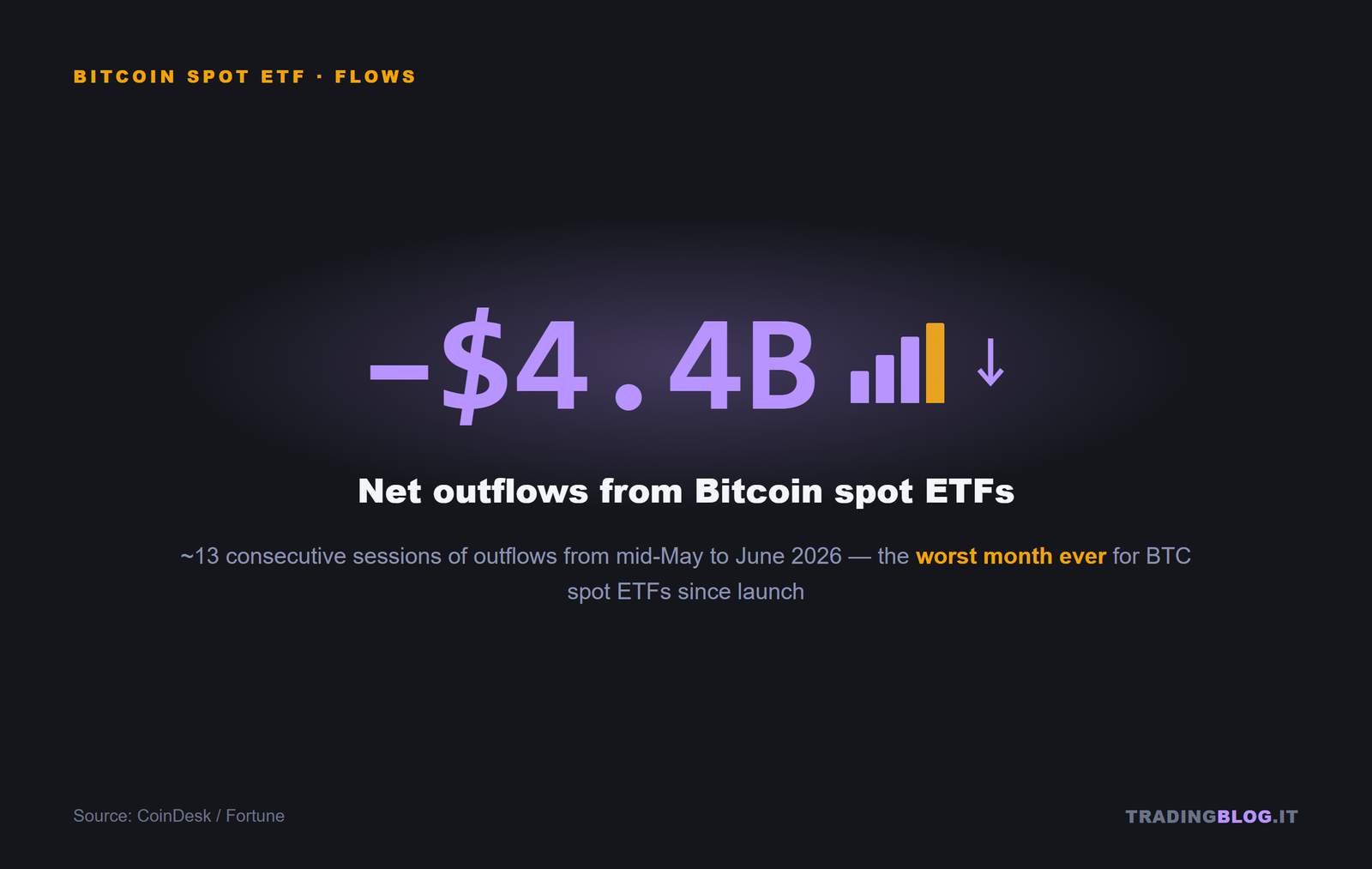
It wasn’t retail panic-selling. It was a slow, orderly, almost bureaucratic flow: continuous redemptions from the U.S. spot ETFs. About $4.4 billion in outflows across roughly thirteen sessions since mid-May. Every day a little piece of supply coming back to the market, no shouting, no memes, no capitulation.

Welcome to Bitcoin in 2026: where the marginal price is set by whoever runs an ETF, not by whoever posts rocket emojis.

Net outflows from Bitcoin spot ETFs: -$4.4 billion in June 2026
June 2026: the worst month ever for Bitcoin spot ETF flows. Source: CoinDesk / Fortune.

Who holds the pen now

For years the narrative was simple: retail moves the price, whales front-run it, institutions show up late. In 2026 that story aged badly.

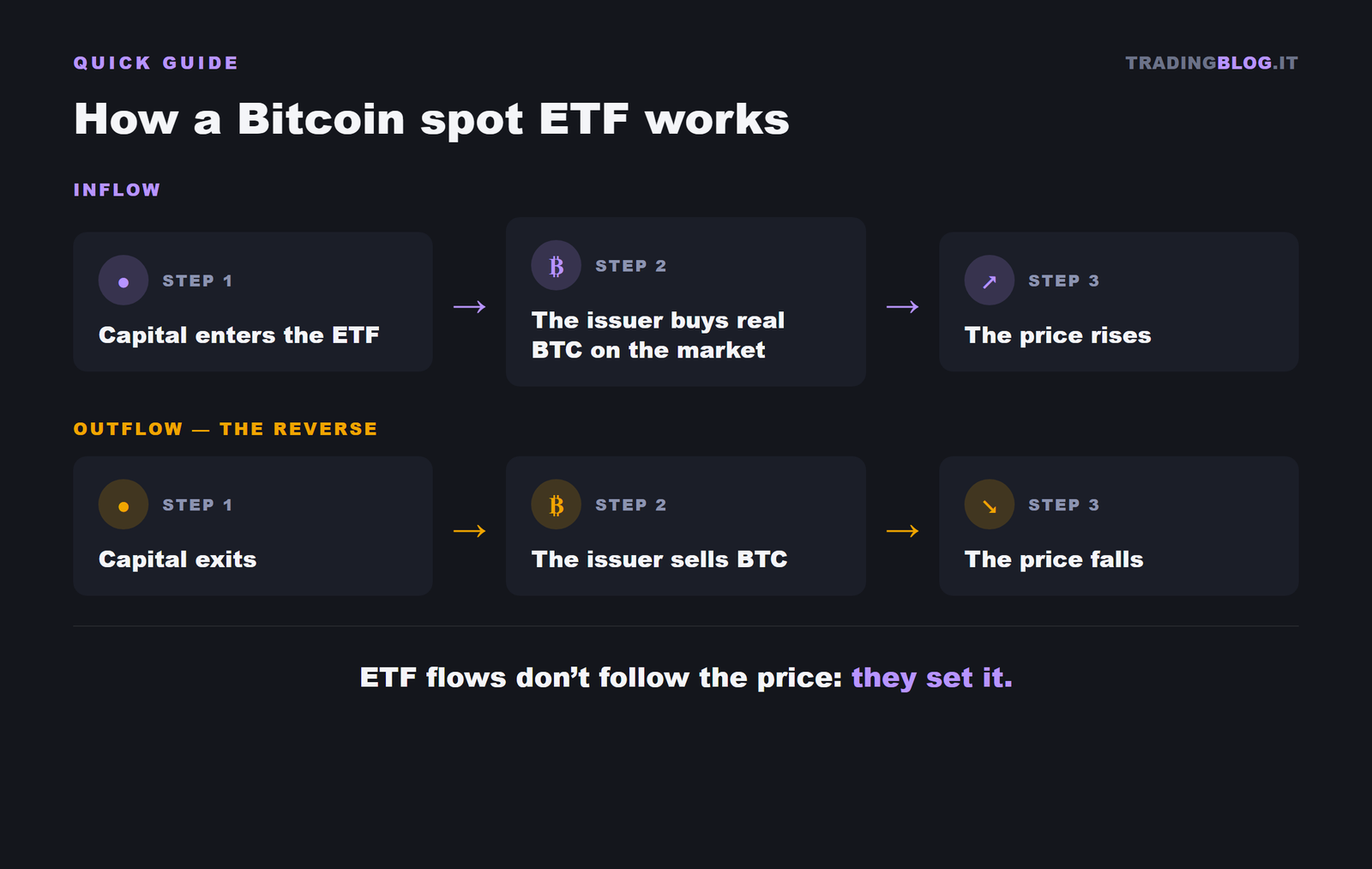
Since Bitcoin spot ETFs became the dominant access channel for professional capital, their net flows are the variable that matters. When money comes in, the issuer buys BTC on the market to back the shares. When it leaves, it sells. ETF flow is supply and demand, translated in real time.

And that’s why June’s drivers tell a coherent story: a more hawkish Fed than expected, keeping real yields high and making a non-yielding asset less appealing; and a rotation of capital toward AI-linked equity, where in 2026 the real party seems to be. In that context, managers simply rotated out. The outflow is the snapshot of that decision.

🧩 Explained Well: what a spot ETF is

A Bitcoin spot ETF is an exchange-listed fund that holds “real” BTC and tracks its price, bought and sold like an ordinary share. Every time capital comes in or goes out, the issuer buys or sells Bitcoin on the real market. That’s why its flows don’t follow the price: they make it.

How a Bitcoin spot ETF works: inflow and outflow
The mechanics of a spot ETF: inflows and outflows translate into purchases and sales of real BTC.

Ethereum, the sibling left behind

If you needed proof that institutional demand is now in charge, not generic “crypto” enthusiasm, look at Ethereum.

In June, ETH spot ETFs recorded outflows for several consecutive sessions, right as the Bitcoin ETFs, for a few sessions, briefly swung back to net inflows. Two products on the same shelf, same regulatory wrapper, opposite behaviors. Professional capital is choosing, and it’s choosing BTC.

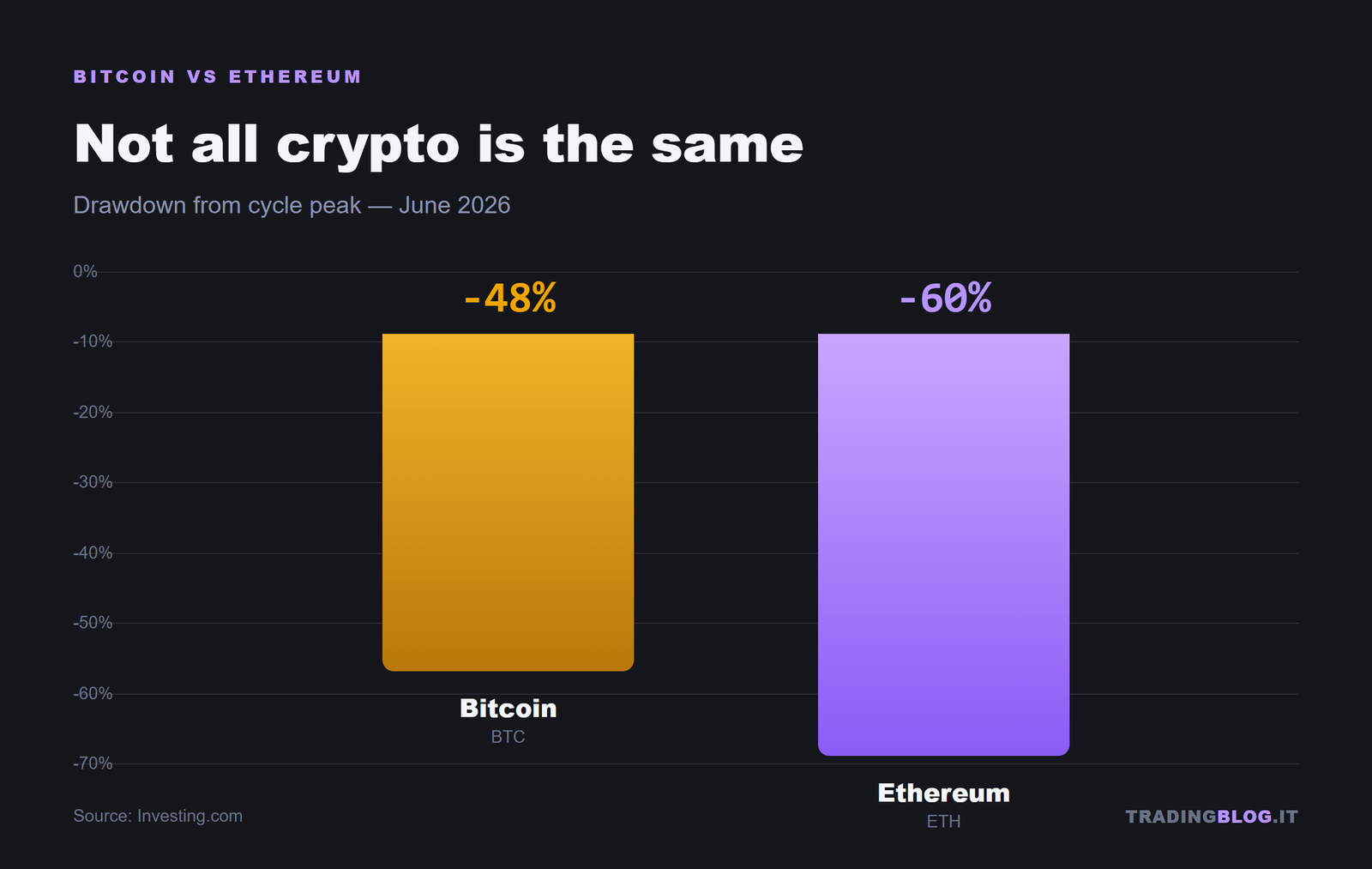
The price result is brutal: ETH’s drawdown from its cycle high widened toward -60%, according to Investing.com. The demand gap between the two assets isn’t closing, it’s widening.

Drawdown from the 2026 cycle high: Bitcoin -48% vs Ethereum -60%
Same wrapper, different mandates: Ethereum’s drawdown from the cycle peak is deeper than Bitcoin’s. Source: Investing.com.

The nerd read is this: in the ETF world there is no “crypto” as a single block. There are individual assets with individual mandates, and whoever allocates decides line by line. Bitcoin has earned “institutional portfolio asset” status. Ethereum, for now, remains the more technical exposure that struggles to find the same patient buyers.

The SEC is redrawing which ETFs get born

Here comes the piece few are connecting, but which could matter more than any single session of outflows.

Around June 30 the SEC opened a comment window of roughly 60 days, through early September, on a new single, “asset-neutral” framework for complex, next-generation ETFs. Source: The Block.

A regulatory gateway filtering crypto tokens into approved and rejected lanes
The SEC’s new “asset-neutral” framework decides in advance which crypto ETFs can be born and which can’t.

What’s inside that perimeter? Basically the entire next wave: spot crypto ETFs, staking-yield products, altcoin baskets, and even ETFs tied to prediction markets. Not by chance, around two dozen event-contract filings have been frozen since May, waiting for the rules of the game to be written.

Translated: the SEC is stepping away from judging every crypto ETF case by case and is trying to define a single model. A framework that decides in advance which structures are admissible and which aren’t. What kind of products will be able to raise institutional capital in the coming years. And if ETF flows are now Bitcoin’s marginal price, then whoever writes the ETF rules is writing the price rules.

It’s no longer a question of adoption. It’s a question of architecture.

What to watch

Two events, both on the near-term calendar.

  • FOMC minutes, July 8. If they confirm the hawkish tone that drove June’s outflows, the pressure on ETF inflows stays. If they open even a slightly softer crack, the flow can turn fast, and we now know that flow is the price.
  • SEC window, through early September. Every comment, every draft, every signal about what will enter the “asset-neutral” framework is material for understanding the next generation of institutional crypto products. And which assets will be left out.

Crypto in 2026 is no longer read on social media. It’s read in the flows and the filings.

Want to put your market reading to the test?Compete and challenge other traders inside an Arena, in a demo environment without risking real capital. Discover The Thunder Trader’s Performance Arena Event.

Enter the Arena →

Disclaimer: content for purely informational and educational purposes. It does not constitute financial advice or an investment solicitation. Always do your own research.