The volume you are looking at is not volume (and it is not useless either)

Hi trader,
for years I looked at the volume column under a forex chart and read it exactly the way I read the one under a futures chart.
They were two different things and I did not know it.
It was not that I was doing the maths wrong: I was using the wrong unit of measurement, which is worse, because you can be extremely precise while measuring the wrong thing.
Today I will tell you what that column actually counts, how much it is worth, and above all what you will never be able to do with it. It is the missing premise for everything we covered in August.
Ok, vamos.
What that column counts
On forex and on CFDs, the number the platform calls volume does not count contracts.
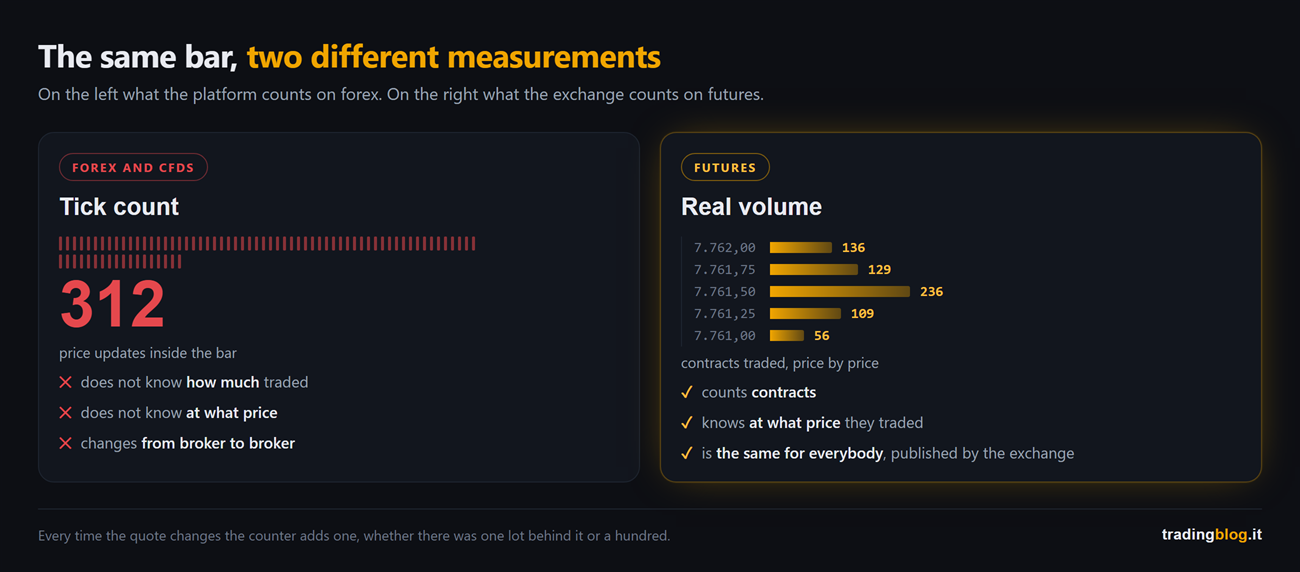
It counts ticks, meaning how many times the price updated inside that bar.
Every time the quote changes, the counter adds one. It does not matter whether one lot went through or a hundred: the counter adds one all the same.
So you are not measuring how much traded. You are measuring how many times it moved.
Why it works that way
It is not laziness on the platform’s part, it is how the market is built.
Forex has no exchange. It is a decentralised market: there is no single register where every trade in the world ends up, the way there is for CME futures. There are banks, brokers, platforms, each with its own slice of the flow.
Your broker can only count what goes through them. And since they cannot tell you how many contracts traded across the whole market, they give you the only thing they have: how many times the price they send you changed.
Now the honest part, which almost nobody says
By now you expect me to tell you that number is garbage.
It is not.
A 2011 study by Caspar Marney, who came from UBS and HSBC, compared tick counts with actually traded volume on the main pairs and found a correlation of around 90%. More recent estimates, comparing retail platform tick volume with CME EUR/USD futures volume on hourly bars, land between 0.85 and 0.90.
Translated: when there are lots of ticks, there was almost always a lot of real volume.
Which makes sense, if you think about it. When people show up, price moves more. When nobody is there, price sits still and ticks drop off. The tick count is a thermometer of activity, and as a thermometer it works.
The problem is not that it is false. It is that it is not a scale, and that has three consequences.
The three limits, in order of severity
One. It changes from broker to broker.
Same market, same moment, two different platforms: two different numbers. Each one counts its own updates, and how many it sends depends on how its infrastructure is built.
Which means a threshold calibrated on one broker is not portable to another. If your system says “I enter when volume goes above 500”, that 500 applies to your platform and to nobody else’s. It is not a market figure, it is your figure.
Two. It is not a quantity.
A one lot tick and a hundred lot tick count the same. So a hundred small trades from nervous people produce a higher number than one enormous trade.
And since the thing that matters in order flow is precisely the size of whoever is moving, this limit is not a detail.
Three, and this is the one that closes the argument: it has no price attached to it.
The tick count tells you how much activity there was in the bar. It does not tell you how much traded at a given price inside the bar.
And there the whole thing falls down.
What you will never be able to do with it
This bears directly on the month this blog has just been through.
Bid/ask candles count the contracts traded at every single price, split between who was aggressive buying and who was aggressive selling. CVD sums that difference over time. The volume profile, the thing behind poor highs, stacks volume at every price level to show you where the market spent most time negotiating.
All three need the exact same thing: how many contracts, at what price, from which side.
The tick count has none of the three. It is not that it comes out worse: it simply cannot be done.
So when you see a footprint on a forex pair, either it is built on futures data (and then say so), or it is an estimated reconstruction. Which is not the same thing, and whoever is selling it has an interest in not specifying.
Where volume is real and where it is not
It is worth having the full picture, because this is not only a forex problem.
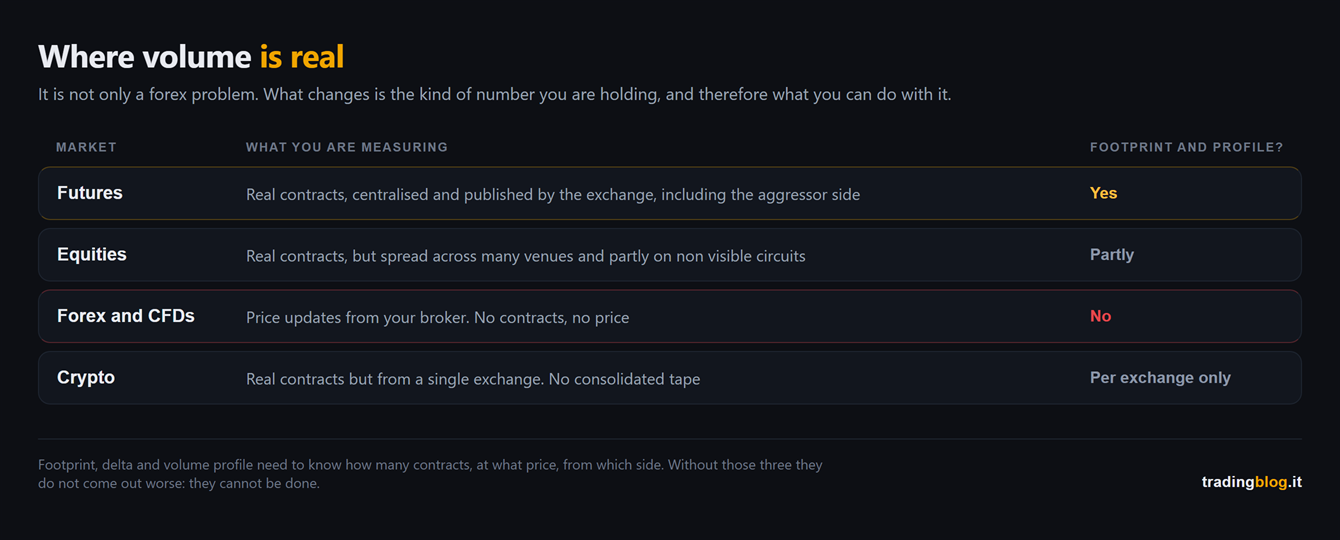
On futures volume is real, official and centralised: everything goes through one place and the exchange publishes it, including the aggressor side. That is why serious order flow analysis is done there.
On equities volume is real, but it is spread across many trading venues and part of it goes through circuits that are not visible. The consolidated number exists, but it is not the complete picture it looks like.
On forex and CFDs you have your broker’s tick count, with everything we have said.
On crypto volume is real but it is per exchange, and there is no consolidated register at all. Adding up the volumes of twenty platforms is an exercise worth exactly as much as you trust the least reliable one.
What you do from tomorrow morning
Three things, and the first one is worth the whole article on its own.
Use tick volume for what it is. A thermometer: there are people around now, there are not now. To work out whether a move was born in a busy moment or in the desert at three in the morning it is perfectly fine, and it is already something plenty of people never look at.
Do not use it for what it is not. No breakout confirmations based on absolute thresholds, no volume divergences taken seriously, no comparisons with yesterday’s volume if you changed broker in the meantime.
And if you want the serious stuff, look where volume is real. It is the structure I work with and I have always said so: analysis on the future, execution wherever you trade. It is not snobbery towards CFDs, it is that instruments which count contracts at a price need a market that actually counts those contracts.
If you want to see what you can do once the volume is the real one, there is a piece I wrote years ago on Market Profile and volume analysis. The platform I was using back then is not the one I use today, but the substance has not aged a day.
The tick count is a thermometer, not a scale. It tells you whether anybody is there, not how much they weigh.
Let me close with the thing that cost me the most time in this story.
It was not discovering that forex volume is not volume.
It was realising that for years I had built rules on a number without ever asking myself what it measured. I saw it sitting there, it was called volume, and the name was enough for me.
And it goes well beyond volume: before you put a threshold on a number, ask who produces it and what it is actually counting. Half the indicators people use do not survive that question.
Suerte Amigo!
Tiziano Brunno
Tradingblog
Want to put your market reading to the test?
Compete and challenge other traders inside an Arena in a demo environment, with no real capital at risk. Discover the Performance Arena Events by The Thunder Trader.
Disclaimer: purely informational and educational content. It does not constitute financial advice or an invitation to trade. Trading involves the risk of capital loss.